
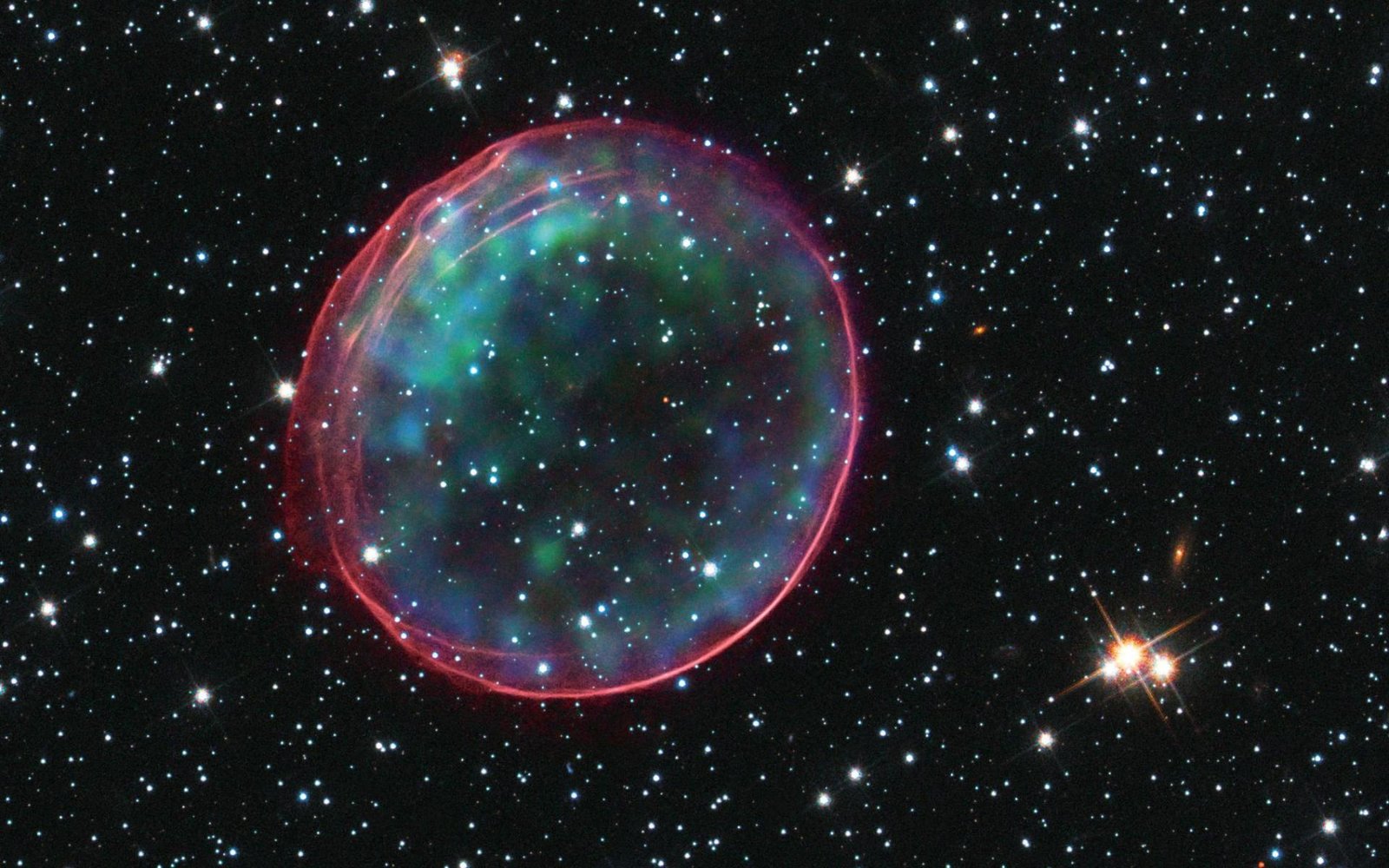
The remnants of a supernova, located in the Large Magellanic Cloud – a satellite galaxy to our Milky Way, 160,000 light years distant. X-RAY: NASA/ESA/CHANDRA X-RAY OBSERVATORY/HUBBLE SPACE TELESCOPE
By Nick Dowson,
Published by New Internationalist, 1 July 2026
A new space race between billionaires and global superpowers is set to worsen inequality, extend conflict, and harm the environment. But there is another way, argues Nick Dowson.
In November 1572 a brilliant new star appeared in the sky – initially bright enough to be seen during daylight. Its appearance was recorded worldwide and it stayed visible to the naked eye for over a year.
It is now commonly known as Tycho’s supernova, after Danish astronomer Tycho Brahe, whose contemporary measurements, along with those of Spanish scientist Jerónimo Muñoz, proved it was further away than the moon.
In doing so they helped overturn the Aristotelian idea – and church doctrine – of an unchanging cosmos beyond the moon, and the Earth as the centre of the universe. This helped spark the scientific revolution, with brought many advances in understanding and technology, as well the democratic ideal at the core of science: that knowledge can be gained from observing the world around us and through critical debate open to all.
We now understand the universe beyond our atmosphere better than we ever have, but humans have looked for meaning from the stars, the sun and the moon for millennia.
Comets have been seen as signs or omens and found on rock carvings. Prehistoric monuments like stone circles are often aligned with the sun’s position at midsummer or midwinter. And the sun and stars have been used by people for navigation for at least 4,000 years – and are thought to be used by birds too.
But our relationship to the night sky and space is changing. Most of humanity now lives in cities, leaving good views of stars – like the spiral arm of our galaxy, the Milky Way – increasingly rare. And in recent years another change has taken place, as increasing amounts of objects made by humans – satellites, probes and occasionally crewed spacecraft – have been launched above the thin layer of Earth’s atmosphere.
The space race accelerates
I saw two shooting stars last night
I wished on them but they were only satellites
Is it wrong to wish on space hardware?
(Billy Bragg, ‘A New England’, 1983)
The first human-made object in space was the Nazi V2 rocket during the Second World War; the first artificial satellite came a decade and a half later in 1957 when the Soviet Union shot Sputnik into orbit around the Earth. As it circled our planet, held by competing pulls of the Earth’s gravity and the centrifugal force created by its own speed, the 58-centimetre sphere sent an iconic ‘beep beep beep’ radio signal. Picked up around the world, it fired the starting gun on the space race.
The next goal was to get to the moon – achieved by the Soviet Union’s unmanned Luna 2 in 1959, and then in 1969 by humans on board the US’s Apollo 11. The years since have seen other achievements like the launch of space telescopes that have been both a source of rich data and of beautiful photography showing the wonders of our galaxy and beyond.
But the last 10 to 15 years have seen something else: an explosion of launches (with the huge fuel use this brings) and an acceleration in the numbers of satellites in orbit. We are seeing a dramatic new push into space, including unprecedented levels of private sector spending and involvement. Most stark is the drastic increase in the number of satellites in orbit: from around 2,000 at the start of this decade to over 15,000 today.

‘Every satellite that is launched, eventually deorbits – burning up the atmosphere and changing its composition,’ said Ruskin Hartley, CEO of DarkSky, an organization which works to protect the night sky and reduce light pollution. He said the growing number of launches raised questions, and argued that sound science is needed rather than assumptions, adding: ‘Stronger environmental review and greater transparency are needed. We need to look before we launch.’
The overall majority of these satellites are owned by Elon Musk’s US-based SpaceX, which made its first public share offering this June – engineered in such a way as to ensure automatic purchases of its shares by many pension funds through its early inclusion in the NASDAQ share index. If the company’s share price proves over-valued, it could mean a massive transfer of wealth from the public to underwrite Musk’s bet on AI. The company, which also owns the X social network, has quickly come to dominate both satellite communications, through its Starlink broadband network, and the ever expanding space launch market.
All of this brings an increase in the importance of space industries, and of their harmful impacts on people and planet. And while we’re a way off colonies on other planets, space is opening up new forms of dependency. From reliance on satellite services dominated by the US; to new communications behemoths like Starlink; as well as new geopolitical and neocolonial relationships to establish launch sites for rockets and satellites and to gain access to the materials and fuels needed.
‘Nowadays space systems are really important in things we take for granted in day-to-day life – for example, position, navigation and timing (GPS) and surveillance (eg weather forecasting),’ said Peter Burt of Space Watch UK, which investigates and challenges the militarization and corporate exploitation of space. ‘Space is important economically but also because pretty much any space technology is dual use. Every kind of civil space technology is important for the military.’
And those most impacted by expanding space industries are often those who are already the most disadvantaged. Launch sites work best in remote areas near either the poles or the equators, and the European Space Agency’s main spaceport has long been in Kourou, French Guiana – an overseas department of France. Now countries are scrambling for new launch sites: China is looking to build a spaceport in Djibouti, Turkey is building one in Somalia, and Italy is looking at re-establishing one in Kenya.

‘Stronger environmental review and greater transparency are needed. We need to look before we launch’
‘For all mankind’
Space has long been a stage for geopolitical competition, but also for remarkable degrees of international co-operation. At its best, it has helped move the superpowers away from conflict towards peace. Space also seems, at points, to have had the power to refocus minds, resurrect the idea of the commons and show that different approaches are possible.
The historic handshake in space between US astronaut Thomas Stafford and Soviet cosmonaut Alexei Leonov in July 1975 is one example of this – a potent moment in a period of détente. The 1970s also saw the launching of the two Voyager probes, sent first to explore Jupiter, Saturn, Uranus and Neptune, and then to head on out of the solar system into the space between the stars.
Since 2 November 2000 there have been humans living in space at all times aboard the International Space Station (ISS), circling the world every 90 minutes – 16 times each day.
Plans for the ISS, a beacon of what collaboration can look like, began to take shape in the early 1990s, with a growing partnership between Russia and the US’s space agencies. Both countries had already experimented with their own space stations in the previous two decades. The first modules were launched in late 1998, and the partnership proved strong: when the Shuttles were grounded first due to safety concerns and then following the 2003 Space Shuttle Columbia disaster, US and other astronauts were launched from Russia’s Baikonur cosmodrome, in Kazakhstan – as they were later when the Shuttles were retired.
For all its feats of engineering – including a sweat and urine recycling system that is able to recover 98 per cent of water – apparently the ISS’s air systems are still unable to fully take away the smell of seven humans in a confined space. Food can be a little tedious, as it is always rehydrated by adding warm water; and crumbs in the zero gravity space station must be minimized.
Those on board have a demanding work schedule, taking forwards experiments as varied as developing new drugs and investigating the impact of microgravity on human bodies, as well as studying the planet and analyzing cosmic particles.6 And the ISS does seem to have achieved remarkable cohesion in its ever-changing crews, regardless of nationality and sometimes fraught relations between nations on the planet below.
Whether this is due to necessity, the drive of the astronauts or cosmonauts aboard, or something inspired by the wonder of their home is hard to say: but 16 sunrises and sunsets a day, none obscured by cloud, can’t hurt.
But the ISS is not entirely immune to ground-based politics and a combination of increasing geopolitical tensions and its own ageing structure – there have been cracks and air leaks, one triggering a temporary evacuation in June – are bringing it towards retirement. It is set to be deorbited by 2031 – a symbolic ending of an era. The ISS is due to be replaced by at least one privately-owned, but publicly funded, space station for the US and allies. Axiom Space, based in Houston, Texas, plans to launch its first module to connect to the ISS next year. Equipment will later be transferred over to the commercial station, while services and visits will be paid for on a commercial basis.

China, which was excluded from the ISS by the US Congress, already has its own space station, and Russia may separate its modules to set up its own operation.
‘I will be very sad to see the ISS retire and deorbit,’ said British astronaut Tim Peake, who spent six months aboard from December 2015.7 ‘The ISS actually is so much more than a scientific laboratory, it’s a beacon of how we can co-operate, how we can collaborate when we focus on a common goal. I’d like to think its legacy will live on.’
The ISS was built on the aspirations of space being for ‘all mankind’, in the words of the high-minded Outer Space Treaty of the 1960s, which prohibited weapons on ‘celestial bodies’ and appropriation of parts of space by countries. This appears to be giving way – and meanwhile the share of military spending on space has been rising.8 The US, Russia and India have all tested anti-satellite weapons, and Trump has been a pushing a ‘Golden Dome’ anti-missile system which could, controversially, include ‘space-based interceptors’. Outer space could become a new battleground.
But space militarization is meeting resistance. In Pembrokeshire, Wales, plans for a new radar station – Deep Space Advanced Radar Concept – are being opposed by people who do not want their region used for the targeting of attacks on satellites. Organizations like the Global Network Against Weapons and Nuclear Power in Space are helping keep outerspace peaceful. On Jeju island, off South Korea, there have been long-running campaigns against the Jeju naval base and space-related infrastructure including missiles and missile defence.
‘Space facilities are related to the militarization of Jeju even though they seldom explicitly say it,’ Sung-Hee Choi, a campaigner on the island involved in groups including People Making Jeju a Demilitarized Peace Island, told New Internationalist. ‘All over the world, militarization is accelerated under the promotion of AI and the space industry, which realigns the economy as the military-industrial tech complex.
‘It is the military and corporations who profit. But our lives are militarized as they penetrate our daily lives and our environment and ecosystem is destroyed.’
Space seems, at points, to have had the power to refocus minds, resurrect the idea of the commons, and show that different approaches are possible
Billionaires, our new cosmic landlords
There is also a wider impact.
Five spacecraft have already left or are currently on their way out of the solar system. The most distant, Voyager 1, was launched in 1977 and is 170 times further away from Earth than the sun is: 25.5 billion kilometres distant. It’s still functioning.
There are a handful more objects that have been sent by humanity beyond Earth’s orbit and that remain in space. Of these, one of them is a Tesla Roadster sports car, with a mannequin in the drivers’ seat, now in an elliptical orbit around the sun.
Put into space by Elon Musk – always happy to attention seek – it is expected to stay in space for tens of millions of years. One billionaire’s whim, littering space, that may outlast humanity, at least if him and the rest of the ruling class have anything to do with it.
What will the aliens think, if they find it?
The involvement of some of the richest men of Silicon Valley in the growing business of throwing things into space is one of the most obvious changes. Amazon founder Jeff Bezos’s company Blue Origin is also a major player, and former Google CEO Eric Schmidt has not only invested in AI-powered killer drones, but rocket manufacturer Relativity Space.
There have been other changes too. The US continues to dominate spending on space: accounting for an estimated 61 per cent of global state space spending in 2024.10 But the way the US goes about this spending has shifted rapidly, along neoliberal lines.
Previously the biggest space contractors were major arms and aerospace manufacturers like Boeing and Lockheed Martin – this has also been true in the smaller European space industry – and these also remain involved. In what has been dubbed the ‘New Space’ sector, instead of paying manufacturers to build its rockets, spacecraft and components, now NASA and partners are paying for them to develop new craft – but not necessarily own them – and then contracting with them for services, such as launches and trips to orbit and beyond. Public spending still drives activity – but as has been seen in areas like Covid-19 vaccine development, the private companies get to keep and continue to profit from the results.
SpaceX and its internet service Starlink far outstrips rivals and it could become a major internet provider worldwide, on top of the powerful role it appears to have played in the Ukraine war and in protest in Iran. We are also seeing a shift to commerce at the expense of science. Elon Musk’s SpaceX has recently applied to put a million satellites in orbit to serve as solar-powered data centres. But scientists are already complaining that the increasing amount of Starlink satellites are making astronomy challenging.
Despite the 1967 Outer Space Treaty, which says that ‘Outer space, including the moon and other celestial bodies, is not subject to national appropriation’, efforts are underway to set up a legal framework for private property in space – using the national qualifier as a loophole. The small European tax haven of Luxembourg – perhaps eyeing new prospects for tax services – became one of the first countries to legalize private ownership of space resources with a new law in 2017, following a similar change by the US in 2015. From 2020 NASA controversially signed four symbolic contracts for purchasing regolith – lunar dust – clearly aimed at establishing a precedent that space resources can be owned.
The contracts were for token sums and didn’t require the private companies involved to actually physically transfer the moondust to NASA – Japanese company Ispace merely ‘declared’ the capture of regolith that settled on the legs of its lander.11 The deals were said to be a way to work through the legal and regulatory issues involved.
Despite newer operators’ big tech roots they too have increasingly become reliant on military contracts: just this June SpaceX won a $4 billion contract to help the military track airborne targets.
The billionairization of space sends a message: that this is a realm for profit, that private control of things that once might have been sacrosanct is right and good and unchangeable. If it’s ok for Elon Musk and Jeff Bezos to do what they will with the skies above our heads and everything else around our closest star – the sun we all rely on – then what can’t they do?
Meanwhile these billionaires are keen to propound the idea – whether or not they believe it themselves – that space can be our salvation from a burning planet. No matter that they themselves are major causes of global warming and inequality.
They’re already planning their own escape routes, whether to Mars or offshore islands. And there’s the worrying talk of geoengineering – deliberate large scale interventions in the climate system to address global warming – Musk, for example, has talked about using AI-powered satellites to block out the sun.

Protecting our pale blue dot
The billionaire boys’ behaviour in space often makes it seem like a Wild West – a fitting metaphor for all those proclaiming it a final frontier. But there is in fact well-established space law, in particular, the founding Outer Space Treaty (OST), signed in 1967 – five years after the first commercial satellite.
It is often criticised as archaic – perhaps in the sense that regulating corporations is also painted as archaic. Cris van Eijk, a final-year PhD student at Newcastle Law School in the north of England, has another take: ‘The OST was written for our time, by people who got remarkably close to right. The problem is that space law was written as a set of principles, presuming that states would apply that law in good faith.’
Private space actors – as a result of demands from Communist and Global South governments at the time – must be authorized and supervised by the states they come from. But some countries don’t want to apply those rules – crucially, the US. Its Federal Communications Commission, which licences most satellites, has for the last 40 years largely excluded operators from the requirement to assess their environmental impact.
Cris suggested that other regions can demand companies act responsibly in space as a condition of allowing them access to their markets – for example the EU’s draft Space Act would require operators do an environmental footprint analysis of space objects to operate in Europe.
But as Starlink satellites become increasingly visible to everyone, he suggests there is also an opportunity to engage ‘with the global public, because outer space – at least, near-Earth space – belongs to all of us. For me, it’s about facilitating a sense of ‘orbital citizenship’ – a dual sense of responsibility and commonality in how we engage with the space around us.’
If nations can’t or won’t properly regulate the billionaire push into space, then we will need a return to space being treated as a genuinely global endeavour – this time, with global regulation to match. We should also remember what has been achieved: thus far we do not have weapons in space, and NASA itself has an Office of Planetary Protection, which works to minimize the risk of contaminating other worlds with Earth life, or indeed bringing anything back.
‘Outer space – at least, near-Earth space – belongs to all of us. For me, it’s about facilitating a sense of “orbital citizenship”’
Meanwhile we should ask, what uses of space – and of technology – do we really need? Can ‘AI’ – the regurgitation of plausible sounding artificial texts – really justify its huge energy usage on Earth, or a million new satellites in orbit? And as for satellite broadband, while this may be useful for the most remote places, there are surely better ways for connecting up most communities, like proper public investment in communications infrastructure, or decentralized, community broadband schemes like the HUBS and Hebnet schemes in remote Scotland.
There is a choice. We can use space wisely – for scientific development, for understanding climate change and Earth’s systems, for peaceful purposes. Or we can let the rich and powerful carry on down the path of exploitation and conflict – a path we’ve seen before – and let our use of space exacerbate inequality and environmental destruction. That’s a route which might see Earth orbits so debris-filled we can’t use them for anything at all.
I’ll give the last word to planetary scientist and science communicator Carl Sagan, writing about an image sent back from the Voyager 1 probe on 14 February 1990 – from 6.4 billion kilometres away – showing Earth as a tiny point less than a pixel in size.
‘The Earth is the only world known so far to harbor life. There is nowhere else, at least in the near future, to which our species could migrate. Visit, yes. Settle, not yet…
‘It has been said that astronomy is a humbling and character-building experience. There is perhaps no better demonstration of the folly of human conceits than this distant image of our tiny world. To me, it underscores our responsibility to deal more kindly with one another, and to preserve and cherish the pale blue dot, the only home we’ve ever known.’
See: Original Article


