
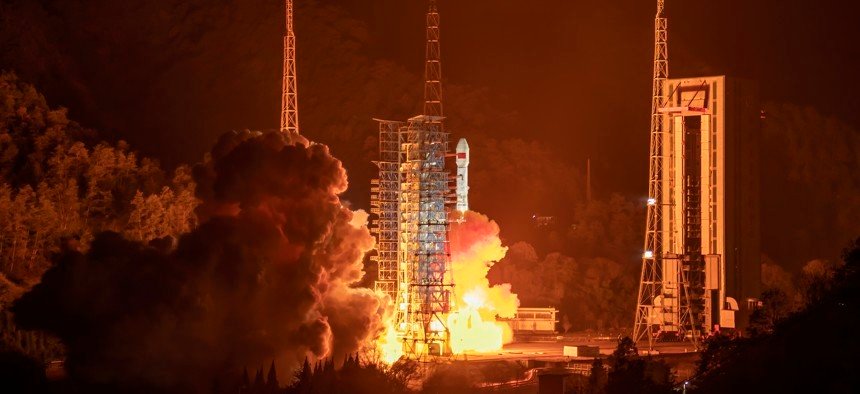
A Long March 3B carrier rocket carrying an experimental satellite blasts off from the Xichang Satellite Launch Center on December 30, 2021 in Xichang, China. Liu Guoxing / VCG via Getty Images
By Martin Belam,
Published by The Guardian, 2 December 2025
In today’s newsletter: As suppliers get ready to meet policy makers and space agencies at the industry’s largest gathering, a look at the exploration and exploitation of space
Good morning. This week Glasgow hosts one of the UK’s largest ever gatherings of the space industry at Space-Comm. With representatives of Nasa, the UK and Scottish governments and the UK space agency among 2,000 space leaders gathering there, it is a chance for people in the commercial supply chain of the space exploration industry to meet policy makers and space agencies.
It comes at a crucial moment in the exploration – and exploitation – of space. For almost three decades the International Space Station (ISS) has bound the US and Russia into cooperation and shared interests. That project is nearing its end, and we can expect to see a realignment of missions and goals – which may bring states and scientists into conflict.
For today’s newsletter, I spoke to Ian Sample, the Guardian’s science editor, to find out what the next few years of a resurgent and competitive space race might look like, why humans seem set on going back to the moon, and why all that is making some scientists angry. But first, the headlines.

When I was a child, as well as my space Lego – which I still have (pictured) – I owned a battered paperback with transcripts of the Apollo 11 mission comms and a potted history of the space race. I pored over it again and again, admiring the bravery and derring-do of the likes of Yuri Gagarin, Valentina Tereshkova, Alan Shepard, Alexei Leonov and, of course, the poor dog Laika.
“I think this new post-ISS world is going to be really interesting,” Ian Sample told me. “We really are in new territory.”
The shift is fundamental. Decades of enforced cooperation – astronauts sharing cramped modules, jointly performing joint repairs and representing two superpowers dependent on one another’s rockets – are coming to an end as the ISS retires. What replaces it isn’t yet clear, but it will not be a single international project but a splintering into parallel alliances with competing goals.
The new space alliances shaping up
With the ISS programme drawing to a close in 2030 – and with diplomatic fault lines caused by the invasion of Ukraine among other topics – Russia is turning away from its cooperation with Nasa and towards working with the Chinese.
“Russia has got the rocket capability,” Ian explained, “while China has been doing some amazing stuff. They are super-competent.” The two countries are now presenting themselves as a single lunar power bloc, planning joint missions, joint infrastructure and even a shared lunar research station.
On the other side sit the US, Europe, Canada and Japan, who are developing their own orbiting platform and surface programmes under the Artemis umbrella. Donald Trump has been urging Nasa to return Americans to the moon as quickly as possible, and recently declared that the US space programme is about “building strength, expanding freedom, and ensuring that the American flag remains the ultimate symbol of leadership across the final frontier”. It is chiefly geopolitics, not science, behind the wheel.
The striking thing, Ian said, is that both coalitions are broadly attempting the same thing – a permanent human presence on and around the moon – but will do it separately, with separate stations, separate landing sites and separate rules of engagement.
Man’s return to the moon
Ian said both sides are working towards the same basic architecture: an orbiting lunar way station where crews can dock, swap in and out, and descend to the surface. “You fly to the moon, you dock there, put your new crew in,” he said. “They go down to the surface. You take the old crew back.”
It does all sound a little like the journeys to the moon in the future world portrayed in Arthur C Clarke and Stanley Kubrick’s 2001: A Space Odyssey – just several decades later.
On the surface itself, nations are weighing up everything from inflatable habitats to simple structures built by heating and compressing lunar soil. “You could pile up loads of lunar soil to make a sort of igloo,” Ian said, “or try to make bricks. Or you take inflatable structures and just pop them up when you get there.”
Much of this would be prepared in advance by robotic missions that deliver equipment and assemble infrastructure long before any astronauts arrive.
The ‘vague’ commercial incentive
The moon is far away and expensive to get to, and people will want to see a return on investment. So, at the risk of sounding foolish, I asked Ian what are the commercial opportunities people see with the moon. He said the economic case is still “vague”, but several ideas are driving interest. One is the extraction of minerals such as rare earth elements, which are essential for electronics and clean-energy technologies.
But the immediate commercial push, he said, is really regarding logistics. “Nasa is funding loads of companies to send stuff to the moon so there’s a private sector that can do lunar missions.” Lower launch costs could eventually make extraction or manufacturing viable – but “that’s the long game”.
Isn’t this all just a self-indulgent waste of carbon?

In an era of fossil-fuelled climate crisis, there are questions about whether space exploration is the right investment for the planet – especially when someone like pop singer Katy Perry (above) is being briefly hoisted to the edge of space by Jeff Bezos for publicity.
Ian said the counterargument from scientists and agencies is that investment in space technology has often produced breakthroughs with environmental benefits on Earth – from more efficient solar cells to satellite climate monitoring. Some even argue that the moon’s resources could eventually support cleaner energy systems at home.
One isotope, Helium-3, is rare on Earth but in abundance on the moon, and some scientists have theorised it could provide safer nuclear energy in a fusion reactor, since it is not radioactive. This is all still in the realms of theory though.
Another reason countries are willing to expend this carbon centres on the question of how do you divide up territory on the moon. It could end up similar to the governance of the Antarctic – which is collectively maintained by the Atlantic treaty, with nobody owning it outright, but nations having designated spheres of influence where they can carry out scientific work.
“Whatever rules will be drawn up on apportioning resources, who gets to work where, what permissions there are, how you carve up the moon, you’ve got to be there to be taken seriously in those debates,” Ian said. “That’s why China and Russia and the US are really keen to get there, so they can demonstrate they have a stake and set the agenda.”
See: Original Article


