
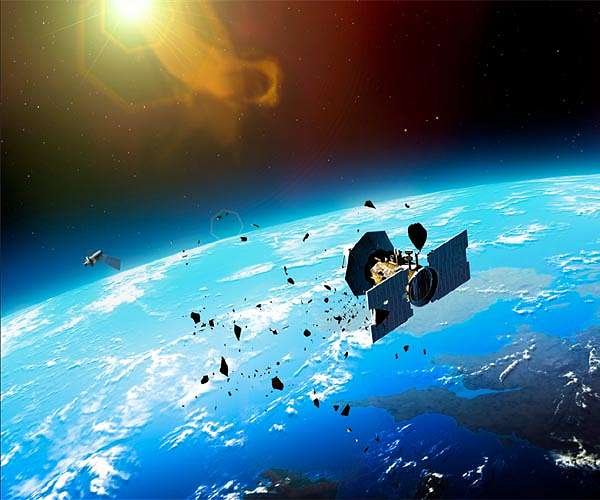
An illustration of satellites breaking up in Earth orbit. (Image credit: Mark Garlick/Science Photo Library/Getty Images)
By Richard Speed,
Published by The Register, 31 March 2026
Starlink satellite 34343 has suffered an “anomaly on-orbit,” spraying debris at an altitude of approximately 560 km above Earth.
The company recently passed the 10,000-satellite milestone, so it is unlikely to miss 34343, but the risk posed by the debris could be a concern for operators.
According to the company, the event poses no new risk to the International Space Station nor the upcoming Artemis II launch, but other than calling it an “anomaly on-orbit, resulting in loss of communications,” it has provided no further information.
Orbital object tracking company LeoLabs called the incident “a fragment creation event” and reckoned it was likely caused by “an internal energetic source rather than a collision with space debris or another object.” That internal source could be something related to the satellite’s propulsion system or perhaps its batteries.
The good news, according to LeoLabs, is that the resulting debris will likely de-orbit within the next few weeks due to the event’s low altitude.
LeoLabs added: “Our analysis indicates this event is similar to a previous event involving Starlink 35956 on 17 December 2025. These events illustrate the need for rapid characterization of anomalous events to enable clarity of the operating environment.”
This is not the first time a Starlink satellite has suffered an anomaly. On December 18, the company admitted to losing satellite 35956, which vented the propulsion tank and released a small number of trackable objects. The satellite remained largely intact and was expected to re-enter the Earth’s atmosphere a few weeks later.
With impeccable timing, SpaceX posted on X: “At SpaceX, helping to keep Earth orbit safe for everyone is a top priority, and we’re committed to leading the industry in space safety.”
Earth orbit is getting crowded. In December, scientists proposed the CRASH (Collision Realization And Significant Harm) Clock as a Key Environmental Indicator (KEI) to estimate how long it would take for a catastrophic collision to occur if collision-avoidance maneuvers were to cease.
While the risk from debris produced by the latest event is likely to be short-lived, the fact that it happened again so soon after the last one is likely to raise concern among scientists, particularly given the sheer number of objects already in orbit and the thousands more planned by constellation operators.
Starlink posted: “The SpaceX and Starlink teams are actively working to determine root cause and will rapidly implement any necessary corrective actions.”
SpaceX launched another group of 29 Starlink satellites on March 30.
See: Original Article


