
Image: Hensoldt
By Bea Castañeda,
Published by The Defense Post, April 11, 2026
Europe’s national air forces grappled with a stark reality: no single country could efficiently defend its airspace alone against ballistic missiles, drones, cruise missiles, and advanced aircraft.
Enter the European Sky Shield Initiative (ESSI) — an ambitious, collaborative effort to build a shared air and missile defense network capable of protecting participating states’ skies with pooled resources, integrated systems, and coordinated command.
More than a program, ESSI embodies the idea that in the age of long‑range precision weapons, collective defense must be collective air defense.
Explore what ESSI is, how it came to be, how it would work, where it fits into Europe’s defense landscape, and what the future holds for this major defense cooperation.

Understanding the European Sky Shield Initiative
The European Sky Shield Initiative is a multinational framework for integrated air and missile defense among European countries.
Rather than each nation procuring and operating its own siloed systems, ESSI aims to pool capabilities, create interoperability, and deliver a shared, layered defense against aerial threats.
The initiative is not a single weapons system but a coordinated network of systems that integrates radar, missile interceptors, command-and-control, and sensors, with participating member states committing capabilities and funding to the collective shield.
Stakeholders include Germany, Poland, Czechia, Slovenia, the Netherlands, Romania, and others that have expressed interest in joining.
ESSI operates alongside NATO’s integrated air defense structures while allowing flexible capability contributions from participants.
Why ESSI Came to Be: Drivers and Origins
By the early 21st century, Europe was no longer debating hypothetical threats — it was watching them materialize.
The rapid spread of long-range ballistic missiles, precision cruise missiles, and coordinated drone swarms laid bare structural weaknesses in national air defense networks, particularly against layered, multi-vector attacks that saturate and overwhelm.
Russia’s war in Ukraine accelerated that reckoning. European capitals faced a hard truth: defending national airspace in isolation was increasingly unsustainable.
For many states, acquiring top-tier missile defense systems, along with the radar coverage, integrated command networks, and lifecycle sustainment, stretched national budgets.
The European Sky Shield Initiative emerged as a strategic response.
Political and Strategic Context
ESSI is rooted in European defense cooperation trends, including the EU’s Permanent Structured Cooperation and efforts to reduce duplication across national defense procurement.
It also aligns with broader NATO air defense integration, ensuring that European airspace is defended in harmony with allied systems and protocols.
How the Shield Initiative Would Work
Layered Defense Architecture
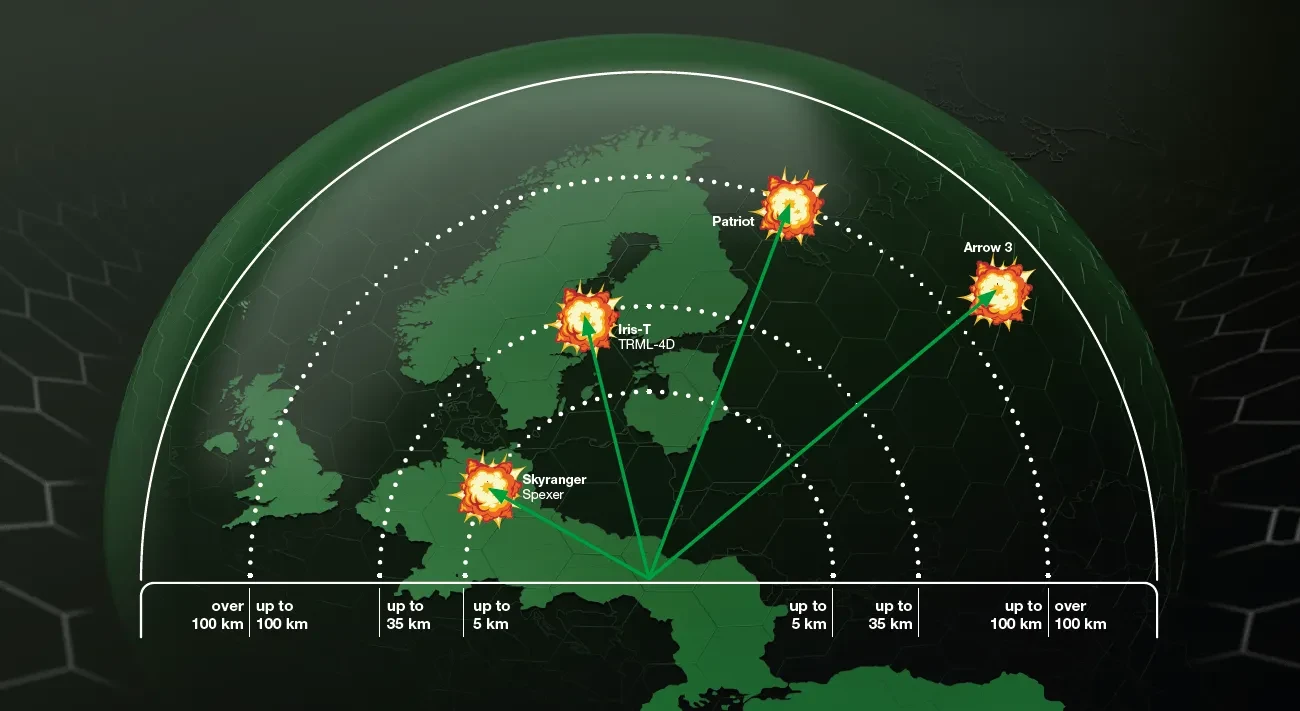
At its core, ESSI is based on a layered air- and missile-defense architecture that combines short‑, medium‑, and long‑range interceptors, advanced radars, and shared command and control.
In practice, this means:
- Long‑range engagement: Systems capable of intercepting ballistic missiles and high‑end cruise missiles at extended distances.
- Mid‑range defense: Interceptors and sensors that protect large areas and critical infrastructure.
- Short‑range and point defense: Systems optimized for last‑line defense against drones and low‑altitude threats.
Outer layers engage threats early, while inner layers provide redundancy and defense-in-depth.
ESSI centers on linking sensors, interceptors, and command networks into a shared operational framework, allowing multiple nations’ radars to feed a unified air picture across borders.
By integrating real-time data into joint command structures, the initiative accelerates threat detection, improves targeting decisions, and enables coordinated engagements.
Shared Procurement and Cost‑Sharing
Rather than forcing each country to independently buy expensive systems, such as Patriot, SAMP/T, IRIS‑T, or future directed‑energy defenses, ESSI pushes nations to invest side by side, cutting costs and building defenses that are designed to operate as one.
This collective approach reduces unit costs, streamlines integration, and spreads long-term sustainment burdens.

Role in Europe’s Defense Landscape
ESSI doesn’t compete with existing NATO air and missile defense structures; it strengthens them.
By adding a regional European layer, the initiative plugs coverage gaps and lightens the load on existing alliance networks. Nations retain control of their own systems while contributing to a shared, real-time picture that enables coordinated defenses to be faster and more effective.
From German Patriot batteries to Czech and Slovak IRIS‑T units and Polish radars, ESSI transforms scattered national assets into a single, integrated shield ready to respond to modern aerial threats.
Growth and Challenges Ahead
ESSI continues to draw interest beyond its founding members, as nations recognize the advantage of shared defense over costly, independent programs.
With emerging threats like hypersonic missiles, drone swarms, and electronic jamming, pooling resources isn’t just practical, it’s essential.
Looking ahead, the initiative could integrate directed-energy weapons, AI-driven decision support, and fused satellite and radar networks to sharpen detection and tracking.
Its success, however, will hinge on aligning national procurement schedules and ensuring that all participants carry a fair share of the burden.
See: Original Article


