
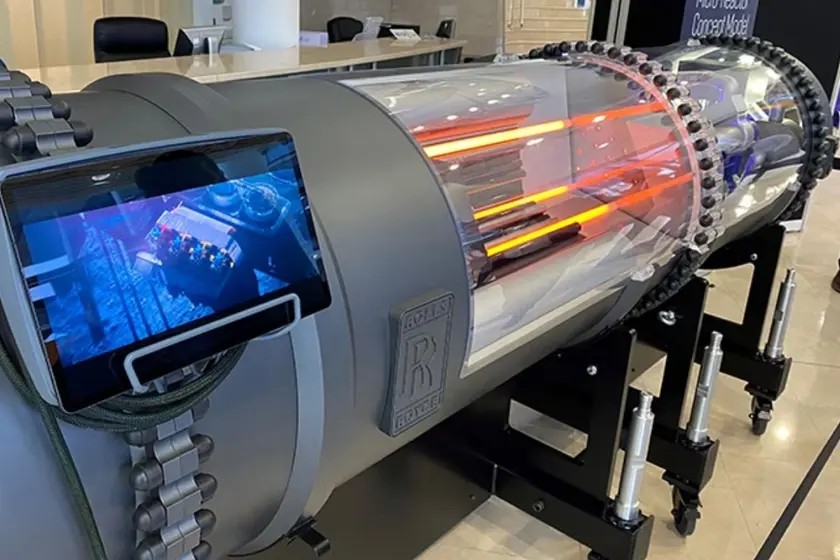
Nuclear Space Micro-Reactor Concept Model.
By Mrigakshi Dixit,
Published by Interesting Engineering, 2 February 2026
The UK Space Agency’s ambitious dream of establishing a nuclear-powered Moon base has dimmed.
Reports suggest that Rolls-Royce has placed its lunar micro-reactor development on indefinite hold after government funding expired.
Despite receiving £9m in funding and aiming for a 2029 launch, the project is currently at a standstill due to a lack of launch partners.
Solar fails when the Moon goes dark for two weeks. Nuclear fission is the only reliable way to keep the lights on and the heaters running.
The micro-reactor was designed to produce 100kW of power — enough for dozens of homes on the Moon.
Shelved lunar dreams
Launched three years ago with high expectations, the project was championed by the UK Space Agency and then-Technology Minister George Freeman as a vital step toward a permanent human presence on the Moon.
It was framed as a dual-purpose initiative to solidify the UK’s status in “frontier science,” create domestic jobs, and deliver technological dividends for both space exploration and life on Earth.
The company is reportedly ready to resume work, but a lack of launch partners has left the program in limbo.
Meanwhile, President Trump has aggressively pivoted toward an America First lunar policy.
Trump signed a December 2025 executive order — Ensuring American Space Superiority — that mandates deploying a nuclear reactor on the Moon by 2030.
“NASA and DOE anticipate deploying a fission surface power system capable of producing safe, efficient, and plentiful electrical power that will be able to operate for years without the need to refuel,” said NASA in a press release.
This initiative, part of a broader $3 billion push to establish a permanent lunar outpost, is designed to secure US dominance in the second space race against competitors like China.
However, the program shuts out international players like Rolls-Royce, as NASA and the Department of Energy have restricted bidding to domestic American firms to ensure national security and industrial leadership.
Battling lunar nights
Nuclear power serves as a survival tool on the Moon. A single night on the Moon lasts 14 Earth days.
During this time, temperatures plummet to -130°C (-202°F), and solar panels become useless. Without nuclear power, a lunar base is just a frozen tomb.
It could provide a constant, always-on energy source. Reactors can withstand plummeting temperatures and power vital mining operations in cold traps — permanently shadowed craters containing water ice.
In comparison, solar panels require impossible amounts of battery storage to survive two weeks of darkness.
Rolls-Royce’s design was intended to be the ultimate off-grid battery, capable of powering dozens of homes or a bustling research station through the long, dark lunar freeze.
Even though the main reactor project is paused, Rolls-Royce’s U.S. branch is still helping NASA build a special “converter” that turns nuclear heat into usable electricity for future Moon bases.
Recent tensions arose after the UK government selected Rolls-Royce over American competitors for domestic Small Modular Reactor (SMR) contracts, which US officials called “extremely disappointing.”
For now, the UK’s lunar ambitions are on ice, waiting for a warmer political climate or a deeper-pocketed partner. Meanwhile, other nations, such as Russia, are actively working to develop a nuclear power plant for the Moon.
See: Original Article


