
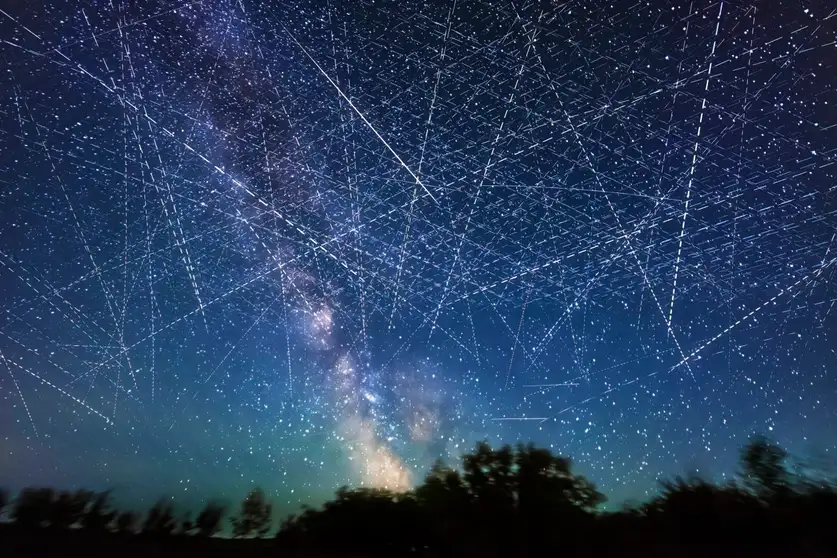
A long-exposure photograph in the northern hemisphere showing satellites in the night sky
Alan Dyer/VWPics/Universal Images Group via Getty Images
Published by Dark Sky, 11 February 2026
In the United States, the Federal Communications Commission (FCC), the agency responsible for authorizing satellite launches and operations, is reviewing two proposals of unprecedented scale and consequence. If approved, they would alter the night sky as we know it, with impacts that would be increasingly difficult, if not impossible, to reverse.
Both proposals are currently open for public comment, making this a critical moment for public engagement as the FCC considers satellite proliferation at unprecedented scales and technologies that pose serious risks to the nighttime environment.
Current activation
Submit a public comment to the FCC
DarkSky International is urging the public to weigh in now, before these projects move forward without the testing, research, and environmental review such sweeping changes to the night sky and nighttime environment demand.
Reflect Orbital’s plan to illuminate Earth at night
The first proposal comes from Reflect Orbital, which plans to deploy satellites fitted with in-space mirrors to beam reflected sunlight back to Earth at night. Marketed as “sunlight on demand,” the company says the system could extend daylight for solar farms or be sold to cities to illuminate streets at brightness levels exceeding three times that of the full moon.
Such illumination would introduce an entirely new source of artificial light at night, with far-reaching consequences, including disruption to wildlife and ecosystems that depend on natural cycles of light and dark, as well as serious public safety concerns.
SpaceX’s proposal to launch one million satellites into low Earth orbit
The second proposal is even more striking in its scale. SpaceX has asked the FCC for permission to launch up to one million satellites, described in its filing as orbital data centers, as part of an expansion of its artificial intelligence infrastructure.
To put that number in perspective, there are currently about 14,500 active satellites in low Earth orbit. Approving the request would increase that figure by nearly 70 times. Once deployment begins at that scale, potentially involving thousands of launches each year, the effects on the night sky, orbital congestion, and the broader environment would be extraordinarily difficult to reverse. Proposals of this magnitude warrant rigorous scrutiny, transparency, and meaningful public input before any approval is considered.
Where DarkSky stands
DarkSky does not oppose satellite technology. Satellites play an important role in modern life. But the organization does oppose unchecked expansion without oversight and full environmental review, particularly when technologies pose real and lasting risks to the global nighttime environment.
In alignment with the five principles of responsible outdoor lighting that guide DarkSky’s programs and initiatives, and consistent with our position on satellite megaconstellations, we urge the FCC to close longstanding regulatory gaps that allow satellite deployments to proceed without environmental review under the National Environmental Policy Act. Until adequate testing and review are completed, both proposals should be rejected in their current form.
Public comment period now open
The comment period for the SpaceX proceeding closes on March 6, while the Reflect Orbital comment period closes on March 9. We strongly encourage submitting comments as early as possible.
While the FCC process can seem technical at first glance, we’ve done the hard work to make this as straightforward as possible. With the steps and templates below, you can submit a comment in as little as 15 minutes.
These proposals are being reviewed under separate FCC applications, and comments must be submitted to the correct file number to be considered.
- Reflect Orbital application file number: SAT-LOA-20250701-00129
- SpaceX application file number: SAT-LOA-20260108-00016
We encourage advocates, community partners, and members of the public to submit comments to one or both proceedings.
Step-by-step: How to submit a public comment to the FCC
You can submit comments on one or both proposals by following the steps below. The process is the same for each application; the key difference is the file number you select.
Step 1: Create an FCC CORES account
Go to https://apps.fcc.gov/cores/userLogin.do and click Register to create a free account using your email address. Complete the verification process to activate your account.
Step 2: Log in to the FCC filing system (ICFS)
Visit https://fccprod.servicenowservices.com/ibfs and log in using your CORES username and password.
Step 3: Find the application
Enter the application’s file number in the search box and open the application page.
- Reflect Orbital proposal: SAT-LOA-20250701-00129
- SpaceX proposal: SAT-LOA-20260108-00016
Step 4: Prepare your comment
Write your comment, clearly stating your position. Include your name and contact information, and save the document as a PDF. We’ve provided templates and sample language to help you get started:
Step 5: Upload your comment (important selections)
From the application page, select Pleadings and Comments from the top banner. This may prompt you to log in again using the same credentials. Once logged in, complete the submission form as follows:
- Select No for the Committee filing question
- Choose Comment as the pleading type
- Leave the FRN field blank and enter Responding as an Individual for Company
- Enter your contact information (anonymous comments are not allowed)
- Enter and select the correct file number
Reflect Orbital proposal: SAT-LOA-20250701-00129
SpaceX proposal: SAT-LOA-20260108-00016 - Select No for confidential treatment
- Attach your PDF and label it Public Comment on File No. [file number]
Step 6: Submit and confirm
Click Submit, confirm the success message, and save your receipt for your records.
See: Original Article


