
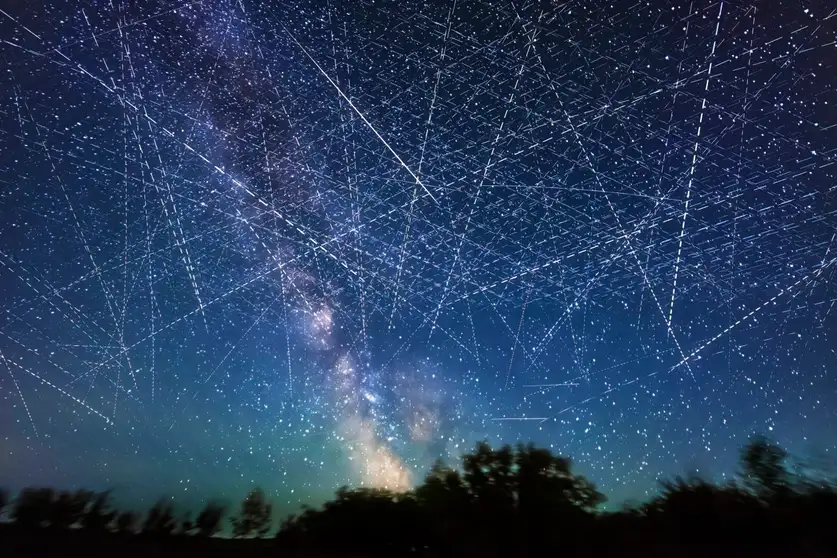
A long-exposure photograph in the northern hemisphere showing satellites in the night sky
Alan Dyer/VWPics/Universal Images Group via Getty Images
By Tori Bonidie and Magnus L’Argent,
Published by Astrobites, 26 February 2026
Across regions and borders, cultures and customs, the one thing we share is the night sky. Access to the night sky is a crucial part of our scientific, religious, and cultural practices across the globe. Right now, one government agency has the power to completely alter the night sky as we know it.
In the United States, the Federal Communications Commission, or FCC, is the government agency that authorizes and regulates the use of space-based satellites. The FCC is currently reviewing two major satellite proposals that have the potential to cause great harm to our access to the night sky. In this astrobite, we discuss these two proposals, how the environmental review policy of the FCC got us here, and our recommendations on how we can prevent these proposals from passing.
Reflect Orbital & SpaceX Proposals
The first proposal is from Reflect Orbital, a company with the stated goal of selling “sunlight after dark”. To achieve this, they propose to deploy a constellation of over 50,000 in-space mirrors by 2035 to redirect the sunlight back to Earth at night. The first of these satellites, Earendil-1, is set to launch as early as April 2026. Once in orbit, this satellite will unfold a 18 m x 18 m sized mirror in a low-Earth orbit. When viewed from the ground, this mirror will be as bright as a full Moon when within the path of its reflection and appear as a star when passing overhead. This means that if Reflect Orbital reaches its goal of 50,000 mirrors, their mirrors will outnumber the real stars visible to the naked eye at night by more than a factor of 5. Beyond the contamination to our night sky, this proposal poses serious risks to wildlife; interrupting the sleep cycles of animals that fall within the beams of these mirrors and disrupting migration for animals who navigate by the stars.
The second proposal is from SpaceX, the private company founded by Elon Musk and responsible for the Starlink constellation of internet satellites. Their proposal asks the FCC for permission to deploy 1 million satellites into low earth orbits in order to build a network of space-based AI data centers. To put this in perspective, there are approximately 14,000 operational satellites currently in orbit, with roughly 10,000 of those being Starlink. While Starlink has already increased the number of satellites by more than 3 times the previous amount, this new proposal would increase it by a factor of 70.
Symptoms of a large problem
While these two projects are problematic by themselves, they are the byproducts of a larger issue within the regulation of the American space economy. The FCC and the Federal Aviation Administration (FAA), which is responsible for regulating the launch and re-entry licenses for rockets carrying satellites to space, have fostered a weak regulatory framework that benefits speculative commercial projects without investigating the potential for severe environmental damage.
One of the most significant undermining of regulatory frameworks is the FCC’s application of the National Environmental Policy Act. Passed in 1970, NEPA establishes a procedure for evaluating federal actions that could impact the environment. If the potential environmental effects of the action are unknown, an environmental assessment is conducted to determine if they are significant. If they are found significant, then an environmental impact statement is created to document mitigation efforts and explore alternatives. Agencies have the power to declare certain actions as pre-emptively excluded from the NEPA process, known as a “categorical exclusion”. The FCC has always treated the licensing of large constellation satellites, such as Starlink, as falling under a categorical exclusion. Only “extraordinary circumstances” can override these categorical exclusions.
In a 2022 audit of the FCC’s environmental review process, the U.S. Government Accountability Office found that the agency, unlike NASA and the FAA, had not reviewed this exclusion nor properly documented these “extraordinary circumstances”, making it difficult for concerned parties to argue any given satellite proposal could have significant environmental impact worthy of the NEPA process.
Importantly, while the FCC does require some environmental review related to orbital debris and radio frequency interference—it does not have systematic guidelines when it comes to effects such as light pollution, atmospheric pollution, and climate effects.
Recent guidance from the US Executive Office has exacerbated the FCC’s already flimsy application of NEPA, following a broader trend of deregulation among US federal agencies. In January, 2025 the Executive Office released an order titled “Unleashing American Energy” to push for the removal of “burdensome and ideologically motivated regulations”, which includes requiring agencies to review their NEPA requirements. Following this, the FCC began a rule change process in August, 2025 to “streamline” its NEPA procedures and seemingly double down on the categorical exclusion for satellites:
“We propose that space-based operations be excluded from NEPA because they are “extraterritorial activities” with effects located entirely outside of the jurisdiction of the United States”
In other words, because satellites are in space, they somehow cannot impact the Earth’s environment. COMPASSE, the light pollution working group of the American Astronomical Society, responded to these proposed changes, highlighting how these satellites have clear and quantifiable impacts on observatories located on U.S. soil and leave behind metals in the atmosphere during re-entry.
Attempts have been made to legally challenge the FCC’s categorical exclusion, most recently in 2023 when DarkSky International attempted to prevent Starlink’s second generation of satellites getting licensed. The court sided with the FCC, stating that “the FCC reasonably concluded that SpaceX’s mitigation efforts…were sufficient to avoid significant environmental impacts.” Remarkably, SpaceX’s collaboration with astronomers was cited as evidence of the company making good faith efforts to mitigate impacts such as light pollution. This comes despite a lack of widespread consensus among astronomers that SpaceX’s mitigations are sufficient to prevent significant impacts on current and future research, with observations indicating most mega-constellations are still exceeding brightness limits recommended by the International Astronomical Union. Not to mention the growing evidence that rocket launches and re-entering satellites are significantly changing the atmosphere’s composition, contributing to climate change and possibly causing ozone depletion. With the announcement of the 1-million satellite data center project, which would undeniably be devastating to astronomy, it appears SpaceX has made clear its commercial interests cannot be reconciled with the interests of astronomers.
The extent of this problem goes well beyond the FCC’s categorical exclusion. Even when the full NEPA process is pursued and environmental assessments are conducted, as they are by the FAA when granting launch permits, this is not a guarantee of accountability from SpaceX and other companies. The FAA does conduct environmental assessments and impact statements for SpaceX’s Starship-Super Heavy rocket, recently approving it for 44 launches a year out of the Kennedy Space Center launch pad LC-39A in Florida. Across its three approved launch sites, Starship could now plausibly launch up to 146 times every year. This approval comes despite condemnation from local groups near the Starbase launch center in Texas, who have noted recent incidents where Starship launches have started wildfires, restricted local beach access, and seismically shaken nearby homes.
For now, it seems even the most speculative and potentially devastating proposals of the space industry will continue receiving a green light from the federal government unless major changes are made.
Take Action
Both of the Reflect Orbital and SpaceX data center proposals are undergoing public comment until March 6 and March 9 respectively. DarkSky International has put together a step-by-step guide on how you can leave a comment. Non-US citizens can also comment.
To learn more about the impacts of satellites on astronomy, check out these other articles from Astrobites:
- The Atmosphere’s Health is Astronomy’s Future
- Satellite constellations will harm Rubin LSST science. What can we do?
- Burning up for your LEOve: Satellites and Atmospheric Pollution
- How low do they go: satellites impacting low-frequency radio astronomy
- Nearly 1 in 3 Starlink satellites detected within the SKA-Low frequency band
See: Original Article


