
By Theodore Kruczek,
Published by Keep Track, 9 May 2026
Russia launched its first 16 operational Rassvet broadband satellites on March 23, 2026, beginning a long climb toward a 900-satellite LEO constellation. Built by Bureau 1440 and funded by billions in government and private capital, Rassvet is a technological sovereignty project driven by a hard lesson from the war in Ukraine. When your military depends on someone else’s satellites, they can turn them off.
On March 23, 2026, a Soyuz-2.1b lifted off from pad 43/4 at Plesetsk Cosmodrome, 17:24 UTC, carrying sixteen satellites into low Earth orbit. The launch was unremarkable by the standards of modern spaceflight. Sixteen spacecraft, roughly 370 kilograms each, separated into a 511-kilometer orbit at 82.3 degrees inclination. No booster landing, no live audience. Plesetsk sits in Arkhangelsk Oblast, roughly 800 kilometers north of Moscow at almost 63 degrees north latitude, which makes it the northernmost orbital launch site anyone uses regularly and the obvious choice for a constellation that has to cover Russian territory all the way to the Arctic coast.
What sets these sixteen satellites apart from a routine commercial launch is the strategic problem they were built to address. Rassvet, which translates to “daybreak” in Russian, is Russia’s attempt to build a sovereign broadband constellation in low Earth orbit. The project is developed by Bureau 1440, a subsidiary of IKS Holding, and backed by a combined $5.7 billion in government funding and private investment through 2030. It exists because Russia discovered, in the middle of a war, that depending on foreign satellite communications infrastructure is a vulnerability that can be exploited at the worst possible moment.
The first batch of operational Rassvet satellites had been scheduled for late 2025. The delay to March 2026 was not publicly explained in detail, but it fit a pattern familiar to anyone tracking Russian space programs over the past decade. Ambitious schedules get set by political leadership, then technical and industrial realities push the timelines to the right. Bureau 1440 had previously launched experimental satellites to validate the platform, including laser inter-satellite link tests that achieved 10 Gbit/s in May 2024 and a first 5G NTN user-terminal session in June of that year. The technology works. The question has always been whether Russia can build and launch enough of it, fast enough, to matter.
Sixteen satellites is a start. By the standards of the market Rassvet is trying to enter, it is also barely measurable.
The goal is sovereign broadband communications infrastructure for the Russian Federation, independent of foreign satellite systems and capable of serving military, government, and commercial users across all Russian territory, including the Arctic.
Bureau 1440, on Rassvet’s mission, paraphrased from official project descriptions
The Battlefield Lesson
Understanding why Rassvet exists requires understanding what happened with Starlink in Ukraine, and what happened afterward inside the Russian military establishment.
From the earliest months of Russia’s full-scale invasion of Ukraine in 2022, Starlink terminals became critical infrastructure for Ukrainian forces. SpaceX provided terminals, the U.S. government purchased additional units, and the constellation’s resilience against electronic warfare made it far more reliable than the terrestrial communications infrastructure that Russian strikes had degraded. Ukrainian drone operators, artillery units, and command networks all depended on Starlink for beyond-line-of-sight connectivity that no other available system could match.
Russian forces noticed. Beginning in 2023, reports emerged of smuggled Starlink terminals appearing on the Russian side of the front line, imported through Central Asian intermediaries to circumvent sanctions and export controls. The terminals were unauthorized, operating on a commercial service that SpaceX had not licensed for use in Russian-controlled territory. Russian soldiers used them for the same reason Ukrainian soldiers did. They worked better than anything else available.
In early 2026, SpaceX deactivated the illicit Starlink connections. The specifics of how this was accomplished are not fully public, but the effect was immediate. Russian units that had come to rely on smuggled Starlink hardware for tactical communications lost connectivity in the middle of active combat operations.
The episode crystallized a problem that Russian military planners had discussed in abstract terms for years. Satellite communications in the 21st century are controlled by the entity that controls the constellation, and Russia does not control any broadband LEO constellation. GLONASS provides navigation. Express-series satellites provide some communications capacity from geostationary orbit. But for the kind of high-bandwidth, low-latency connectivity that modern military operations increasingly require, Russia had no sovereign option. Rassvet is the response. Russia subsequently banned the import of foreign satellite communication systems, including Starlink, making the development of a domestic alternative a matter of declared national policy.
Bureau 1440 and the Hardware
Bureau 1440 was established as the development entity for Rassvet within IKS Holding, a Russian technology investment group. The organization has operated with relatively less public visibility than Roscosmos or the major Russian defense enterprises, but its funding profile is substantial. The Russian government has committed 102.8 billion rubles (approximately $1.26 billion at current exchange rates) to the program, with Bureau 1440 itself investing 329 billion rubles ($4 billion) in private capital through 2030. The total program cost of roughly $5.72 billion places Rassvet in the same financial weight class as the early phases of OneWeb or Kuiper, though well below the cumulative investment SpaceX has made in Starlink.
The constellation architecture calls for more than one orbital echelon, and the first one is now flying. Both 2026 batches went into near-polar orbits at 82.3 degrees inclination and roughly 511 kilometers altitude, an inclination Plesetsk has been throwing payloads into for decades. Published plans add a second, higher-inclination polar echelon near 88 degrees to close the coverage gap directly over the pole. Bureau 1440’s earlier experimental satellites flew at 588 kilometers in a 98-degree sun-synchronous orbit for testing purposes, but the operational constellation is targeting lower altitudes for reduced latency and better link budgets.
- 32 Satellites Launched. Two batches of 16, March and July 2026
- $5.7B Total Investment. Government + Bureau 1440 private
- 900+ Target Constellation. Full deployment by 2035
- 511 km Operational Altitude. 82.3° inclination, near-polar
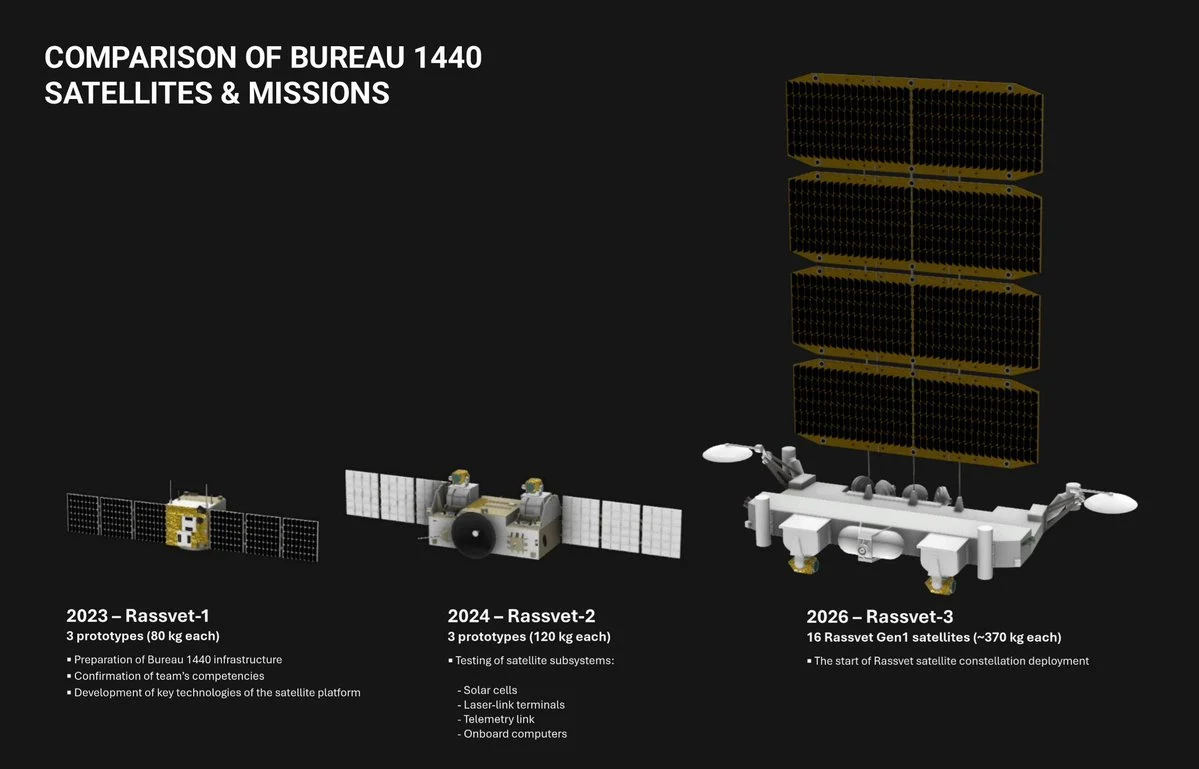
The naming is confusing, so it is worth being precise about which hardware is actually in orbit. Rassvet-1 was three experimental satellites that rode a Soyuz-2.1b rideshare out of Vostochny in June 2023. Rassvet-2 was three more on a Plesetsk launch in May 2024. The satellites launched in 2026 are Rassvet-3, the first operational variant, and they are not small: 370 kilograms each, roughly four meters long with a ten-meter solar array span, operating in Ku and Ka band. Later Rassvet-3 production is expected to add laser communications terminals for inter-satellite links and 5G NTN (non-terrestrial network) equipment for direct connectivity with standard cellular devices. The laser link capability is the more significant addition. Bureau 1440 demonstrated 10 Gbit/s optical inter-satellite data rates in testing during May 2024. If that capability scales across the constellation, it would allow Rassvet satellites to relay traffic between nodes without routing through ground stations, a feature that Starlink has been deploying incrementally and that dramatically improves coverage over areas where ground infrastructure is sparse or nonexistent. For Russia, with its enormous landmass and limited ground station density in Siberia and the Arctic, laser inter-satellite links are an architectural necessity rather than an optional upgrade.
Performance targets for the full constellation are 1 Gbit/s throughput with latency below 70 milliseconds. Actual test results from Bureau 1440’s experimental campaigns have shown 48 Mbit/s downlink and 12 Mbit/s uplink with latency of 38 to 42 milliseconds. Those numbers are roughly comparable to early Starlink performance before SpaceX scaled its constellation to thousands of satellites, and they suggest that the underlying link technology is sound. Scaling that performance across a constellation of hundreds of satellites, maintaining it under load, and delivering it reliably to military and commercial users across eleven time zones is the engineering challenge that remains.
The Deployment Schedule and the Math Problem
Bureau 1440’s published roadmap calls for 156 satellites in orbit by the end of 2026, 292 by 2027 (the threshold for initial commercial service), 610 by 2028 after adding 318 more, and a full constellation of over 900 satellites by 2035. The March 2026 launch delivered the first 16 and a second Soyuz-2.1b out of the same Plesetsk pad added 16 more on July 19. That is 32 in orbit, which leaves 124 satellites to launch before the end of the year to stay on schedule.
- 2024-05 – Laser ISL Test – Bureau 1440 demonstrates 10 Gbit/s optical inter-satellite link between experimental satellites.
- 2024-06 – 5G NTN Session – First direct-to-handset 5G non-terrestrial network connection achieved using Rassvet test satellite.
- 2026-03-23 – First Operational Launch – 16 Rassvet-3 satellites reach a 511 km, 82.3° orbit from Plesetsk pad 43/4 on Soyuz-2.1b. Delayed from late 2025.
- 2026-07-19 – Second Batch of 16 – Another Soyuz-2.1b from Plesetsk 43/4 doubles the operational constellation to 32 satellites.
- 2026 – 156 Satellites Target – Published deployment goal for end of 2026. Requires ~124 more satellites after the first two batches.
- 2027 – Commercial Service Begins – 292-satellite threshold for initial commercial coverage. Military and government users are priority.
- 2028 – 318 Additional Satellites -Second major deployment phase brings constellation to ~610 satellites.
- 2035 – Full Constellation – 900+ satellites providing global coverage with Rassvet-2 generation hardware.
The math here is difficult, and it starts with launch capacity. Russia’s total orbital launch cadence has been running at roughly 20 missions per year across all payloads, all customers, and all vehicle types. SpaceX alone exceeded 150 launches in 2025. The Soyuz-2.1b can carry a batch of Rassvet satellites per flight, but how many per flight depends on the fairing volume and the satellite mass. Sixteen per launch is the demonstrated number, twice over. To reach 156 satellites by end of 2026, Bureau 1440 needs roughly eight more Soyuz launches dedicated to Rassvet in about five months, having managed two in the first seven. That would consume nearly half of Russia’s entire national launch manifest for the year, competing with GLONASS replenishment, military reconnaissance satellites, ISS crew rotation, and every other mission Roscosmos has on its books.
The competitive landscape gives some sense of how far behind that puts Russia.
| Constellation | Operator | Satellites Deployed | Target Total | Launch Cadence |
|---|---|---|---|---|
| Starlink | SpaceX | 7,000+ | 12,000+ (Gen1) | 20-60 per mission, multiple per week |
| OneWeb | Eutelsat OneWeb | ~630 | ~648 (Gen1) | Complete |
| Kuiper | Amazon | ~60 | 3,236 | Ramping with New Glenn + Atlas V |
| Rassvet | Bureau 1440 | 32 | 900+ | ~16 per Soyuz, ~20 national launches/yr |
LEO broadband constellation scale comparison (as of August 2026)
The gap is not subtle. Starlink has deployed more satellites in a single week than Rassvet has launched in total. Even OneWeb, which went through bankruptcy and corporate restructuring before completing its first-generation constellation, managed to deploy over 600 satellites in roughly three years by purchasing dedicated launch capacity on Soyuz (ironically, before Roscosmos severed that commercial relationship after the 2022 invasion). Amazon’s Kuiper is behind its own schedule but has access to multiple launch vehicles and a corporate treasury that can absorb delays without existential consequences.
Rassvet’s deployment timeline assumes a launch infrastructure that does not yet exist at the required tempo. Scaling from one Soyuz launch to nine or ten dedicated constellation flights per year is theoretically possible, but it has never been demonstrated. Russia’s launch industry is operating under sanctions pressure that constrains access to Western electronics, precision manufacturing equipment, and quality control instrumentation. Every satellite and every launch vehicle has to be built from a supply chain that is more restricted than it was four years ago.
The Chinese Question
The supply chain constraints have pushed Bureau 1440 toward an uncomfortable dependency. After the Starlink cutoff in early 2026, Moscow accelerated its Rassvet timeline and began engaging Chinese aerospace firms more directly. Shanghai Spacecom Satellite Technology (SSST), a Chinese company developing its own LEO constellation ambitions, has been linked to cooperation discussions with Bureau 1440.
The logic is straightforward. China has the manufacturing capacity, the component supply chains, and the satellite production experience that Russia currently lacks at the required scale. Chinese firms can produce satellite buses, solar arrays, reaction wheels, and communications payloads at volumes and costs that Russian industry cannot match under current sanctions conditions. If Bureau 1440 sources its first-generation satellite hardware from Chinese suppliers, the constellation could potentially deploy faster than a purely domestic production chain would allow.
The irony is considerable. Rassvet exists because Russia learned that depending on a foreign power’s satellite infrastructure creates a strategic vulnerability. Building the constellation with another foreign power’s technology and components does not remove that vulnerability so much as relocate it. A constellation assembled from Chinese-supplied hardware creates a dependency on Beijing’s willingness to continue supplying that hardware. In a bilateral relationship where Russia is increasingly the junior partner, that dependency carries its own risks.
This does not mean the Chinese cooperation path is wrong. It may be the only way to meet the deployment timeline. But it transforms Rassvet from a pure sovereignty project into something more nuanced, a constellation that provides operational independence from Western systems while creating new dependencies on Eastern ones. Whether Russian military planners view that tradeoff as acceptable depends on assumptions about the durability of the Sino-Russian relationship that are, by nature, political rather than technical.
Bureau 1440 has not publicly joined any international space sustainability frameworks, including the Space Safety Coalition or the Inter-Agency Space Debris Coordination Committee’s voluntary guidelines for mega-constellation operators. As Rassvet scales toward 900+ satellites, the absence of published conjunction assessment and debris mitigation commitments is a gap that the space sustainability community will increasingly scrutinize.
Military Implications
The military dimension of Rassvet is inseparable from its commercial purpose, and Bureau 1440 has made little effort to pretend otherwise. The constellation’s dual-use architecture is designed from the ground up to serve government and military users alongside civilian broadband customers. Several capabilities are specifically relevant to military operations.
Beyond-line-of-sight communications improve dramatically with even a small LEO constellation. Thirty-two satellites in a 511-kilometer orbit do not provide continuous coverage at any latitude, but they do provide multiple communication windows per day, and a near-polar inclination means those windows are longest exactly where Russia most wants them, at high latitude. For military units operating in areas without reliable terrestrial infrastructure, even intermittent satellite connectivity is a significant upgrade over no connectivity at all. As the constellation grows, the coverage gaps shrink, and the windows merge into persistent service.
UAV control is another priority application. Modern military drones require continuous data links for real-time control and sensor feeds. Russian forces in Ukraine have relied heavily on short-range tactical drones with line-of-sight radio links. A LEO broadband constellation opens the possibility of beyond-visual-range drone operations controlled via satellite, extending operational reach and reducing the exposure of ground control stations to counter-battery fire.
The Ka and Ku band frequencies Rassvet uses offer some inherent resistance to electronic warfare. Higher-frequency bands are more directional than the VHF and UHF frequencies commonly targeted by battlefield jamming systems, and the narrow beam patterns of LEO satellite links make them harder to intercept or disrupt than wide-beam GEO satellite signals. This does not make Rassvet jam-proof. Any satellite downlink can be targeted with enough power and the right equipment. But it raises the cost and complexity of interference compared to the radio systems Russian forces have been using.
Combined with Express-RV (Russia’s planned high-elliptical-orbit communications system for Arctic coverage) and ongoing GLONASS navigation constellation upgrades, Rassvet adds a new layer to Russia’s space-based communications architecture. The three systems together would provide navigation, voice and data communications, and broadband connectivity across a layered architecture that no single point of failure can disable. Whether Russia can build and maintain all three simultaneously, given budget pressures and industrial constraints, is an open question. But the architectural intent is clear.
What KeepTrack Users Should Know
The two 2026 launches added 32 new tracked payloads to the LEO catalog, orbiting at approximately 511 kilometers altitude. For KeepTrack users, these satellites are visible in the catalog and trackable like any other LEO object. As the constellation grows, the tracking implications become more significant.
The orbital architecture is distinct from Starlink’s. At 82.3 degrees, Rassvet’s deployed shell crosses Starlink’s 53-degree and 70-degree shells at steep angles rather than shadowing them. That geometry produces close approaches at high relative velocity and at every longitude, instead of the shallow, repeating conjunctions typical of two satellites in similar inclinations. For conjunction assessment, more operators in LEO means a more complex screening environment, and Bureau 1440’s absence from international coordination frameworks raises questions about how responsive the operator will be to conjunction warnings.
At 511 kilometers, Rassvet satellites sit in a moderately congested altitude band. They are below the densest Starlink shells (which cluster around 540 to 570 kilometers) but above the lower shells that SpaceX has been populating. That altitude also places them in a region where atmospheric drag will deorbit failed satellites within roughly 5 to 10 years depending on solar activity and ballistic coefficient, which provides a natural debris mitigation backstop, but only if the satellites are designed to passivate at end of life and do not fragment.
As Rassvet scales toward its 292-satellite commercial service threshold and eventually toward 900 or more, it becomes another mega-constellation operator contributing to the increasingly crowded LEO environment. The space sustainability implications are real, and they will become more pressing as the deployment rate increases. KeepTrack will continue cataloging each new batch as it reaches orbit.
Looking Up
Thirty-two satellites in a 511-kilometer orbit is the beginning of a very long road. Russia’s Rassvet constellation is years behind Starlink, orders of magnitude smaller than SpaceX’s deployed fleet, and dependent on a launch infrastructure and industrial base operating under significant constraints. The $5.7 billion commitment is real. The technology, based on demonstrated test results, works. And the strategic motivation, after a war in which dependence on foreign satellite communications became an operational liability, is as clearly stated as any rationale in the history of government-funded satellite programs.
Whether Bureau 1440 can scale from 32 satellites to 292, then to 900, on a timeline that matters, using a supply chain that may depend heavily on Chinese manufacturing, while maintaining the performance and reliability that military and commercial users require, is a question that will take years to answer. The schedule says 2027 for initial commercial service and 2035 for full constellation. The schedule has already slipped once.
You can track the Rassvet constellation in KeepTrack as new batches reach orbit. The 32 operational satellites from the March and July 2026 launches are cataloged at their 511-kilometer altitude in 82.3-degree inclination orbits. Watch for additional launches through 2026 as Bureau 1440 attempts to reach its 156-satellite target, and for the eventual deployment of the higher-inclination polar plane that would close the coverage gap directly over the pole.
See: Original Article


