
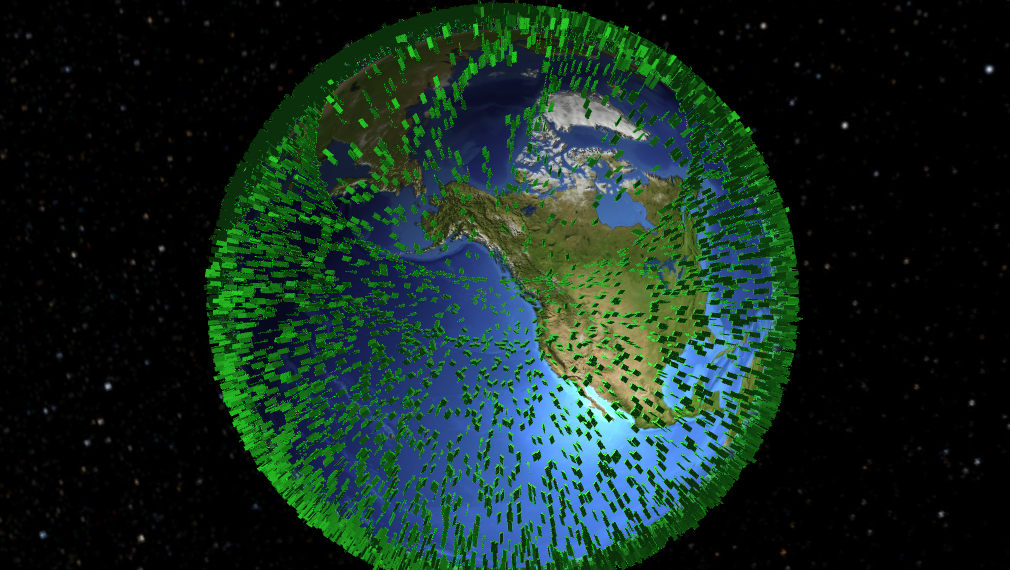
Snapshot of the some 11,000 Starlink satellites on orbit as of Sept. 21, 2026 using LeoLab’s free online tool for visualizing objects in low Earth orbit. (Screenshot from LeoLab’s visualization tool)
By Caron Copek,
Published by Stuff, 31 October 2026
Taranaki astrophotographer Brendan Larsen’s spectacular image of satellites in the night sky has gone viral, attracting 15 million views on Facebook and 1 million on Instagram in just seven days.
Larsen, an adult literacy tutor from New Plymouth, told Stuff he spent 45 hours combining the 578 photographs to create the one image.
No AI was used.
That photo, featuring 14,000 satellite trails, was taken with his camera over two hours with an eight-second exposure and a two-second gap, resulting in 578 images.
Larsen who had been photographing the night sky for six years, agreed to let Stuff share the photo as well as his behind the scenes video showing how the image was made. You can watch it at the top of this page.
The image captured trails of about 1400 individual satellites criss-crossing through the frame during the photo shoot, resulting in 14,000 satellite trails, “because on average each satellite appeared in 10 photos.”
“It was taking eight-second shots, and then there’d be a two-second gap. That’s why you get the gaps in the satellite trails,” he explained.
Larsen, speaking to Stuff on Saturday, said he has been contacted by people from all over the world. His story has been picked up media including a front page story on the Taranaki Daily News to a feature in New Scientist magazine.

He said he was starting to see the image taking shape and thought he really shouldn’t stop.
“I was like, wow, this is starting to look like this cool pattern and it’s looking really beautiful. I figured that it was worth putting the the time and to carry on and do the whole thing.”
He told Stuff he has more ideas in mind for another similar photo, “but I’m hoping that I can figure out a way that I can do it without having to spend 45 hours editing”.
In May, Larsen’s work was recognised in a global competition to photograph the Milky Way.
See: Original Article


