
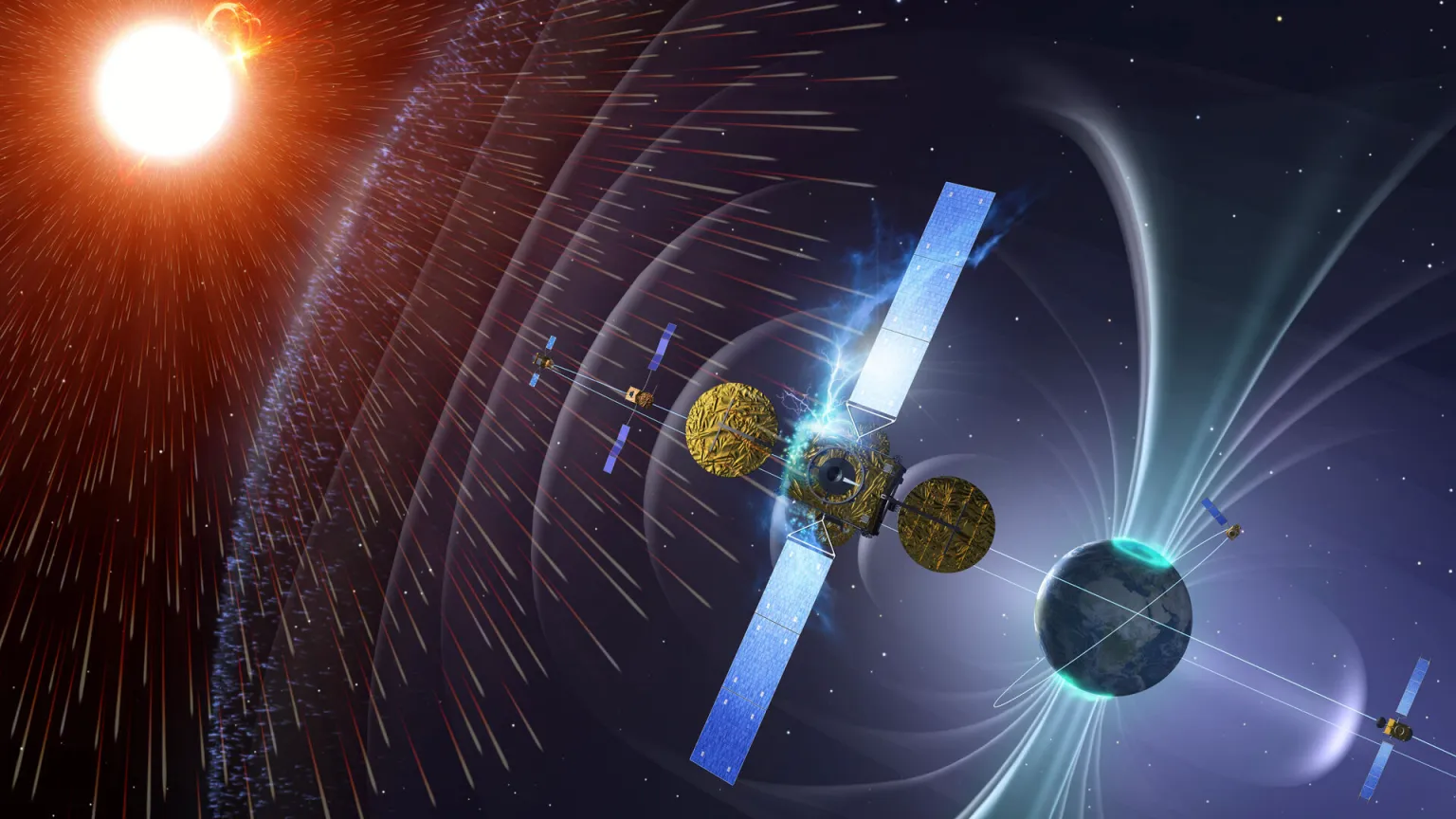
Illustration of a space situational awareness system. Credit: ESA
By Andrew Parsonson,
Published by Space News, 1 October 2026
JOHANNESBURG — European governments are preparing to invest up to 24 billion euros ($27 billion) in SPACE, a joint military space project spanning satellite communications, surveillance and missile warning. The initiative is part of a broader EU effort to expand its defense capabilities in orbit.
The Council of the European Union formally approved the SPACE project Sept. 28 as one of the first five European Defence Projects of Common Interest under the European Defence Industry Programme (EDPI).
Launched in late 2025, EDPI provides 1.5 billion euros in EU grants from 2025 to 2027, of which 325 million euros have been allocated to support the establishment and deployment of the European Defence Projects of Common Interest. The EU-level grant program will be used to seed, coordinate and incentivize the much larger commitments required for the individual projects.
SPACE will involve participation from 20 countries, including 18 EU member states, Norway, and Ukraine. The project covers space-based early warning, satellite communications, intelligence, surveillance and reconnaissance, positioning, navigation and timing, navigation warfare and responsive space systems.
According to the Council decision approving the project, participating countries will examine the development of a multi-mission constellation, with a focus on the common procurement of defense products and supporting infrastructure.
The Council estimates that the project could involve up to 24 billion euros in overall investment by 2034. That figure reflects the projected scale of the program rather than funding already allocated through EDIP, with individual national contributions still to be determined.
Alongside SPACE, the Council approved projects covering drones and counter-drone systems, maritime and seabed defense, integrated air and missile defense and protection of Europe’s eastern flank.
Expanding military awareness in orbit
Less than a day after SPACE was approved, 15 European Union countries agreed to establish a separate initiative to jointly access and share data used to track and characterize objects in orbit.
The initiative, which will be run by the European Defence Agency (EDA), was announced on Sept. 29, four days after participating countries formally agreed to establish it. The agency said the project aims to provide a “common, up-to-date picture of what’s happening in space, for military use.”
The 15 countries that have agreed to participate are Austria, Belgium, Finland, France, Germany, Ireland, Italy, Latvia, the Netherlands, Poland, Portugal, Romania, Slovenia, Spain and Sweden. Participation will also be open to other EU member states that may select to join at a later date.
According to the EDA, the initiative will build on the procurement model used for its EU SatCom Market program, which aggregates demand from European governments and EU institutions for commercially available satellite communications. The agency describes the program as its “largest joint procurement project,” with a contract ceiling of 250 million euros.
EDA expects the new space domain awareness initiative to initially be worth around 50 million euros. Like the EU SatCom Market program, the initiative will use a non-binding, pay-as-you-go model that lets participating countries procure services without making long-term budget commitments.
The agency expects to conclude an initial survey of potential suppliers in December, after which it aims to establish a program arrangement with participating countries in 2027 or 2028. A framework contract would then follow, with an initial operating capability expected to come online in early 2029.
Broader response to space threats
Alongside its new investment initiatives, the Council of the European Union has also moved to strengthen the Union’s Space Threat Response Architecture.
The revised framework was approved on Sept. 28 and expands the bloc’s ability to monitor and respond to hostile or irresponsible activity in space beyond threats to EU space programs to include threats against member states, their territory and their space systems and services. The Council said the revisions were intended to “respond to increased irresponsible and hostile behavior in the space domain.”
The new Threat Response Architecture will allow the EU’s foreign policy chief to adopt a provisional response when urgent action is necessary, with the Council then deciding to confirm, amend or revoke it within four weeks. It also establishes a dedicated “space security toolbox” to draw on diplomatic and other Common Foreign and Security Policy measures, including targeted sanctions.
See: Original Article


