
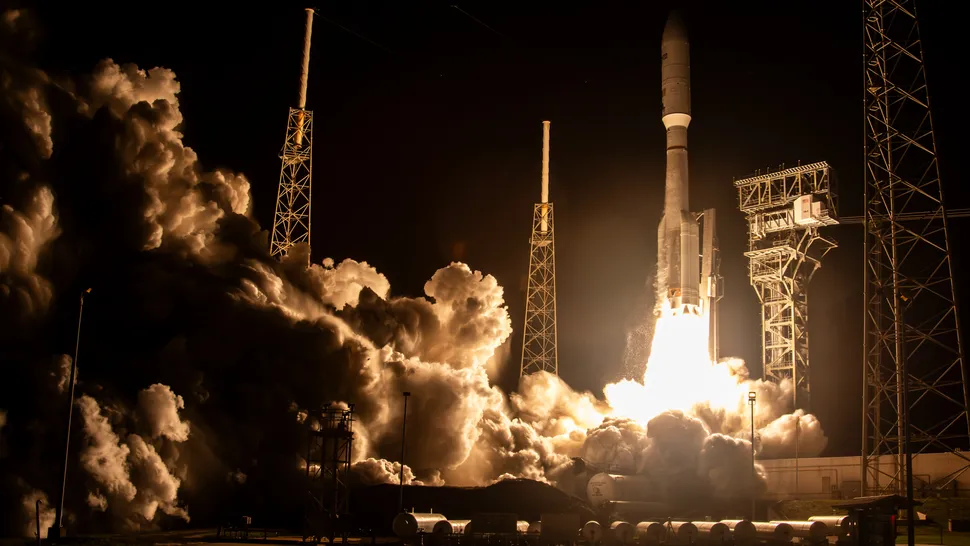
A United Launch Alliance Atlas V rocket launches 27 Amazon Leo internet satellites to orbit on Dec. 16, 2025. (Image credit: ULA)
By Hugo Ruher and Xavier Demeersman,
Published by Futura-Sciences, 9 February 2026
The Amazon Leo satellite constellation poses a growing threat to astronomical observations. According to researchers, these spacecraft are far too bright and could interfere with ground based telescopes, especially as their numbers increase.
Numerous studies have already shown how Starlink satellites affect astronomical observations. SpaceX’s constellation has had measurable impacts not only on ground based telescopes, but also on several space telescopes, including Hubble, and even on radio telescopes.
This time, however, attention is turning to a smaller but still concerning project: Amazon Leo. In a preprint paper published on the arXiv platform and highlighted by Space.com, researchers explain that these satellites, designed to provide internet connectivity, are excessively bright and could significantly disrupt ground based observations.
Nearly Invisible To The Naked Eye, But Not To Telescopes
Their brightness reportedly exceeds the threshold recommended by the International Astronomical Union, whose guidelines aim to ensure peaceful coexistence between satellite megaconstellations and the astronomical community.
More specifically, the satellites have an apparent magnitude of 6.28. At first glance, this seems relatively faint, making them nearly impossible to see with the naked eye under most conditions. However, they remain far too bright for sensitive telescopes, where even small amounts of reflected light can degrade observations.

© FLICKR
The issue lies less in the satellite design itself than in their orbital placement. The Amazon Leo constellation, which currently includes around 180 satellites, operates at an altitude of 590 kilometers, significantly higher than Starlink, which orbits at about 480 kilometers. More importantly, Starlink satellites often pass through Earth’s shadow, which reduces their brightness. This is not the case for Amazon Leo satellites, which remain sunlit for longer periods and become much brighter around sunset.
That said, they are still far less luminous than BlueBird satellites, currently the brightest artificial objects visible from the ground, thanks to their massive antennas measuring 64 square meters, or even 223 square meters for future models.
For now, the disturbance remains limited due to the relatively small number of satellites in orbit. However, Amazon plans to deploy roughly 3,200 satellites in the coming years, a scale that could dramatically change the situation.
Some Progress, But Growing Concerns
Damage can be reduced if satellite manufacturers continue working closely with astronomers. This has been the case with Amazon, as well as with SpaceX, both of which have spent years attempting to reduce light pollution in the night sky. Measures include mirror systems that redirect reflected sunlight back into space rather than toward Earth, as well as satellite orientations that prevent the most reflective surfaces from facing the ground.
These efforts were largely driven by repeated complaints from astronomers, supported by images of night skies streaked with bright satellite trails crossing telescope fields of view.

As a result, the latest Amazon Leo satellites, while still too bright, are significantly dimmer than the first prototypes launched in 2023, which offers some hope for future improvements. Starlink has followed a similar path, making gradual progress since the early stages of its deployment.
Still, the outlook remains bleak for the scientific community. Even with mitigation measures in place, the sheer multiplication of satellites represents an unprecedented challenge for astronomical observations. Meanwhile, Chinese satellite constellations currently under construction also exceed the brightness limits recommended by the International Astronomical Union, raising further concerns about the long term future of observational astronomy.
See: Original Article


