
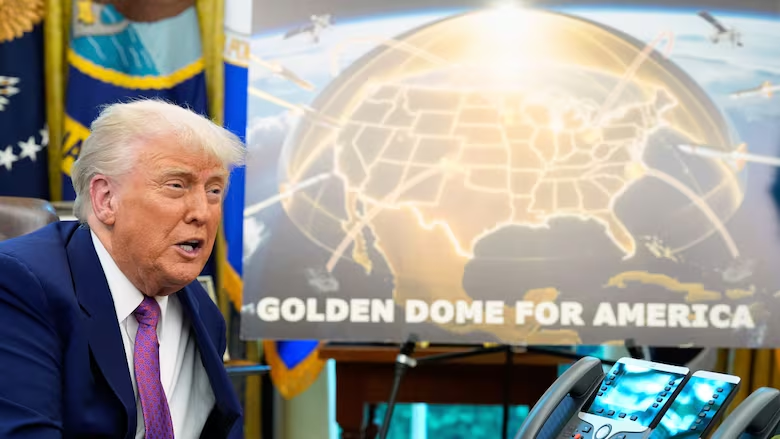
U.S. President Donald Trump speaks in front of an illustration of his proposed Golden Dome missile defense system in the White House in Washington on May 20, 2025. Chip Somodevilla/Getty Images
By Azriel Bermant,
Published by Foreign Policy, 9 February 2026
The delusion of invulnerability tempts leaders to take risks.
As the United States deploys anti-missile batteries to the Middle East as part of its force buildup in the region, the idea that these systems are a purely defensive means to shield against attacks—and thereby deter an adversary from attacking in the first place—is looking increasingly unconvincing. Instead, the current round of conflict in the Middle East suggests the opposite: A reliable anti-missile shield could just as well create an incentive for escalation. If policymakers believe that their state is secure behind the shield, they may calculate that their own offensive military actions carry significantly lower risk.
The purely defensive and de-escalatory case for anti-missile systems is easily made. Exhibit A is Ukraine, where the the Kremlin’s perceptions of Ukraine’s vulnerability—including its lack of missile defense—incentivized Russia to attack in 2022. Between February and May that year, Moscow fired more than 2,000 cruise and ballistic missiles at Ukrainian military installations, infrastructure, and population centers in an attempt to clear the way for taking over the country. Had Ukraine been able to deploy large numbers of sophisticated anti-missile systems, the Russian leadership may have calculated the risks of an invasion very differently.
In the Middle East, too, the logic of missile defense has long been defensive and de-escalatory. When Hamas launched a series of rocket attacks against Israeli population centers in 2012, the effectiveness of Israel’s Iron Dome removed the need for Israel to launch a costly and bloody ground offensive into Gaza. Whether in Israel or Ukraine, even a partially successful missile defense has great value in strengthening public morale and degrading the missile threat posed by adversaries.
Indeed, by devaluing Iran’s missile threat, Israel’s air defenses have contributed to the weakening of the regime in Tehran. In funding Israel’s Arrow 3, David’s Sling, and Iron Dome systems, Washington’s objective was not just to support a key ally but also to make war less likely by degrading the ability of Israel’s adversaries to attack.
Iran’s strikes on Israel in April 2024 also reinforce this argument. With 99 per cent of the approximately 320 Iranian missiles and drones intercepted by Israel’s missile defense systems, as well as U.S., British, French, and Jordanian forces, the Biden administration viewed this success as a reason for self-restraint. “Take the win,” then-U.S. President Joe Biden reportedly advised Israeli Prime Minister Benjamin Netanyahu, referring to Israel’s killing of a number of senior generals in the Islamic Revolutionary Guard Corps in Damascus, which had preceded the unsuccessful Iranian missile attack.
Today, this defensive logic has been turned on its head. Under the Trump administration, missile defense seems not so much a tool to lower tensions but a shorter fuse to war. Rather than disincentivizing the use of force, the psychological reassurance provided by missile and drone defense may increase the temptation to take calculated risks.
This new calculus clearly shaped Israel’s decision to launch air attacks against Iran’s nuclear and ballistic missile programs last June. Iran’s vulnerability to aerial attacks following Israel’s destruction of its Russian-supplied air defenses strengthened Netanyahu’s resolve to strike. At the same time, Israeli confidence in the effectiveness of its own missile and drone shield fortified its belief that it could absorb the inevitable Iranian retaliatory strikes with manageable civilian casualties.
What the new offensive logic of missile defense ignores, however, is the increased vulnerability caused by overreliance on missile shields. Israel’s shield was far less successful in 2025 than 2024. According to the Israel Defense Forces, air defenses intercepted 86 percent of the Iranian missiles during the 12-day war. At least 33 Israelis were killed and more than 3,500 were wounded. The brief conflict also left Israel’s stock of missile interceptors severely depleted. In December, former Israeli National Security Council head Eyal Hulata warned that Israel’s defensive capabilities will struggle to keep pace with Iran’s missile production. Nearly one-third of Israelis still lack adequate protection against missile attacks.
Even as the Trump administration rushes Patriot and Terminal High Altitude Area Defense (THAAD) batteries to the region, it is operating under the dangerous illusion that its allies are now missile-proof. In reality, an Iranian regime with its back to the wall—and capable of extreme brutality, as we have recently seen—will have every reason to try and overwhelm the defenses of its adversaries, especially if it senses that the Israeli missile shield is vulnerable. As we saw in the 12-day war, Iran did not hesitate in attacking Israeli population centers. Were it to succeed in causing large-scale civilian casualties in a future confrontation, the prospect of further dangerous escalation would be palpable.
The potentially destabilizing effects of missile defense are not restricted to the Middle East. U.S. President Donald Trump’s ambitions for a Golden Dome to protect the U.S. homeland risks undermining the fragile nuclear balance with Russia and China. By openly planning a universal defense against all threats—not just rogue actors like Iran and North Korea—Trump is triggering a classic security dilemma, whereby the actions taken by one state to strengthen its own security are seen by its adversary as a threat, regardless of the first state’s intent. By merely increasing its own chances of survival, the security dilemma theory posits, a state will invariably threaten the survival of its rival.
U.S. adversaries now fear the worst, viewing a shield against all threats as a potential prelude to a first strike. Thus, the shield will induce them to strengthen their own offensive capabilities to break through. At the height of the Cold War, each superpower’s fear that its rival would enjoy nuclear superiority prompted a dangerous arms race.
See Original Article


