
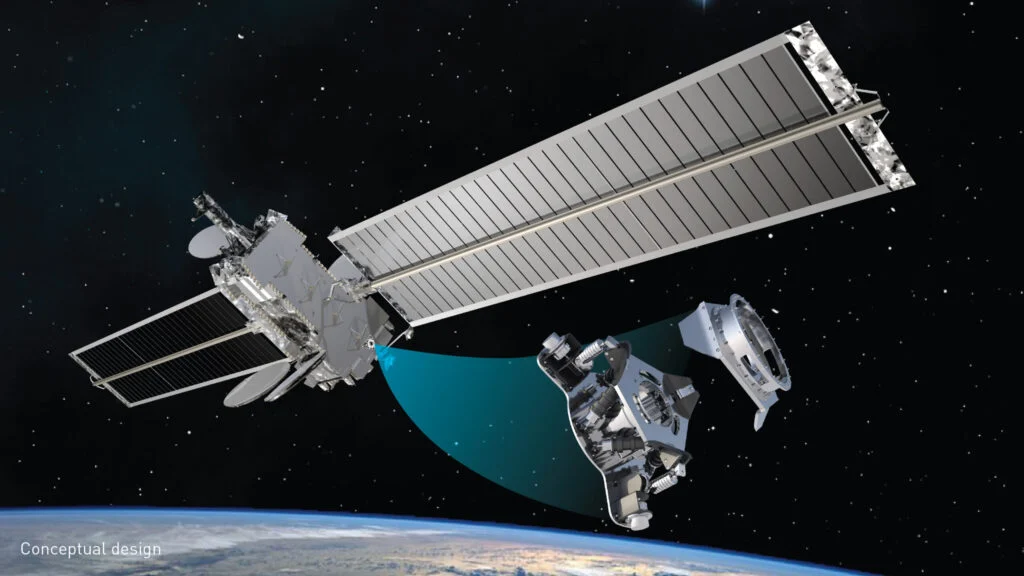
Lockheed Martin’s new ASPIN adaptor provides an electrical and a data interface, and a docking mechanism for a servicing vehicle. (Graphic: Lockheed Martin)
By Theresa Hitchens,
Published by Breaking Defense, 16 April 2026
The service’s new Objective Force plan calls for demonstrating on-orbit refueling and fielding operational “space tugs” by 2030.
COLORADO SPRINGS — After years of open skepticism about US Space Command’s push for development of satellites with the ability to move freely on orbit over long periods of time, the Space Force now is embracing the concept as a foundation for orbital warfare.
Chief of Space Operations Gen. Chance Saltzman told reporters on Wednesday here at the annual Space Symposium that the service is working very closely with SPACECOM on orbital warfare, and to explore the technology and the operational concepts to enable on-orbit maneuverability and satellite refueling as part of its 15-year Objective Force plan.
SPACECOM head Gen. Stephen Whiting has been an unflagging advocate for on-orbit mobility and logistics over the past year, as was his predecessor Gen. James Dickinson. Whiting in his Tuesday symposium presentation called for a new space maneuver warfare strategy, explaining later to reporters that “it is a strength of the United States Joint Force that we we outmaneuver our adversaries, and that’s what we want to bring to the space domain as well in ongoing operations.”
Space Force officials have historically been more hesitant about mobility operations, questioning its near-term “military utility.” But this week Saltzman suggested he has come around, saying, “When [Whiting] says ‘dynamic maneuvering’, I agree. We need a maneuver force.”
But he said key questions remain. “Okay, what does that look like? Let’s model it. Let’s simulate it. If they can maneuver, do you need as many or does that drive a different set of requirements? … [W]e have a starting point: the Future Operating Environment, the Objective Force.”
He explained that the purpose of including space mobility in the Objective Force plan was to raise those questions, including “what are the unknowns that we need to resolve in the coming years so we can get our programming and our resourcing and our acquisition strategies right?”
Saltzman said the Space Force “will work closely with US Space Command on war games, modeling and simulation. … We will have to do continual analysis and then refinement as it marches its way closer and closer.”
The Future Operating Environment and the Objective Force, both released by the Space Force on Wednesday, are aimed at defining threats and the service’s future needs — ranging from kit to personnel to infrastructure to training — in five-year increments through 2040.
The Objective Force plan asserts that due to “competitors” seeking to degrade US space capabilities, “the most successful” space architectures will be designed to include “maneuverable and serviceable platforms.”
It calls for demonstrating on-orbit refueling and fielding operational “space tugs” that it characterizes as “Augmented Maneuver” systems between 2025 and 2030. Between 2030 and 2035, the plan envisions making re-fueling operational and demonstrating “high thrust reusable” orbital transfer vehicles. Finally, between 2035 and 2040, the plan calls for fielding an “initial on-orbit logistics architecture.”
Saltzman noted that the Space Force recognizes refueling as a “valuable contributor to that operational concept of maneuvering without regret,” and noted that the fiscal 2027 budget is funding demonstrations of that capability.
The Space Force also for the first time included refueling capacity as a requirement in its Jan. 17 bid solicitation for its new Andromeda (RG-XX) constellation to replace the aging Geosynchronous Space Situational Awareness Program (GSSAP) neighborhood watch satellites.
Whiting told reporters he is optimistic about the FY27 budget for refueling and maneuver capabilities.
“We’re excited about the opportunity with the budget. The president’s budget that he’s announced is, you know, truly a generational investment. And we are expecting some additional good news in the area of sustained space maneuver. I believe it’s a departmental priority,” he said. “Now we’ll see exactly what form that takes. We certainly need to do some prototyping. Need to demonstrate some capability. But from US space plan perspective, we want that to be heading in a direction of then fielding operational capability.”
Meanwhile, citing this apparent increase in Space Force demand, executives from both Lockheed Martin and BAE Systems announced plans to self-fund on-orbit maneuver demonstrations.
Tim Lynch, Lockheed Martin vice president for space security missions, mission strategy and advanced capabilities, told reporters here on Monday that the firm intends to undertake experiments in 2028 and 2029, “launching an asset into geosynchronous orbit” to undertake “a subset of maneuvers to prove out our capabilities when it comes to RPO [remote proximity operations] and also command and control mission management.”
He added that Lockheed Martin has already proven that it can provide some capabilities with current technologies, the the new demo is “more showing that we can do it at scale.”
Brad Shogrin, BAE vice president and general manager of national space, also told reporters on Monday that the company is developing a new spacecraft bus called Ascent that “is capable of high delta V, high maneuverability, [and] multi-payload hosting capability,” as well as “refueling” and “high thrust propulsion capabilities.”
BAE is targeting the bus for missions in medium and geosynchronous Earth orbits, as well as cislunar orbits between the Earth and the Moon.
Thai Sheridan, vice president and general manager for BAE’s military space business, said that the firm is “poised to deliver the first Ascent spacecraft to demonstrate dynamic space operations in 2027” — a demo that is being both funded by an undisclosed US government customer and BAE itself.
He added that the new bus “provides a platform for diverse mission solutions, multi-mission, multi-domain, maneuver, mobility, rendezvous and proximity, operations and docking that can communicate, maneuver, refuel, sense, defend and engage,” and “positions the nation for space maneuver warfare, supporting space superiority.”
See: Original Article


