
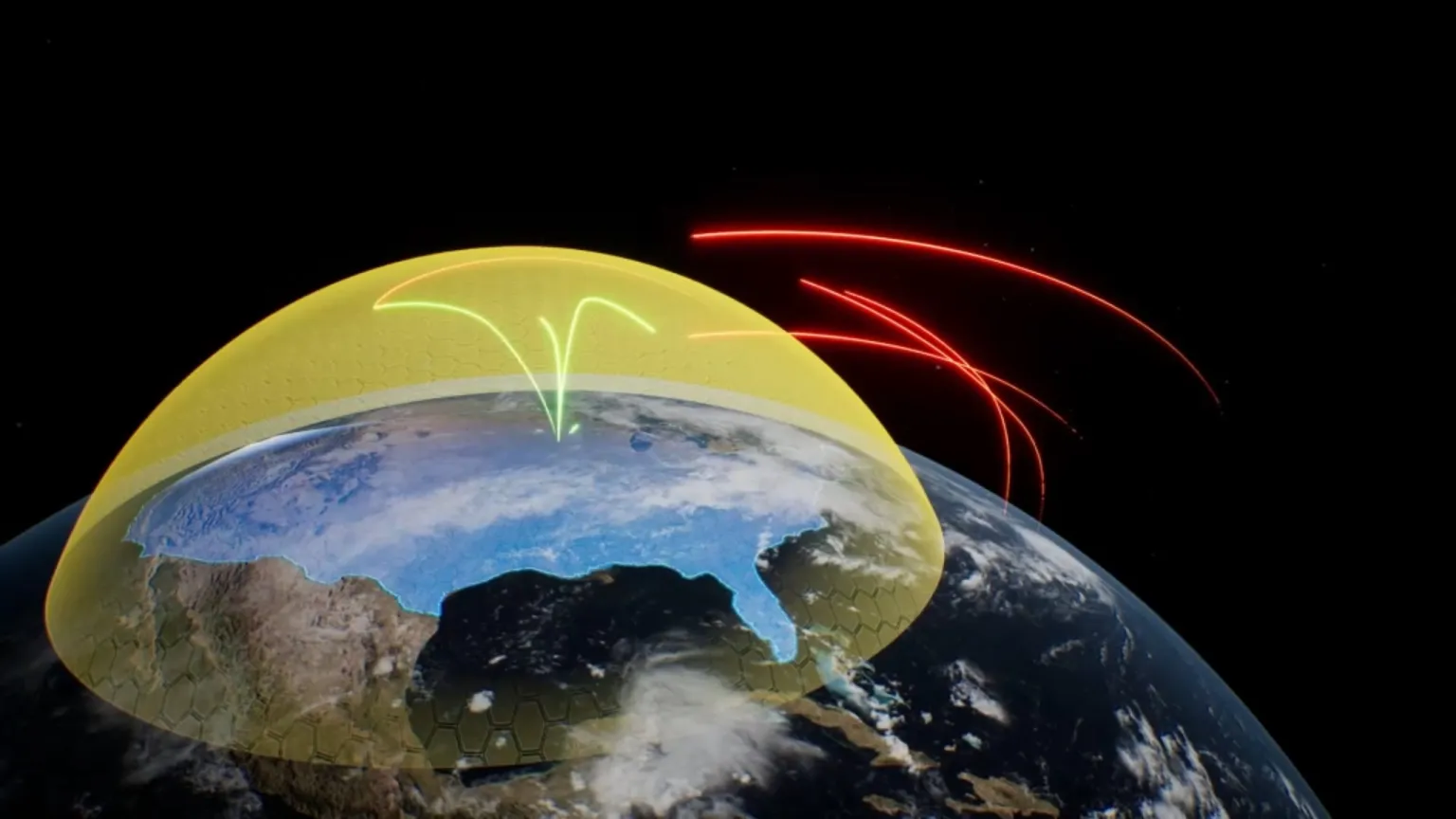
An illustration of the Golden Dome. Credit: Arcfield
By Ingolf Kiesaw,
Published by Kungl Krigsvetenskapsakademien, 22 December 2025
SIPRI’s 2024 yearbook is titled “Role of nuclear weapons grows as geopolitical relations deteriorate.” The content of that statement has grown in importance in 2025.
Golden Dome
On January 27, 2025, just a few days after taking office for a new term as President of the United States, Donald Trump signed an “Executive Order” to the US Department of Defense – now called the “War Department” – to build a missile defense system, what he later came to call “The Golden Dome”.
According to a statement by the then Department of Defense (now the “Ministry of War”), the Golden Dome will “unify a range of capabilities to create a system of systems to protect the United States from air attack by any aggressor“. Congress approved $24,5 billion for the purpose on September 5.
Donald Trump has said that this grant should be seen as a first installment and that the entire project should be fully operational before his presidential term ends.
He said in May that the total cost could be estimated at $175 billion. The Congressional Budget Office has since estimated that it will cost more than $500 billion. Other observers argue that the need to continuously replace satellites in the system, as Earth’s gravity pulls them out of orbit, means that the cost will exceed a trillion or several trillion dollars before it can be operational.
A first contract under Golden Dome was signed on November 4. Space X will receive $2 billion to build a system of 600 satellites with Lockheed Martin to create an “Air Moving Target Indicator (AMTI).” These low-altitude satellites will detect and track advanced threats from maneuvering glide missiles and stealth aircraft and then feed the data obtained into the US missile defense targeting system.
Congress has pointed out that the US missile defense strategy has so far been formulated as the US striving afterr “to defend against rogue states as well as against unauthorized or accidental missile launches while relying on nuclear weapons to deter China and Russia from striking American territory“.
Now the wording is changed to: “The United States will deter – and defend its citizens and critical infrastructure – against any airstrike against its territory“. The level of ambition has been raised significantly.
The relationship between the White House and Congress on the Golden Dome is marked by suspicion. In a statement, the Congressional Office laments that the administration has failed to provide the public with a detailed account of the project, has not held meetings with representatives of the business community, and has reportedly instructed military officials not to discuss the Golden Dome publicly.
Reactions to the Golden Dome
On May 8, China and Russia issued a joint statement criticizing the project for undermining the link between strategic offensive weapons and strategic defensive weapons, i.e. the very idea of a nuclear balance. Russian press spokesman Peskov said that while a decision on Golden Dome is a sovereign matter for the United States, it is also in the common interest of both countries to create a new legal framework to replace the no longer functioning nuclear arms treaties between the United States and Russia.
However, as of the end of October 2025, no preparations for negotiations on US-Russian arms control have been initiated. Donald Trump is said to have said that it might be a good idea, but without wanting to discuss the matter in more detail. On January 5, 2026, the only Russian-American arms control agreement still in force, the so-called New START agreement, expires.
In addition to China and Russia, there has also been criticism in the West that the US is trying to make the US invulnerable to nuclear attack with Golden Dome and thereby create a strategic advantage. This would damage the balance that has so far rested on the theory of mutual deterrence, a concept that also presupposes a certain degree of mutual vulnerability.
China shows off its weapons
China celebrated the eightieth anniversary of its victory over Japan in World War II with a military parade in Beijing on October 3 of this year. The parade was characterized by three things: coordination with the authoritarian countries of the world, the focus of Chinese defense on preparations for a war with the United States, and the belief that the next war will be fought globally.
Vladimir Putin and Kim Jong Un sat on either side of Xi Jinping during the parade, and among the invited guests were a large majority of presidents and prime ministers from the global south.
The new weapons systems on display included new advanced fighter jets, tanks, hypersonic anti-ship missiles and long-range rocket artillery. Three different groups of missile systems were displayed: five nuclear-capable systems, three cruise missile systems and three hypersonic missile systems.
The direction has been interpreted abroad as a warning to the United States not to try to oppose a possible upcoming attempt to invade Taiwan and to keep the United States away from the waters along China’s coasts in the Pacific Ocean.
FOBS has been a headache for the Pentagon
The presence of a Fractional Orbital Bombardment System (FOBS) in both Russia and China has been a particular concern for Western defense forces in recent times. This is especially true since China conducted a pair of test flights in the summer of 2021, when a launch vehicle was launched into orbit around the Earth and a hypersonic glide missile was released, which re-entered the atmosphere on the other side of the world and hit a designated target. The launch vehicle remained in a relatively low-altitude orbit (around 150 kilometers) and the entire crew moved at hypersonic speed the entire way, making them very difficult – almost impossible – to detect and combat.
Some of the missiles displayed at the military parade may be included in FOBS, which would mean that production and supply to units is ongoing.
After China’s first hypersonic missile flight, it took the United States several years to build a similar system and get the missiles flying, which has been a major concern for the Pentagon. The lack of a US system to defend against FOBS has been explicitly cited by the Defense Intelligence Agency as one of the reasons for introducing Golden Dome.
Truce in the trade war with China, but not peace and no deal
In the fall of 2025, Donald Trump has devoted a lot of time and energy to foreign policy, so much so that many have wondered if he would be able to cope with all the time zone changes and late banquets. After visiting the Middle East in September, he spent late October and early November visiting Malaysia, Japan, and South Korea. He attended a summit with the ASEAN countries and the opening of a summit with the APEC countries. He concluded trade agreements with Malaysia, Cambodia, Thailand, Vietnam, South Korea, and Japan.
The most important feature of the trip was a conversation with Chinese President Xi Jinping, which, however, did not lead to any written agreement. The parties limited themselves to publishing lists of commitments that each participant considered they had agreed to. This was a disappointment for Trump, who had expressed his hopes for a written and binding agreement. However, he managed to achieve, among other things, that China began to buy soybeans from the United States again, supply rare earth metals and take other measures that the United States had desired – not least to crack down on the illegal production and smuggling of fentanyl.
The US, in turn, gradually stopped applying the sky-high tariffs that had been imposed to pressure China into concessions, and China abolished the application of the countermeasures in the tariff area that had been imposed. The final impression, according to most media outlets reporting from Asia, was that the talks resulted in a truce in the tariff war rather than a peace agreement in the trade war. The US had been the pleading party, and China continues to withhold much of what the US had wanted.
Sympathy for the US is also reduced by the content of the trade agreements that were actually concluded. Trump had imposed very high tariffs on imports from Asian countries. Now they were reduced in exchange for significant measures in favor of the US, in the cases of South Korea and Japan, promises of investments in the US of 200 billion and 550 billion dollars respectively. This open form of blackmail of countries with a trade surplus with the US has not been well received in East Asia and Southeast Asia.
This was evident at the APEC meeting. Trump attended a pre-meeting dinner, but returned to the US before the meeting began. Treasury Secretary Scott Bessent was allowed to represent him, and it was Xi Jinping who set the tone for the talks. They largely focused on the need for free trade and how to work together for shared economic development, in other words the opposite of the protectionist policies that Trump has come to symbolize.
Arms race looms
Around the same time that Trump was concluding trade agreements and making state visits to Asian countries, a series of events occurred that appear to be able to usher in a new period of arms race.
1) Putin announced that Russia had successfully tested a nuclear-powered cruise missile capable of carrying nuclear weapons on October 21. The test flight lasted 15 hours, and the missile had traveled 14000 kilometers. Putin claimed that it is impossible to detect and counter. This claim has been questioned in the West, but it is clear that Russia has made great progress in its efforts to create nuclear weapons that are difficult to counter.
2) A few days later – on October 24 – Netflix released a film online titled “ A House of Dynamite”. The following day, the Pentagon took the unusual step of issuing an official rebuttal to the film’s content. The film’s plot involves a nuclear-armed missile from an unknown country approaching the United States and evading all attempts at countermeasures that the US space defenses can muster. The Pentagon claims that the description is unrealistic and inaccurate and that the US space defenses are well-equipped to counter incoming missiles. The film and the Pentagon’s attempt to deny its description have sparked intense debate, both in the US and Asia. Leading newspapers there see the Pentagon’s reaction as a sign of nervousness about the possibility that the film could create distrust of Golden Dome and influence Congress to cut funding.
3) On October 29, Putin said on TV that Russia had successfully tested an underwater torpedo, powered by a nuclear reactor. It has been given the designation “Poseidon” and Putin claimed that it is unconquerable. It can carry nuclear weapons.
4) The same day, hours before he was to meet Chinese President Xi Jinping in South Korea, Trump announced that he had instructed his Department of Defense to immediately test US nuclear weapons “on an equal basis,” citing other countries’ weapons development and nuclear tests. However, he has so far refused to clarify whether the tests will be digital or with test explosions.
The development of events and the action to announce nuclear weapons tests immediately before the conversation with Xi almost give the impression that Trump was panicking because it might appear that the United States has fallen behind in nuclear weapons development.
China is the US’s main adversary
It appears that the US is now planning to devote enormous resources to Golden Dome instead of focusing on renewing its twenty- to thirty-year-old stockpile of nuclear weapons and generally modernizing its outdated nuclear arsenal. China and Russia have apparently been doing just that for several years and have come to the point where they pose a threat to the US position as a unilateral world leader. There is much talk, especially in East Asia, Southeast Asia and South Asia, that the US is now in a phase of forced withdrawal and that China is about to take its place. Donald Trump’s brutal treatment of his Asian allies on trade issues is viewed with incomprehension and a certain degree of contempt, both in allied and neutral countries.
The US’s self-image as the leader of NATO and the rest of the “free world” has also suffered from the events during Trump’s Asia trip. China’s display of technological advances in the field of weapons, especially nuclear weapons and new types of aircraft with capabilities that are said to exceed the performance of US fighter jets, has reinforced the impression that the US is no longer a dominant power in the Pacific.
The question arises what happens if the United States fails to build a functioning Golden Dome in time, while China and Russia continue their already successful modernizations of their respective nuclear arsenals.
The US economy has been significantly slower than China’s over the past ten years. Growth expressed as a percentage has been a fraction of China’s. Trump’s trade policy is unlikely to contribute much to economic growth, and it is reducing cohesion with allies, while China is already benefiting from the US’s reduced participation in international trade and is making advances in Africa and Latin America.
New weapons require new spending
It is unclear how the United States will learn from the experience of the war in Ukraine. In one respect, Donald Trump has continued to follow the policy of his predecessor. He has made it clear that the United States will not use nuclear weapons or threaten to use nuclear weapons to save Ukraine from losing the war against Russia. This has contributed to ground warfare taking a leading role in that war. Protracted artillery duels and trench warfare have been reminiscent of Europe during the First World War.
This, in turn, has led to a revolution in ground warfare, namely the introduction of drones and the technical development of this new weapon. As long as none of the participants threatens with nuclear weapons, the ability to use drones could give Ukraine the opportunity to repel or at least delay the Russian attack. This lesson leads to all armed forces suddenly being faced with the question of whether they need to equip their ground forces with trained personnel and equipment for a new form of warfare in order not to appear militarily weak.
The US cannot escape. For Home Defense, basic drone warfare capabilities must be created for psychological reasons. For US Marines and other units operating outside their own borders, it is also a question of the possibility of survival in a hostile environment. The demands for new spending are piling up.
Europe is now left with responsibility for its part of the world
Europe has reason to be concerned about the development. Golden Dome is only intended to protect the US’s own territory and, as far as is known, not that of its allies. Europe will have to devote its resources to its own defense to a greater extent, especially to defending itself against Russian ambitions to expand its influence westward. Unless some decisive change occurs in the US in the near future, we must reasonably conclude that the US is on the verge of not having the financial resources required to continue to live up to its responsibility for our military defense within the framework of NATO.
Since the 1980s, China’s official position has been that NATO should be abolished or dissolved. Therefore, it has been a setback for China that the EU and NATO have begun a certain integration under the pressure of Russia’s attack on Ukraine. However, this integration between the EU and NATO began to come under strain already in the first days of the Trump administration, with the US threatening huge tariffs and demanding European investment in American industry in exchange for waiving tariff increases. Ideas for a European defense system capable of acting independently in response to the US’s unfriendly stance towards Europe have been seen and debated in both Europe and the US.
For example, Ursula von der Leyen’s launch of the EU’s defense loan system called SAFE has been accompanied by such obvious hints of a European defense capability that it has drawn criticism for undermining coordination within NATO under US leadership.
A similar mechanism can be observed in Asia. There, China has tried to bind its neighbors to itself and criticized the United States’ attempts to appear as their protector towards China. The mutual defense agreements that have existed since the Cold War between South Korea and Japan on the one hand and the United States on the other are criticized by China, not to mention new attempts at joint defense efforts between the United States, Asian countries and countries in Europe, such as the AUKUS agreement on nuclear-powered submarines.
The shameless display of how tariff blackmail has enabled the US to extract trade benefits from its Asian allies has been touched upon in this article. It has damaged the US’s reputation and given the impression that the US is an unreliable ally. Cooperation based on shared values no longer seems like a viable slogan in the global South, and the effect is starting to be felt in Europe as well.
Trade; US fights free trade as a concept while China defends
It was China’s accession to the World Trade Organization (WTO) in 2001 that enabled the amazing economic development over 25 years that has given the country a GDP as large as the United States. It was the opening of China’s borders and the use of the opportunities offered by free trade that led to this result. It was also China’s abuse of the opportunities and violation of the rules that led the United States under Donald Trump to start its trade war. Worse, that war is not only directed against China but also against almost the entire rest of the world.
The WTO aims to eliminate all trade barriers through ongoing international negotiations and tariff reductions. Negotiations have been at a standstill for many years. The main reason is that the United States openly obstructs the work, overrides the rules in the charter and refuses to appoint members to the arbitration tribunals that are to decide disputes about the application of the charter. This is damaging world trade, and several countries are campaigning for the WTO negotiations to be revived.
China has taken the lead in that campaign. The EU has not shown a high profile, possibly out of consideration for the US stance. There is reason to reconsider its stance and not shy away from joining the attempts by China and the countries of the global south to breathe life into the WTO without making US participation a condition. The fact that it is China that is taking the lead in the campaign should not be seen as an obstacle.
China is also trying, together with Russia and eight countries in the global south, to push for free trade through another international body, BRICS (the initials for Brazil, Russia, India and South Africa). The goal of BRICS is to reform the current world order so that it more reflects the needs and interests of its members.
This formulation makes accession unattractive to the EU because it involves an attack on the influence of a number of international institutions on which the EU depends and in practice has proven to be mainly directed against the US and the EU’s own influence in these institutions.
BRICS represents around 40% of the world’s population. As the negative impact of the US attack on free trade grows, it is possible that some rapprochement between Europe and BRICS may occur on trade issues, even if it still seems absurd.
NATO under pressure
NATO will be put under strain as the US has to make a huge effort to row the Golden Dome project ashore while simultaneously updating and re-equipping all of its other defenses. The US is tempted to scale back its presence in Europe.
The current planning work within NATO is based on the assumption that the defense forces of the European members are not sufficient to withstand an attack by Russia and that resources must be supplied from the United States in the event of war. Much work is being done on how troops and equipment will be transported through Europe to the front in the East. This orientation may need to be changed and the starting point will be to work more with the resources that Europe already has at its disposal in the initial situation.
If the United States were forced into a two-front war by Russia attacking Europe at the same time as China attacking Taiwan, Europe would be left almost entirely to rely on its own resources. It is important to remember that in its defense planning, the United States considers China to be its main adversary.
Since NATO is designed to function under American leadership, Europe must now create its own organization in peacetime in order to be able to function without or at least with weakened support in wartime. That is the only conclusion that seems logical to draw in the light of this article. Whether such an adaptation can take place within the framework of NATO or can best be done within the EU or through the creation of an entirely new European defense organization has become a pressing question.
How Europe should dispose of its own nuclear weapons assets to deter Russia from attacking is also an issue that is now demanding attention even in peacetime.
Conclusions for Europe.
In any case, the connection between economic and military strength will play a central role. If the US fails to mobilize the financial resources required for Golden Dome and if the EU fails to find the means to both help Ukraine avoid defeat in the war with Russia and at the same time build up our own defenses, the situation may become difficult to manage.
The US is acting openly protectionist. Donald Trump praises his own tariff hikes and imposes export controls to protect American companies. In its drive to accelerate its economic growth, China has also at times acted in violation of the WTO charter, but now Xi Jinping’s statements indicate that it realizes that was a mistake. In any case, China is trying to take the lead in the global resistance to populist protectionism. The US has become an uncomfortable ally for Europe, and China has come to appear as a less antagonistic power.
In Europe, there are also advocates of populist protectionism, but US tariffs are also aimed at members of the EU, which was formed precisely to be a free trade union. Advocating protectionism within the EU will not be possible in the long run without also working towards the dissolution of the EU.
The EU’s foundations also include respect for international law. The US, for its part, has long violated the rules of international law, for example the rules on human rights in the treatment of prisoners in Guantanamo and respect for the sovereignty of other countries in connection with the overthrow of unpopular leaders in Latin America. So far, this has been so relatively rare that it has not made cooperation within NATO impossible.
Since Donald Trump came to power, however, the US has committed serious violations of international law, such as the prohibition of genocide in connection with its support for Israel’s war in Gaza and against the rules on freedom of the seas and human rights in connection with the killing of suspected smugglers from Venezuela and Colombia without prior trial. Being part of NATO and being part of the same alliance as the US is beginning to feel embarrassing to a European.
The nonchalance with the rules of international law also raises uncertainty about how serious the US is about its own membership in NATO and its obligations to help the EU preserve sovereignty over its territory.
Donald Trump’s fickleness and the uncertainty about what the investment in Golden Dome will entail create uncertainty for Europe and the rest of the “West”. For Europe, this means having to walk a balance between the desire not to lose the US as an ally in the long term and, on the other hand, the prospect of perhaps having to face a growing threat from Russia alone. In addition, the US may demand help in its power struggle with China, something that it is not in Europe’s interest to allocate resources to.
Can the EU prepare for a period of reduced American support without irreparably damaging the relationship with the US? Can the EU build a partnership with countries in the global south and even with China that resembles the world trade and payments system that functioned before Xi Jinping and Donald Trump came to power in their respective countries?
Puppet dreams? Yes, maybe, but what choice do we have?
See: Original Article


