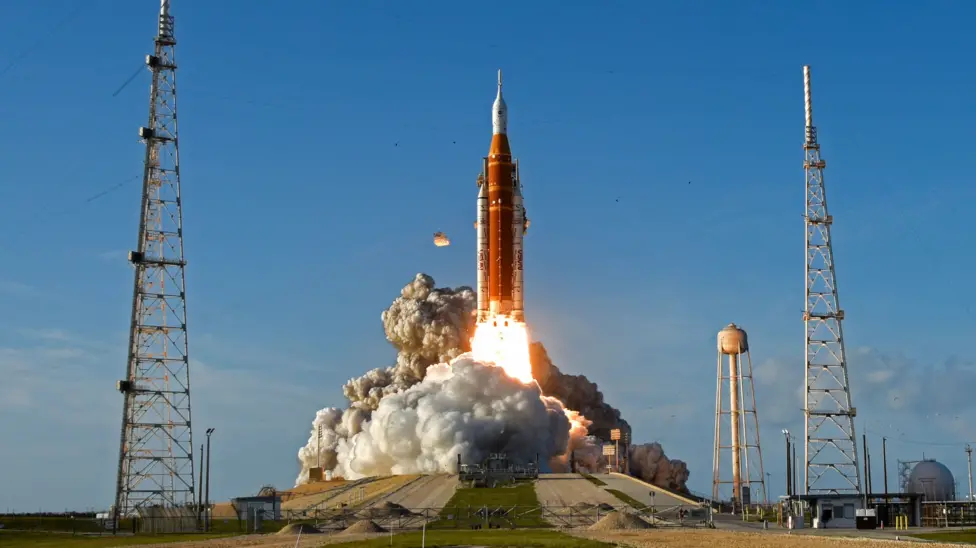
While rocket launches usually tend to cause a bit of disruption to these types of signals, scientists say Artemis II’s was more intense
Published by The BBC, 6 November 2026
In April 2026, the world watched on as Artemis II took to the skies to study the Moon.
But a new study says the rocket launch disrupted part of the Earth’s atmosphere and interrupted GPS signals that we use down on the ground.
GPS signals are made using satellites, and they help us do all kinds of things, like see where we are on maps on our phones.

A team of researchers from National Cheng Kung University in Taiwan looked at a GPS receivers on the ground in the US, and found that the power of the rocket’s launch cause disturbances there more significant than any other rocket to date.
For example, the disruption to these signals was ten times more severe than the test launches of SpaceX’s Starship.
What is Artemis?
Artemis is NASA’s newest Moon mission. They want to get astronauts back there for the first time since 1972.
It’s happening in stages.
Artemis I took place in November 2022, and was used as a way to test all their kit, without anyone on board.
Artemis II, the one this new study refers to, saw a crew of four travel around the Moon in April 2026.

Artemis III will be a bit closer to home, as a crew will fly into the upper prt of the Earth’s atmosphere and practise some manoeuvres they’ll need for the big finale.
And that is, of course, Artemis IIII, which will hopefully see a crew touch down on the Moon.
What are GPS signals?
GPS stands for Global Positioning System.
GPS satellites send out signals to say where they are above the Earth, which are then picked up by phones and other devices.
Whatever’s being used to pick these signals up will figure out how long it took for the signal to reach them, and this timing shows how far away from each satellite the device is.
Your device needs to pick up at least four satellites to work out your exact location.
What happened with Artemis II?

The rocket disturbed a part of the Earth’s atmosphere called the ionosphere, which is electrically charged.
When this layer is disrupted, by things like rockets or solar storms, it can make GPS signals get down to Earth far more slowly than they usually would.
And according to the authors of this new study published in Geophysical Research Letters, this happened intensely in two places above America with Artemis II.

Charles Lin, an earth science professor at National Cheng Kung University and one of the co-authors of the paper, told science website Space.com these disruptions could have big effects on things that rely on GPS signals.
He said: “A positioning error of a couple of meters is enough to cause an autonomous car to change lanes.
“It could have a strong impact not only on self-driving cars but also on drone positioning.”
He continued: “In the future, as we are going to see many more missions going to the moon and to Mars, these space weather effects will become much more significant.”
See: Original Article