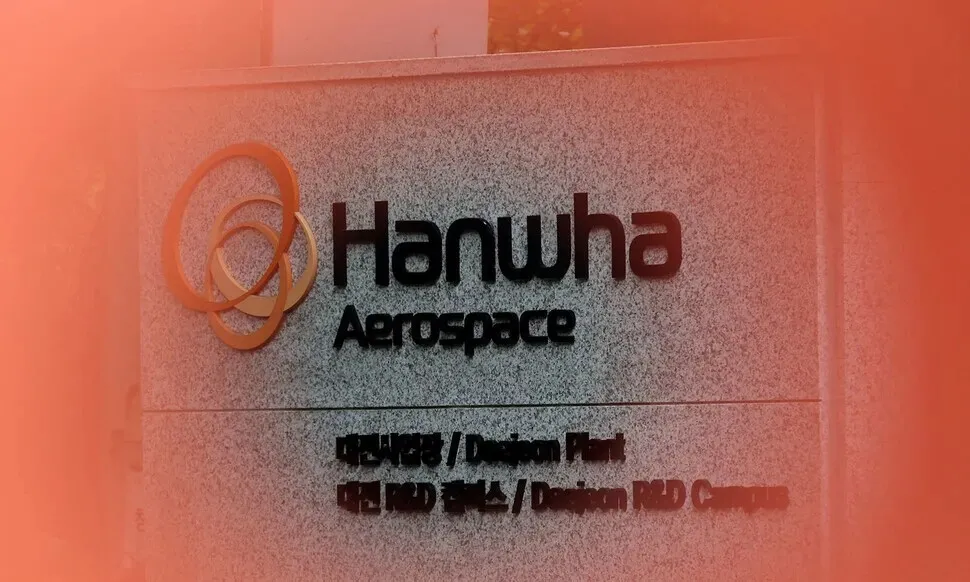
Hanwha Aerospace’s Daejeon plant on June 1, 2026, following an explosion there. (Kim Hye-yun/Hankyoreh)
By Choi Ye-rin, Jang Hyeon-eun, Kim Joong-gon and Kwon Hyo-jung
Posted on Hankyoreh, 2 June 2026
Five were killed and two injured at an explosion at the defense contractor’s Daejeon plant
Another explosion at defense contractor Hanwha Aerospace’s plant in Daejeon, the country’s No. 5 city, killed five people Monday, bringing the total death toll from explosions at the site to 13, including five fatalities in 2018 and three in 2019.
Hanwha Aerospace has recently emerged as a leader in the country’s cutting-edge defense industry. Yet behind the scenes, its plant has seen a series of workplace disasters that are at odds with the standards expected of a world-class manufacturer.
The site of Monday’s explosion was the plant’s tool cleaning area of Building 56. Hanwha Aerospace said this facility, which washes explosive materials from tools used to make rocket propellant, is separated from other buildings.
The company added that a management supervisor and six production staff were cleaning tools using water mixed with detergent when a sudden explosion caused a fire. Five workers died and one suffered second-degree burns over his entire body, with one manager who was outside the facility sustaining minor injuries.
The workers apparently had no time to escape as the explosion caused flames to instantly engulf them. Police plan to request DNA analysis from the National Forensic Service to identify the victims.
Speaking to reporters outside the site of the explosion, Ga Jae-woong, a Hanwha Aerospace senior vice president and manager of the plant, questioned how the explosion occurred.
“Trace amounts of explosive material inevitably get on tools used in the propellant production process, so the tools are washed with water mixed with detergent. I can’t understand how the explosion occurred since the hazardous properties of the explosive material disappear upon contact with water,” he said.
“We had two major accidents a few years ago, and though we pledged measures to prevent a recurrence, I sincerely apologize that another occurred,” he added. “I’m just perplexed because we initially thought that the process in which today’s accident occurred posed relatively low risk.”
Ga declined to disclose details such as what sort of explosive material was involved, only saying that all processes at the workplace are “confidential.”

Hanwha Aerospace’s failure to pinpoint the cause of the blast has sparked fierce criticism considering the growing death toll at the plant. All three explosions are known to have been related to solid propellant used to transport weapons.
In 2018, an explosion occurred during the process of loading fuel into a rocket propellant container. The next year, another happened during the removal of a propellant core.
Workers at the plant bear inherent risk because of the highly explosive properties of the propellant used in rocket boosters. But Monday’s catastrophe demonstrates the company’s failure to take effective measures to prevent such explosions even after similar incidents in 2018 and 2019.
Immediately after the 2018 blast that killed nine, a Ministry of Employment and Labor inspection uncovered as many as 486 violations of workplace safety regulations.
An annual report by Hanwha Aerospace also said it had been fined 2 million won (US$1,300) by fire authorities in Daejeon in January 2025 for failure to comply with regulations for hazardous material prevention, as well as 1.6 million won that June for inadequate maintenance and management of fire safety facilities.
“Defense contractors often classify their production processes as confidential, so there are cases where they never take proper follow-up measures even after explosions resulting in casualties occur,” said Yeom Gun-woong, a professor of police and fire administration at U1 University. “Three similar accidents have occurred at the same workplace, so a fact-finding investigation and comprehensive inspection are necessary.”
The company’s union demanded a thorough investigation into the incident and identification of those responsible, slamming Hanwha Aerospace’s “slogans of eradicating industrial accidents and creating a safe workplace” as “nothing but empty words.”
The Korean Confederation of Trade Unions, one of the country’s major umbrella unions, also criticized the company in a statement.
“Hanwha Aerospace has made it abundantly clear that it not only neglects the safety and lives of its workers, but has also made no safety improvements since the last two accidents,” it wrote.
In response to the explosion, the company’s parent conglomerate Hanwha Group released a statement from Chairman Kim Seung-youn.
“I offer my deepest condolences and words of comfort to the victims’ families,” he said. “I order prompt and diligent action to redress the damage caused by the incident, including support for the victims’ families and treating the injured.”
The group also issued a statement saying it would “fully investigate the cause of the accident to ensure that such a tragedy never happens again.”
See: Original Article