
By Space Investor,
Posted on X.com, 8 November 2026
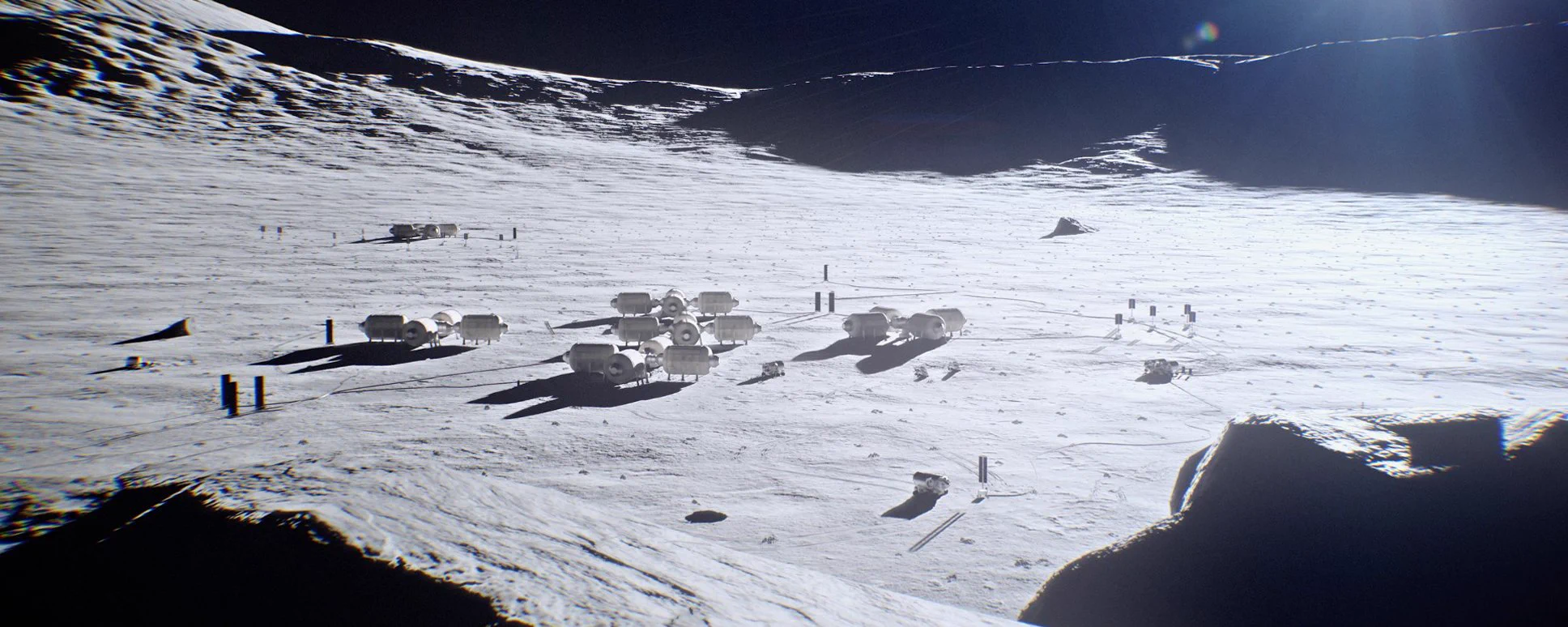
NASA named 15 companies in its latest Moon Base announcement. Cargo landers, a nuclear-powered rover, Earth-to-Moon transportation, communications satellites and surface power.
The headline number is $10 billion.
The more immediate work includes six transportation task orders worth about $1.3 billion combined, plus Blue Origin’s $94 million base contract to deliver a rover to the lunar South Pole.
NASA announced the package Saturday, November 7, at the MAX POWER aerospace expo and air show at Kennedy Space Center.
There are three different kinds of numbers in the release:
- Contract ceilings: the maximum NASA can order under a broader agreement over time. They are not guaranteed revenue.
- Task orders and base awards: specific work NASA has awarded.
- Options: additional work NASA may authorize later, subject to the contract’s conditions.
1. Eight companies make the CLPS 2 list
NASA selected eight vendors for the next phase of Commercial Lunar Payload Services:
- Blue Origin
- Firefly Aerospace ($FLY)
- Intuitive Machines ($LUNR)
- iSpace US
- Lockheed Martin Space ($LMT)
- Northrop Grumman Space Systems ($NOC)
- SpaceX
- Voyager Technologies ($VOYG)
CLPS 2 is a 10-year contract with a combined maximum value of $10 billion.
The companies can compete for future lunar surface delivery missions. Those missions would involve managing, building and operating landers to carry NASA’s science, technology and infrastructure payloads to the Moon.
For the selected companies, the next commercial milestone is winning specific delivery orders.
2. The original CLPS contract gets more capacity
NASA also increased the existing CLPS 1 contract ceiling from $2.6 billion to $4.2 billion.
That is $1.6 billion of additional ordering capacity, not $1.6 billion allocated to named companies in this announcement.
The original contract remains in place through November 2028, followed by an additional five-year period to complete awarded deliveries through November 2033.
CLPS 1 and CLPS 2 therefore overlap. NASA is expanding the existing delivery program while establishing the next one.
3. Blue Origin gets the clearest individual award
NASA is moving forward with PROMISE, the Polar Rover for Observation, Mapping, and In-Situ Exploration.
Blue Origin received a $94 million base contract to deliver the rover to the lunar South Pole using its Mark 1 lander. The contract includes an additional $140 million performance-dependent option.
If exercised, that would bring the delivery contract to $234 million.
The award expands a May 2026 task order to Blue Origin for delivery of two lunar terrain vehicles.
PROMISE itself is a six-wheeled, nuclear-powered rover. NASA’s Jet Propulsion Laboratory, a division of Caltech, will manage the mission and build it using spare flight components and engineering test models from the Curiosity and Perseverance Mars rover programs.
NASA says that approach reduces cost and shortens integration and testing.
The rover will investigate the lunar surface and subsurface, assess resources, and support landing-site selection and infrastructure planning. Its equipment includes:
- A drill reaching about one meter below the surface.
- Spectrometers to study surface chemistry.
- Temperature and radiation sensors.
- Visible-light cameras.
- A next-generation spaceflight computer and advanced autonomy technology.
Nuclear power supports operations through long lunar nights and in permanently shadowed regions thought to contain ice.
NASA is targeting a late-2028 launch and an 18-month mission.
4. Six transportation orders total about $1.3 billion
This is the largest package of specific task orders with a disclosed combined value in the announcement.
NASA awarded six orders to:
- Arrow Science and Technology
- Blue Origin
- Impulse Space
Together, those orders are worth approximately $1.3 billion. NASA did not disclose each company’s share.
They fall under the Venture-Class Acquisition of Dedicated and Rideshare launch services contract, or VADR. That broader contract has a $5 billion ceiling over 10 years.
The $1.3 billion in orders sits inside that framework. It is not another $1.3 billion on top of the $5 billion ceiling.
The work covers transportation and demonstrations needed to move Moon Base cargo between Earth and the Moon.
One group of missions will test communications, navigation and the ability to deliver a CLPS lander to a desired orbit. That includes CAPSTONE 02, which will test proximity maneuvers, navigation and communications around the Moon.
Another group will help survey the lunar South Pole before astronauts arrive. That includes MoonFall drones, intended to scout terrain beyond the reach of traditional rovers, plus transportation of other Phase One Moon Base assets.
A third group will demonstrate navigation and operations in multiple orbits between Earth and the Moon, supporting commercial transportation systems that could increase the cargo future landers deliver.
5. The awardees are not the entire supplier list
NASA separately identified the rockets and transportation spacecraft involved in some of these missions.
Launch vehicles:
- Blue Origin’s New Glenn.
- Relativity Space’s Terran R.
- SpaceX’s Falcon 9.
In-space transportation spacecraft:
- Blue Origin.
- Firefly Aerospace.
- Impulse Space.
- Quantum Space.
No individual amounts were disclosed for those provider roles.
This is particularly important for Firefly. It appears both as a CLPS 2 vendor and as an in-space transportation spacecraft provider.
NASA’s release does not detail the contractual relationships between every spacecraft supplier, launch provider and task-order recipient.
6. SpaceX gets a separate Starship communications mission
NASA selected SpaceX for a Cislunar Communications Deployment Demonstration under an existing lunar logistics contract.
Through a Specialized Delivery Mission task order, SpaceX will use Starship to launch communications satellites into the region between Earth and the Moon in 2028.
The demonstration is intended to inform future communications networks linking astronauts, mission controllers and the Moon Base.
NASA did not disclose the task-order amount.
SpaceX therefore appears in three distinct roles: CLPS 2 vendor, Falcon 9 launch provider for some transportation missions, and provider of the Starship communications deployment demonstration.
7. Redwire gets surface power work
The Moon Base also needs infrastructure after the cargo lands.
NASA announced component awards for miniCAST, its Mini-Communications and Solar Tower:
- Honeybee Robotics, a Blue Origin company: energy storage.
- Redwire ($RDW): power generation.
- Yank Technologies: wireless power transfer.
NASA plans to purchase components including solar arrays, batteries and wireless power-transfer hardware. Marshall Space Flight Center will assemble and test the systems before deployment to the lunar surface.
Work is expected to begin within months.
NASA did not disclose amounts for any of the three companies.
For Redwire, this is a named power-generation award. NASA expects a separate solicitation for fully integrated power systems in early 2027.
8. Another opportunity is still ahead
NASA also plans a directed call under NextSTEP-3 B, part of its Next Space Technologies for Exploration Partnerships program.
The goal is to address high-priority information gaps for Moon Base development.
Potential work includes small spacecraft missions, payloads on future Moon Base flights, and purchases of data collected by commercial partners.
BOTTOM LINE
My read: NASA is beginning to order the transportation, communications and power systems needed for repeated lunar operations, while expanding the contracts through which future missions can be purchased.
The task orders will show who converts that opportunity into business.
See: Original Article


