
Victus Haze
By Mustafa Bilal,
Published by Space News, 1 October 2026
When a spacecraft closes in on another satellite, the operator tracking its trajectory on the other side now also has to consider whether that spacecraft is a weapon. On Sept. 14, 2026, Secretary of the Air Force Troy Meink revealed that the United States has “on-orbit space control weapons” to defend United States forces. Then Chief of Space Operations Gen. Douglas Schiess confirmed that Space Force personnel operate weapons in orbit. The world now knows that American weapons are in orbit, but since officials left their number, capabilities and locations undisclosed, there is no reliable public way to tell them apart from other spacecraft. For other operators, that silence adds to the dual-use dilemma, since an American spacecraft that appears to be inspecting or servicing a satellite may now turn out to be one of those weapons.
The uncertainty will persist until Washington identifies the orbital systems. The counterspace systems it had previously acknowledged were based on Earth, such as the Counter Communications System, a jammer first introduced in 2004 to temporarily deny satellite communications. A jammer on the ground, however, gives no one a reason to be wary of American satellites. Astropolitics expert Bleddyn Bowen has suggested that the new orbital weapons might be a close-inspection satellite or an electronic-warfare platform. A kinetic interceptor or grappling spacecraft is still a possibility, but only Washington knows what systems the announcement covers.
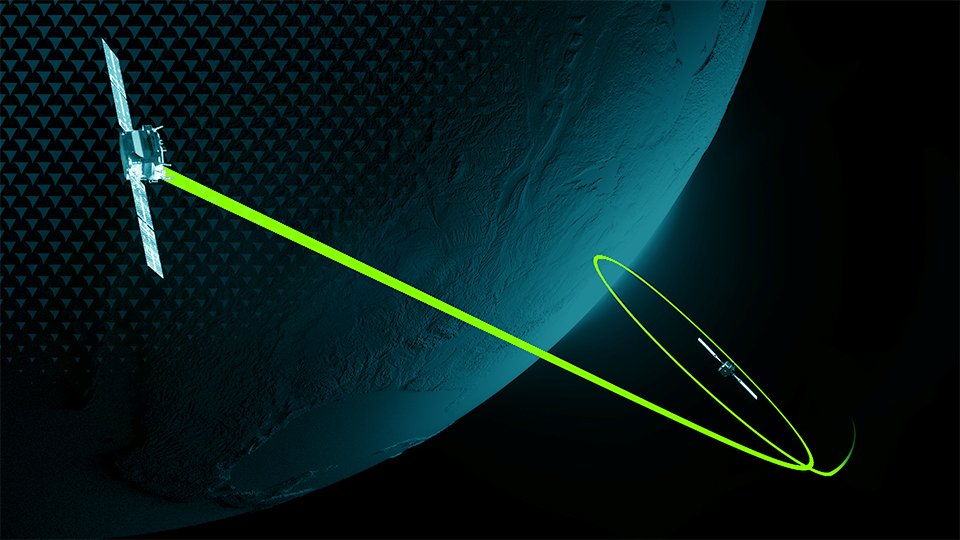
Meink’s announcement also followed two public demonstrations involving manoeuvrable spacecraft. On Sept. 8, U.S. Space Command said it had completed its first live-fly orbital exercise, Apollo Maneuvers. In June, during the Space Force’s VICTUS HAZE mission, a spacecraft built by True Anomaly located a Rocket Lab satellite within hours of its launch and imaged it. In a later sortie, it caught up with the same satellite again after the target tried to get away. The military calls such maneuvers rendezvous and proximity operations, or RPO. Space Command publicized Apollo Maneuvers weeks before it took place, while True Anomaly and Rocket Lab put out updates on VICTUS HAZE as the mission went on. Had an American spacecraft approached a Russian or Chinese satellite in the same way without any such explanation, Moscow or Beijing might well have taken it as an attempt at spying or interference.
The cameras and robotic arms that let a spacecraft inspect or refuel a satellite during RPO would work just as well for photographing its sensitive components or for dragging it out of its orbit. China’s Shijian-21 did so in January 2022, when it towed a dead BeiDou navigation satellite out of the geostationary belt. Ground operators can see a spacecraft maneuver, but don’t know the intent behind it. That intent has to be inferred from who operates the spacecraft, whether any warning was issued and how it behaves as it approaches. Neither hardware nor trajectory necessarily identifies a spacecraft as a servicing vehicle or a threat.
In 2007, DARPA’s Orbital Express successfully demonstrated autonomous rendezvous and satellite servicing. But in recent years, Russian and Chinese spacecraft have conducted similar maneuvers around sensitive targets or in coordinated formations. Two Russian spacecraft maneuvered near an American reconnaissance satellite in 2020. One later released a high-speed object close to another Russian spacecraft. Four years later, five Chinese satellites conducted coordinated proximity operations, maneuvering in and around one another in low Earth orbit in what a senior Space Force officer called “dogfighting”. Neither episode established that an attack was imminent, but both showed how hard it can be to determine a spacecraft’s purpose from its maneuvers.
The risk of miscalculation is greatest during an unannounced close approach. If an American spacecraft changes orbit towards an adversary’s reconnaissance satellite, the other operator may be able to calculate its trajectory without being able to determine its purpose with confidence. An inspector, a repair vehicle and, in some cases, a weapon may present similar observable behavior during an approach, leaving the other operator to infer intent from incomplete information. The other satellite operator may then move its own satellite in what it considers to be self-defense. It might go further and try to jam or dazzle the approaching spacecraft, which Washington could in turn consider as an attack.
The number, location and performance of the orbital weapons remain classified, presumably because an adversary could use such information to evade, jam or destroy them. Meink said more detail “would not benefit” deterrence. There is some logic to this, as an adversary that cannot tell which American satellites are armed may hesitate to attack any of them. Deterrence, however, also requires an adversary to understand what behavior might elicit a response and what that response might be. While a certain level of operational classification can lead to caution, greater secrecy can encourage worst-case assumptions. That would run counter to the Space Force’s aim of conducting counterspace operations without provoking destructive escalation.
Washington does not have to disclose classified capabilities to reduce that risk. It could describe their general effects, the conduct they are designed to prevent and the situations in which they may be deployed. It could give advance warning of close approaches, if possible, and offer a means of urgent communication and an explanation of how U.S. military spacecraft are expected to behave near another operator’s asset. Under normal conditions, such prior communication could ease many concerns. Washington could also offer these steps on the condition that Moscow and Beijing, which have been no more transparent about their own spacecraft, do the same.
Some of this could build on guidance the Pentagon has already issued. In 2021, Secretary of Defense Lloyd Austin issued five Tenets of Responsible Behavior in Space, and the Pentagon followed them up with eight specific behaviors in 2023. These address proximity operations, safe trajectories and notifying other operators when a collision is predicted, but none of them requires advance notice before a U.S. spacecraft deliberately approaches another operator’s satellite. A requirement of that kind could at least reduce the chances of a routine inspection or servicing mission being mistaken for a threat.
Washington may well have sound operational reasons for keeping its orbital weapons secret. But as long as it does not say which of its spacecraft are armed, any American spacecraft that approaches another satellite may be treated as one of them, and that is a risk the Pentagon will have to weigh.
Mustafa Bilal is a research assistant at the Centre for Aerospace & Security Studies (CASS), Islamabad.
See: Original Article


