By Shawn Simpson,
Posted on Katie Singer’s Substack, 16 September 2026
Here’s a new technology—satellites with mirrors. It could and beam sunlight to Earth at night! Solar panels could get more hours to generate electricity! The military could use this, somehow. Shawn Simpson wrote this piece, originally published in the Santa Fe New Mexican on September 13th.
In July, the Federal Communications Commission approved the deployment of a new technology that should alarm all of us.
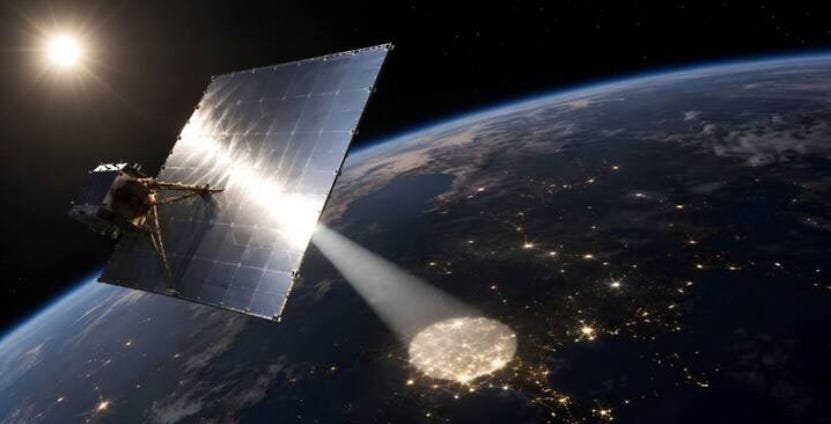
A California startup named Reflect Orbital received authorization to launch its Eärendil-1 satellite, which features a mirror nearly 60 by 60 feet designed to capture and beam sunlight down to Earth at night. Unlike previous satellites that produce light pollution as an incidental byproduct, this satellite’s whole purpose is to turn on the lights and turn off the night.
Eärendil-1 is designed to reflect sunlight onto a roughly 3-mile-wide area for approximately five minutes at a time, at intensities of 0.1 lux — comparable to the brightness of a full moon. This test satellite is a deliberately modest proof of concept. Future mirrors in a full constellation of satellites are planned to be nearly 180 feet wide and capable of reflecting as much light as the equivalent of 100 full moons.
The European Southern Observatory has warned that such a constellation would make the night sky three to four times brighter than it is today. Robert Massey, deputy executive director of the Royal Astronomical Society, called it “catastrophic.”
Reflect Orbital’s CEO says the technology offers several potential benefits. Among them include allowing solar farms to generate electricity after sunset, extending growing seasons for agriculture and illuminating key areas during search-and-rescue operations.
The company has also secured a U.S. Air Force contract, suggesting military and defense applications. These might sound like legitimate goods — though the military case should raise some eyebrows. But the company also intends to sell this service to paying customers — anyone, apparently, who can afford the $5,000 per hour.
The company’s stated goal is to deploy 50,000 such satellites by 2035, with 1,000 by the end of 2028. This is to say nothing of the effect this project will have on an already congested low Earth orbit. A study from 2025 by the original Kessler Syndrome researchers found that critical debris density thresholds had already been exceeded at nearly all altitudes between 520 and 1,000 kilometers. This is the threshold beyond which cascading collisions of debris could render that part of the atmosphere permanently unusable.
The night sky is one of the last common resources we all have. It belongs to no one. And it requires no infrastructure to access or appreciate it. For millennia the celestial tapestry has served as navigation system, calendar, sacred fabric and object of wonder for humans of just about every culture on Earth. Aboriginal Australians use dark constellations defined by the spaces between stars. Indigenous communities of the Americas and the South Pacific have long planned ceremonies and the planting of crops by the seasonal patterns of the night sky. Some scholars now use the term “astro-colonialism” to describe how light pollution from satellites is negatively affecting these practices. Reflect Orbital’s larger plans would almost certainly accelerate that disturbance.
Scientists have warned that altering the natural cycles of sunlight and darkness could disrupt the circadian rhythms of various species, including the light-dependent cycles of marine phytoplankton that produce approximately half the planet’s oxygen. Many migratory birds navigate by star patterns, and dung beetles orient themselves using the Milky Way. A constellation of orbital mirrors would represent yet another massive intervention into planetary ecosystems with ecological costs that cannot be fully calculated in advance and that, once implemented, plausibly cannot be undone.
This is the sort of technology that should require — at minimum — a thorough environmental impact assessment before implementation. And yet, in its review of Reflect Orbital’s plans, the FCC concluded that under NEPA the agency lacked the authority to evaluate the very sort of environmental impacts that should be considered.
The result was a review limited to the technology’s radiofrequency spectrum, effectively treating the tech’s orbital mirrors as exempt from domestic environmental law. Meanwhile, the Trump administration’s January 2025 “Unleashing American Energy” executive order has further weakened National Environmental Policy Act requirements, thus making meaningful review even less likely in the future.
The problem with technology like Reflect Orbital’s, however, is much broader. The Outer Space Treaty of 1967 holds nations responsible for spacecraft launched from their own territories. But there is no treaty requiring consent from those in or outside those territories who might be affected by that technology. Additionally, there is no mechanism by which those who are negatively affected could seek any sort of remedy.
This is a potential case of technological progress gone wrong in classic form: a well-intentioned intervention that may produce unforeseen costs on people, wildlife and the environment. No one consented to this trade. Did anyone really ask for it? It’s hard to imagine that this isn’t just another case of tech entrepreneurship in service of CEO and venture capital profit, justified by a list of benefits that do not clearly outweigh what stands to be lost.
The night sky is not just some floating, disconnected resource awaiting exploitation and monetization by private corporations. It is part of the delicate fabric that makes up the living world. We have already allowed too much of the night sky to be taken from us inadvertently. We should not allow it to be further transformed, and so casually, by a private corporation, especially not on such thin grounds.
Shawn Simpson is a former forest service and park ranger and a postdoctoral research fellow in environmental philosophy at North-West University in South Africa. He has a bachelor’s degree from Arizona State University and advanced degrees from the Graduate Center of the City University of New York.
For more information about Reflect Orbital’s beams, read Jonathan O’Callaghan’s report, originally published by MIT’s Technology Review August 21, 2026.
Odette Wilkens, President & General Counsel at the National Call for Safe Technology, has posted notice about HR 8255 and S.3639. Passage of these bills would rubber-stamp the approval of millions of satellites without meaningful health or environmental review. The FCC, which authorizes the satellites, has NEVER assessed the health or environmental impacts of satellites. In 2020, the Government Accountability Office (GAO) found the FCC is not adequately analyzing environmental harms by improperly categorically excluding satellites from human health and environmental review. Currently, there are applications for over a million satellites before the FCC.
Effects from satellites include:
- Significant increase in electromagnetic radiation, which in turn raises the risk of harm to people, animals and plants
- Toxic metals released when satellites burn up, poisoning air, food and water
- More rocket‑fuel pollution already appearing in ecosystems
- Severe orbital crowding—Starlink logged 25,000 collision‑avoidance maneuvers in six months
- Hundreds of thousands of polluting satellites falling back to Earth each year
- Loss of dark, night skies with adverse ecological, biological, cultural and scientific effects
- More rare-earth mining, which is linked to unsafe conditions for workers and child labor
- No meaningful process for health or environmental review
An environmental coalition is speaking out against the lack of environmental review under the National Environmental Policy Act (NEPA) and FCC actions, see https://earthjustice.org/press/2026/coalition-calls-for-rigorous-federal-review-of-space-based-data-center-proposals
These bills have already passed through the House Energy and Commerce Committee and the Senate Commerce Committee. Here’s what the Government Accountability Office says: https://www.gao.gov/assets/730/723690.pdf
https://www.gao.gov/assets/gao-22-105166.pdf
Click Here to Take Action and oppose HR 8255 and S.3639.
See: Original Post