
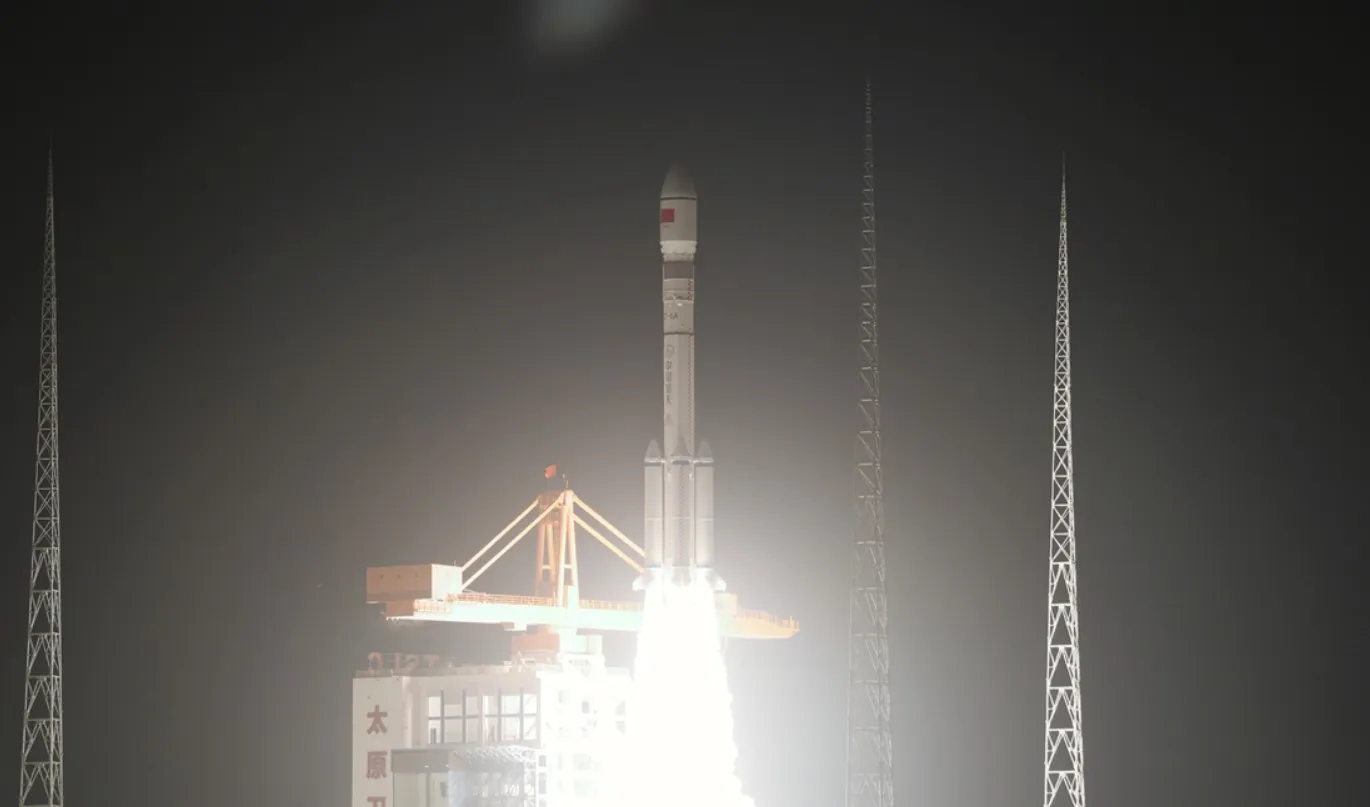
A Long March 6A rocket lifts off from Taiyuan Satellite Launch Center, March 15, 2026, carrying the Yaogan-50 (02) satellite into orbit. Credit: CASC
By Andrew Jones,
Published by Space News, 4 September 2026
HELSINKI — A Chinese satellite launched into an unusual orbit early this year has suffered an apparent fragmentation event, generating a field of debris.
Jonathan McDowell, a space activity tracker and former astrophysicist at the Harvard-Smithsonian Center for Astrophysics, stated on social media platform X Sept. 4 that the U.S. Space Force had cataloged 43 debris objects from the breakup of Yaogan-50 (02), citing 18th Space Defense Squadron orbital data. The fragments span an altitude range of roughly 600 to 1,100 kilometers, while sharing the satellite’s highly retrograde, 142 degree inclination orbit.
The cause of the breakup was not immediately clear, nor whether the debris count is likely to grow. Possible causes include a propulsion or battery anomaly or a collision with another space object such as a piece of debris. The debris pieces are at an altitude that means atmospheric drag is negligible, and the objects will likely remain in orbit for decades or longer.
“These are relatively low velocity, so not a super violent breakup,” McDowell told SpaceNews. He added that the breakup “may be just insulation shedding or a small battery event.”*
Neither the China Aerospace Science and Technology Corporation (CASC) nor its subsidiaries have commented on the breakup. Yaogan-50 (01) was developed by the Shanghai Academy of Spaceflight Technology (SAST), the 02 satellite was developed by the China Academy of Space Technology (CAST). Both are major CASC subsidiaries which produce spacecraft. China’s own space object catalog, Spacemapper, notes four pieces of debris associated with the satellite, suggesting Chinese trackers are aware of the event.
43 debris objects cataloged by US Space Force from the breakup of a Chinese satellite in 141 deg retrograde orbit, Yaogan 50-02. The debris is in the 600 to 1100 km altitude range.
— Jonathan McDowell (@planet4589) September 4, 2026
Yaogan-50 (02) launched March 15 on a Long March 6A rocket from Taiyuan Satellite Launch Center, joining Yaogan-50 (01), launched two months earlier in January, in a highly retrograde orbit which sees the satellite orbit in an opposite direction to Earth’s rotation. Such launches are rare and trade payload mass and launch efficiency for a higher relative ground-track velocity, enabling more frequent revisits of mid-latitude regions including China and surrounding areas. Israel is one of the few other operators to use them regularly, for geographic launch constraints rather than mission-driven purposes.
CASC described the Yaogan-50 satellites in generic terms, as being for land surveys, crop yield estimation and disaster mitigation. Outside analysts assess Yaogan-series spacecraft to carry intelligence, surveillance and reconnaissance payloads, including synthetic aperture radar (SAR), optical and signals intelligence sensors.
The Long March 6A used for the launch has had its own fragmentation issues regarding the kerolox upper stages, with a number suffering fragmentation events following successful spacecraft deployment. Last week, the related Long March 6C suffered an upper stage fragmentation event, with LeoLabs estimating that tens to hundreds of fragments of space debris were generated. U.S. Space Force has yet to catalog objects related to this event.
The European Space Agency’s Space Debris Office estimates that there have been more than 660 break-ups, explosions, collisions, or anomalous events resulting in fragmentation. In 2024, the retired U.S. military weather satellite DMSP-5D2 F14 suffered a fragmentation event at an altitude of 840 kilometers. China’s 2007 anti-satellite missile test destroyed the defunct Fengyun-1C satellite in what is the biggest single debris-creating event to date. An analysis by KeepTrack found there are still 2,318 trackable pieces of debris in orbit from the Fengyun-1 ASAT test, 19 years after the event.
ESA’s Space Debris Office estimates around 54,000 space objects larger than 10 centimeters are currently being tracked in orbit, of which roughly 9,300 are active payloads. Below that, the numbers grow by orders of magnitude, with an estimated 1.2 million objects between 1 and 10 centimeters, and around 140 million between 1 millimeter and 1 cm. These fragments are too small and numerous to catalog individually, but still capable of disabling a spacecraft on impact due to orbital velocities.
See: Original Article


