
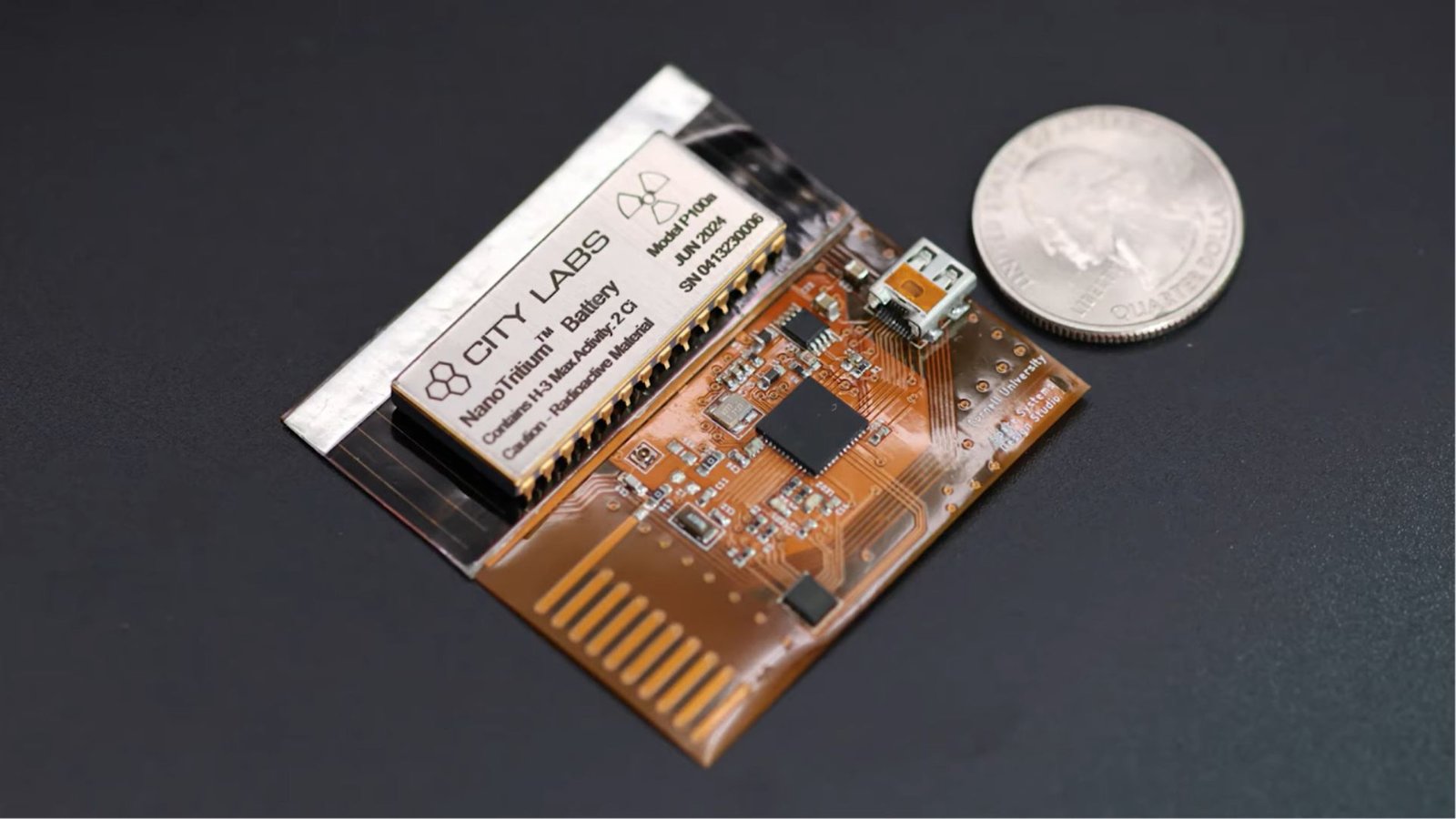
Nano Tritium battery: Citi Labs
By Mrigakshi Dixit,
Published by Interesting Engineering, 7 July 2026
Miami-based City Labs is all set to launch the world’s first commercial nuclear-powered satellite into orbit.
Solar panels have some challenges. When a satellite slips into the shadow of the Earth, hits a permanently dark lunar crater, or drifts into deep space, its solar arrays become useless. Batteries can step in, but they eventually die.
City Labs thinks nuclear energy could solve this persistent problem. On July 7, the company announced that its BOHR (Betavoltaic Orbital High-Reliability) satellite had secured a launch slot on a SpaceX Transporter-17 rideshare mission.
According to reports, SpaceX has scheduled the launch of its Transporter-17 rideshare mission for Tuesday, July 7, at 3:10 a.m. ET. The launch will mark a massive historic milestone. BOHR will be the first-ever nuclear CubeSat to enter orbit.
“This is a historic step for commercial nuclear power in space,” said Peter Cabauy, CEO of City Labs. “BOHR demonstrates that safe, compact, and regulatory-approved nuclear power systems are ready for routine commercial deployment. This capability enables persistent, always-on payload operations that are not constrained by sunlight or battery life.”
Secures FAA approval
Engineered for safe handling, transportation, and integration into standard commercial launch environments, City Labs’ tritium-based power systems operate at extremely low radiation levels.
BOHR’s core technology is City Labs’ proprietary NanoTritium™ betavoltaic system, which generates continuous power from the natural beta decay of tritium rather than nuclear fission.
Compared to space-bound nuclear reactors, betavoltaic cells operate with no moving parts, no liquid electrolytes, and zero risk of fire or thermal runaway. Furthermore, as the tritium fuel naturally decays, it harmlessly transforms into helium-3, a completely stable and non-radioactive isotope.
This process operates at safe, ultra-low radiation levels suitable for standard commercial handling. In this mission, the nuclear battery will run and validate the primary payload independently, while a solar power system manages the main satellite bus operations.
Getting a nuclear payload onto a commercial rocket isn’t easy.
In fact, it requires cutting through some of the toughest regulatory red tape on Earth. BOHR represents the first commercial space mission to successfully navigate the Federal Aviation Administration (FAA) pathway for nuclear launch approval, a framework established under National Security Presidential Memorandum-20. The safety analysis was led by City Labs’ Kevin Makinson and independently validated by Sandia National Laboratories.
The FAA issued its definitive payload authorization on September 30, 2025.
Advancing space exploration
Backed by the Department of War, NASA, and the Air Force Research Laboratory, the mission arrives at a key time for space exploration.
NASA’s Artemis program aims to establish a permanent human presence on the Moon. Therefore, the demand for continuous, light-independent power sources is skyrocketing. It could position this satellite as a pathfinder for future deep-space operations.
“This milestone establishes a new class of spacecraft capabilities, enabling persistent operation of critical subsystems where traditional power systems fall short. This includes deep space, permanently shadowed lunar regions, and long-duration autonomous sensor networks,” the company stated in the press release.
As a result, the BOHR mission will serve as a vital pathfinder for future nuclear-powered spacecraft supporting both civil and national security operations. When SpaceX’s Falcon 9 lifts off, it will be launching the next era of nuclear-powered space exploration.
See: Original Article


