

By Joseph Trevithick and Howard Altman,
Published by TWZ, 14 September 2026
Space Force has finally confirmed it has weapons in space and has also shared details about its “space control” mission set.
Secretary of the Air Force Troy Meink made a bombshell admission this morning, disclosing that there are on-orbit weapons deployed right now to protect America’s interests in space. Those weapons support a Space Control mission set, and the U.S. Space Force has now also shared additional details about that directly with TWZ.
Meink first made mention of what he described as “on-orbit space control weapons” during his keynote speech earlier today at the Air & Space Forces Association’s (AFA) 2026 Air, Space & Cyber Conference, at which TWZ is in attendance. As head of the Department of the Air Force, Meink serves as the top civilian overseeing both the Air Force and the Space Force. Space-based weapons have historically been a very sensitive topic for the U.S. military, with much discussion over the decades about whether such capabilities could already exist to varying degrees in the American arsenal. There has already been a dramatic shift in this regard in recent years, with the head of U.S. Space Command (SPACECOM) openly declaring the acquisition of new anti-satellite weapons to be a top priority just last month.

“Today, we continue to ensure we remain ready to meet the challenges of evolving threats, wherever they exist,” Meink said during his keynote address. “This is why the United States now has on-orbit space control weapons capable of defending the joint force against hostile adversary action.”
“That phrase was very well thought out. So whatever I said before is what I say again,” he said when asked if he could elaborate in any way on those capabilities at a question-and-answer session immediately following his speech. “It is critically important that we maintain our dominance not only in the air, but in space, and so we’ve had to take steps to make sure that when we’re threatened, we can take care of that.”
“Not going to go into specifics on the type of weapon,” Meink said when asked again if he could elaborate at a press roundtable with TWZ and other outlets on the sidelines of the Air, Space & Cyber Conference today. “Just like in air dominance, we need to maintain dominance in space as it becomes more and more important to how we function, how we operate militarily, and economically [and] civilian-wise.”
“There’s a lot of factors that go into how we talk about these things. We spend a lot of time talking about how we’re going to talk about these things,” Meink added at the roundtable when asked about why this disclosure was being made now and its implications for deterring adversaries.
“It is important from a deterrence perspective, but on the other hand, me talking about the details of what we’re doing would actually not benefit that deterrence,” he continued. “So I’m not going to talk about the specifics of what we’re doing, whether we’ve tested or not tested, or anything else.”

TWZ had separately reached out for more information after Meink made his initial remarks this morning.
“It is longstanding policy that the U.S. will protect and defend the Joint Force through all domains,” a Space Force spokesperson subsequently told us. “We are increasing readiness against existing threats, and the U.S. has on-orbit space control weapons capable of defending the Joint Force against hostile adversary action.”
“Space control encapsulates the mission areas required to contest and control the space domain – employing kinetic and non-kinetic means to affect adversary capabilities through disruption, degradation and even destruction, if necessary,” they continued. “These capabilities can be employed for offensive and defensive purposes at the direction of combatant commands. U.S. military operations are conducted in compliance with international law, including the Outer Space Treaty and LOAC [the Law of Armed Conflict].”
The Outer Space Treaty, which came into force in 1967, prohibits the United States and other signatories from placing nuclear weapons and other weapons of mass destruction (WMD) in orbit. It does not impose limits on the deployment of conventional weaponry. After receiving this initial statement from Space Force, TWZ followed up to ask whether the service was confirming that it has kinetic (e.g. physical interceptors) and non-kinetic space control weapons (e.g. electronic warfare jammers) now, and that any such weapons could be employed both offensively and defensively.
“We are confirming that the United States has on-orbit space control weapons capable of defending the Joint Force against hostile adversary actions,” the Space Force spokesperson said in response. “Beyond that, we will not discuss specific operational methods, payloads, technical characteristics, or employment concepts.”

“As the Space Force continues to mature, our public discussion is intended to clarify doctrine and mission sets, not disclose sensitive operational details,” they added. “What is important is that the U.S. Space Force is committed to the long-term safety, security, and sustainability of the space domain, and our operations are guided by longstanding principles of professional military behavior and international law. That commitment remains central as space operations continue to mature and normalize.”
There are a wide range of means by which a platform on-orbit can attack another or otherwise defend against incoming threats. Not all of those options involve effects that are destructive or even irreversible, either. For instance, a laser could be used to blind optics on a target temporarily without damaging them. Electronic warfare suites could similarly disrupt a threat without causing any kind of permanent harm. Doing so could help provide extra time for a friendly asset to maneuver out of danger. There are, of course, also capabilities that do seek to damage and/or destroy a target, such as physical interceptors, grappling arms, aerosols that can be sprayed on optics and solar panels, or even just using one satellite as a kinetic weapon to smash into something else.
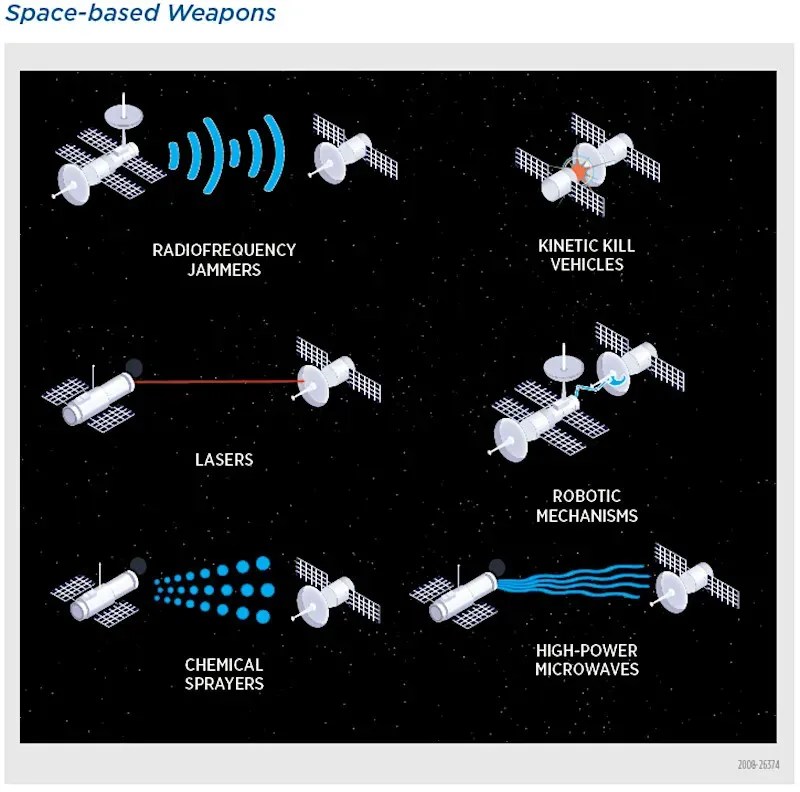
So-called counter-space weapons, as a broad category, are also not limited to space-based capabilities. There are also direct-ascent anti-satellite (ASAT) interceptors launched from the surface and other capabilities deployed from within the Earth’s atmosphere. Prior to today, the only acknowledged anti-satellite weapons the U.S. military had in inventory were ground-based electronic warfare systems. In 2022, under President Joe Biden, the U.S. government had announced a self-imposed moratorium on destructive direct ascent anti-satellite weapons testing. Still, this would not have precluded development of those capabilities using other means, and it’s not even clear if that policy is still in place.
It is important to further note here that plans for new space-based anti-missile interceptors are at the core of the Trump administration’s Golden Dome missile defense initiative.
There is certainly no debate about the absolutely vital role that space-based capabilities – including early warning, general intelligence gathering, weapons guidance, near-real-time communications, and more – play in U.S. military operations today. Similarly, it is well-established at this point that America’s principal global competitors and potential adversaries, especially China and Russia, have been actively developing and fielding increasingly more threatening anti-satellite capabilities. China’s People’s Liberation Army (PLA) has also been dramatically expanding its own space-based capabilities, steadily eroding the U.S. military’s historic dominance in this domain and presenting new threats to U.S. forces.
“From the broadest perspective, maybe the most critical characteristic of the responsive and adaptive national security space architecture called for in the President’s Ensuring American Space Superiority executive order is that survivability matters at least as much as performance,” U.S. Space Force Gen. Stephen Whiting, head of SPACECOM, said in August at the annual Space & Missile Defense (SMD) Symposium. “In space, there is no safe harbor. You can’t dig a trench or build a shield. Our satellites are consistently or predictably in an opponent’s weapons engagement zone. And we can build the most high-performing, exquisite satellites in human history, but if they depend on fragile, targetable supporting infrastructure, their performance will drop to zero on the first day of the next war.”

Whiting publicly declared at that time that having “credible, acknowledged” options for countering enemy capabilities in space, to include damaging or even destroying them, was a key priority for deterring hostile action and surviving if a major fight in orbit were to break out.
“Protective measures on satellites is just like thinking about protective measures on aircraft, okay? And we’re working through that,” Lt. Gen. Gregory Gagnon, head of the Space Force’s Combat Forces Command (CFC), also told TWZ and others more recently at a roundtable at AFA’s Warfare Symposium back in February. “I won’t provide specifics, because I want those protective measures to work, right? I don’t want to tell Beijing and Moscow what I’ve done.”
“But protecting and defending satellites can’t simply be done by protect and defend. You can’t run away from a bully forever. Sometimes you got to turn around and punch,” Gagnon continued. “So protect and defend, although necessary, is insufficient to deliver space control. We also need, as part of our joint force, the ability to attack.”

Meink’s remarks today put Gagnon’s prior comments, in particular, in a whole new light.
The Secretary of the Air Force’s new disclosure has prompted additional questions beyond just what actual weapon systems the U.S. military has actually fielded in space. There are long-standing concerns about the potentially wide-reaching ramifications of increasingly weaponizing space. As Meink himself noted today, space-based communications and other capabilities are increasingly central to daily life, in general, and widespread, long-term disruption could have serious negative economic and other impacts.
At the roundtable today, Meink pushed back on a question about these concerns, citing Chinese and Russian anti-satellite developments.
“Is there a question in the room by anybody about whether or not the Chinese and Russians have been developing these sorts of weapons?” he said. “We are focused on making sure we can protect ourselves and operate in that environment.”
“Depends on where you sit, right, you know? But to say that it’s the responsibility for the U.S. government to protect its citizens from emerging threats makes perfect sense to me,” now-retired Chief of Space Operations Gen. Chance Saltzman said last year when asked a similar question in the context of the Golden Dome initiative’s plans for space-based interceptors. “And we clearly see a country like the PRC [People’s Republic of China] investing heavily in these kinds of threats, whether it’s hypersonic [weapons], whether it’s threats from space. And so now it’s time for the U.S. government to step up to the responsibilities to protect American citizens from those threats.”
Though many questions remain, it is now clear that the U.S. military is not just planning to, but has already fielded at least some weapon systems in orbit as the threat ecosystem outside the Earth’s atmosphere continues to expand and evolve.
See: Original Article


