
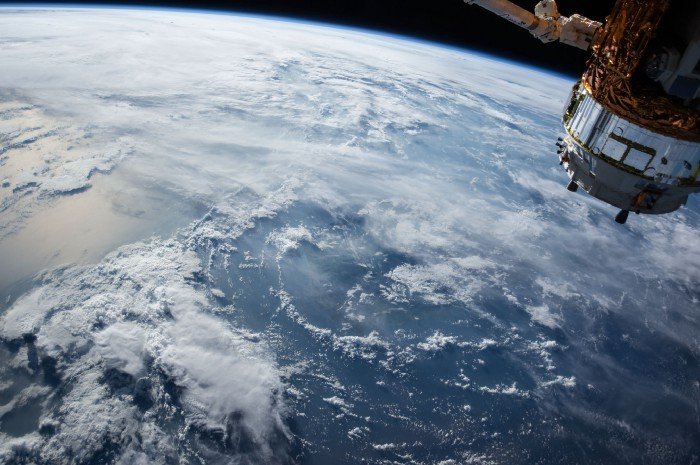
Photo by NASA on Unsplash
By Daniel Frostwick,
Published by Blackburndrone, 23 January 2026
On the screens inside ESA’s control room, the orbits look clean and calm. Thin blue lines wrapping around Earth, a silent ballet of hardware and code. Then a technician zooms in on a weather satellite’s trajectory and the line twitches, dipping a few kilometers lower than expected. Nobody gasps, nobody panics, but the room goes slightly quiet in that way people do when they’ve just realized something is off.
Outside, the sky looks perfectly normal. The air feels the same. Yet far above the planes and clouds, the invisible skin of our planet — the upper atmosphere — is shrinking faster than anyone seriously planned for. And the satellites we rely on every hour of every day are already feeling it.
Something up there is changing, quietly and quickly.
The sky above the sky is thinning — and satellites are slipping
If you could ride an elevator 400 kilometers straight up, past the last wisps of breathable air, you’d arrive in a place engineers call “the edge of space” and physicists call the thermosphere. It’s ghostly thin, more like a mist of atoms than air, yet it tugs on every satellite that passes. That high, even a little less atmosphere makes a big difference.
Scientists watching this region are now seeing that ghostly mist fading, centimeter by centimeter, year after year. The upper atmosphere is literally thinning. Orbital paths that used to behave like well‑known highways are starting to look slightly warped, and the satellites riding them are drifting in ways models didn’t fully predict.
You can see the impact in the data logs from missions like ESA’s Swarm or NASA’s CHAMP and GRACE, which have been acting like flying barometers for the past two decades. These satellites measure atmospheric drag along their path, and the numbers have been steadily dropping. Less drag means they stay higher for longer, which sounds like good news… until you realize debris stays longer too.
One European research team recently compared today’s thermosphere density with that of the early 2000s. They found drops of up to 20–30% at some altitudes. In orbital mechanics terms, that’s not a gentle trend. That’s a different world.
What’s going on is a mix of solar mood swings and human chemistry. When the Sun is quiet, the upper atmosphere cools and contracts. On top of that, greenhouse gases like CO₂ don’t just warm the ground; they also radiate heat away in the upper atmosphere, causing it to cool and shrink. So while we talk about a warming planet, the very top of that planetary blanket is chilling and thinning out.
*The result is a kind of slow, planetary exhale — except the air doesn’t come back in the same way.*
How a thinner exosphere quietly rewrites the rules of orbit
For satellite operators, the thinning upper atmosphere means one thing above all: the old playbook needs rewriting. Traditionally, low‑Earth orbit missions budgeted fuel to periodically “reboost” their altitude, fighting against drag that steadily pulled them down. With less drag, they drift more gently, which shifts the rhythm of these orbital maintenance burns.
That might sound like a subtle scheduling change. In reality, it ripples through design, cost, and risk calculations. A few kilometers’ difference in altitude over time can alter when a satellite passes overhead, how precisely it can image a city, or when a phone can ping a satellite internet constellation.
Think of Starlink, OneWeb, and the coming Amazon Kuiper fleet: tens of thousands of small satellites packed into low orbit like a rush‑hour train. Their positions are calculated using detailed models of atmospheric drag, collision risk, and debris behavior. As the upper atmosphere thins, the drag term in those equations changes.
That means old lifetime estimates suddenly look too pessimistic for some satellites and too optimistic for junk that was supposed to fall back faster. Debris from past missions — bolts, panels, even dead satellites — now lingers longer at certain heights, subtly raising the chance of collisions. Nobody feels that on the ground, but the engineers watching radar screens see the number of “conjunction alerts” ticking upward.
There’s a plain‑truth angle here: **our entire space infrastructure was built assuming the sky above the sky would stay roughly the same**. It hasn’t. As the thermosphere shrinks, the thin drag that used to act as a natural cleaning service for low‑orbit junk is losing some of its power. The same phenomenon that lets modern satellites live longer can let dangerous debris live longer too. That tension is now at the heart of every quiet conversation in orbital‑safety circles.
How agencies and companies are scrambling to adapt in real time
The most practical response right now is annoyingly unglamorous: better modeling. Space agencies and private operators are feeding new density data into their orbital prediction tools almost constantly. When a satellite like Swarm or the International Space Station flies through a patch of thinner air, those fresh readings get folded into the models that tell everyone else where they’ll be next week, next month, next year.
For companies planning new constellations, this means designing orbits with more flexibility. More fuel for maneuvers. More robust collision‑avoidance systems. More room between orbital “shells” so that small model errors don’t turn into traffic jams at 550 kilometers up.
We’ve all been there, that moment when you realize your assumptions were off and you’ve been planning on the wrong baseline. That’s essentially what’s happening to space traffic managers today. Old spreadsheets that described drag at certain altitudes now have big asterisks on them.
One common mistake is to see “less drag” and think “less worry.” In reality, it’s more like swapping one type of risk for another. Yes, satellites stay up longer with less fuel. At the same time, dead hardware and paint flakes also hang around, and every extra day in orbit is another chance for an unlucky hit. Let’s be honest: nobody really runs their risk scenarios every single day — yet this is starting to feel like the kind of environment where you might have to.
The people working closest to this describe it in very human terms.
Space used to feel empty,” a flight dynamics engineer at a European operator told me. “Now it feels like a shared highway in fog, and the fog itself is changing thickness while you drive.”
To cope, agencies are quietly shifting their standards:
- New satellites are expected to deorbit more actively, not just “wait to fall”.
- Operators are sharing tracking data more freely to reduce collision blind spots.
- Debris‑removal missions, once a niche idea, are moving into funded reality.
- Future designs factor in a variable atmosphere, not a fixed one.
All of this effort, just to keep those silent dots above us following lines we can trust.
A planet that warms below and thins above
Once you see this double reality — a warming lower atmosphere and a thinning upper one — you can’t really unsee it. The same greenhouse gases that trap heat near the surface are helping cool the air hundreds of kilometers up, changing the way space itself behaves around Earth. It’s not a sci‑fi twist. It’s just physics, playing out over decades instead of movie minutes.
In a way, the satellites feeling this shift are both victims and witnesses. They’re hurt by the changing drag, yet they’re also the tools that revealed it. Their wobbles, their tiny orbital glitches, are the clues scientists followed to understand what the thermosphere is quietly doing.
For anyone living below — which is all of us — the story is still strangely intimate. GPS timing, satellite TV, global weather forecasts, crop monitoring, disaster alerts, even ATM transactions lean on those metal dots up there behaving predictably. When their environment gets less predictable, our routines down here become just a little more fragile, even if we don’t notice it right away.
**The upper atmosphere is no longer just a backdrop for auroras and astronaut photos; it has become a shared infrastructure zone we are accidentally reshaping.**
This is not a neat story with a clean ending. The Sun will ramp up and down, as it always has. Human emissions may rise or fall, slowly bending the arc of this long atmospheric thinning. Space agencies will adapt, companies will update their software, and your smartphone’s blue dot will keep snapping to your location on the map.
Yet somewhere above that screen in your hand, a satellite is flying through air that’s a little thinner than its designers once expected. Its orbit is a quiet, ongoing reminder that the boundaries of our world are not fixed. They breathe, they shift, and they answer to us more than we once believed.
| Key point | Detail | Value for the reader |
|---|---|---|
| Thinning upper atmosphere | Thermosphere density has dropped up to 20–30% at some altitudes | Helps explain why satellite behavior and space‑debris risks are changing |
| Impact on satellites | Less drag extends satellite lifetimes but also keeps debris in orbit longer | Reveals hidden vulnerabilities in GPS, internet, and weather services |
| Human link | Greenhouse gases warm the surface while cooling and shrinking the upper layers | Connects everyday climate choices to the future of space traffic and safety |
FAQ:
- Question 1 What does “thinning upper atmosphere” actually mean?
Scientists are seeing fewer gas particles per cubic meter in regions like the thermosphere, so the air is less dense than it used to be at the same altitude.- Question 2 Is this dangerous for people on the ground?
Not directly; you won’t feel anything in daily life, but services you rely on — GPS, communications, weather data — depend on satellites affected by these changes.- Question 3 Why does global warming cool the upper atmosphere?
Greenhouse gases trap heat down low while also radiating energy away higher up, which leads to cooling and contraction in those thin outer layers.- Question 4 Will satellites start falling out of the sky?
No sudden rain of satellites is expected; the real issue is changed lifetimes, altered orbits, and a higher persistence of space debris.- Question 5 Can anything be done about this trend?
Reducing greenhouse‑gas emissions over time can ease the long‑term thinning, and better space‑traffic management, active deorbiting, and debris‑removal missions can reduce the risks in orbit.
See: Original Article


