
Opportunity Rover
By Jeff Foust,
Published by Space News, 7 November 2026
WASHINGTON — NASA is moving forward with plans to convert an engineering model of a Mars rover into one that will go to the moon in 2028.
At a Nov. 7 briefing, NASA announced it would send to the moon the Polar Rover for Observation, Mapping, and In-Situ Exploration, or PROMISE. The rover would go to the south polar regions of the moon to characterize the surface and look for resources such as water ice.

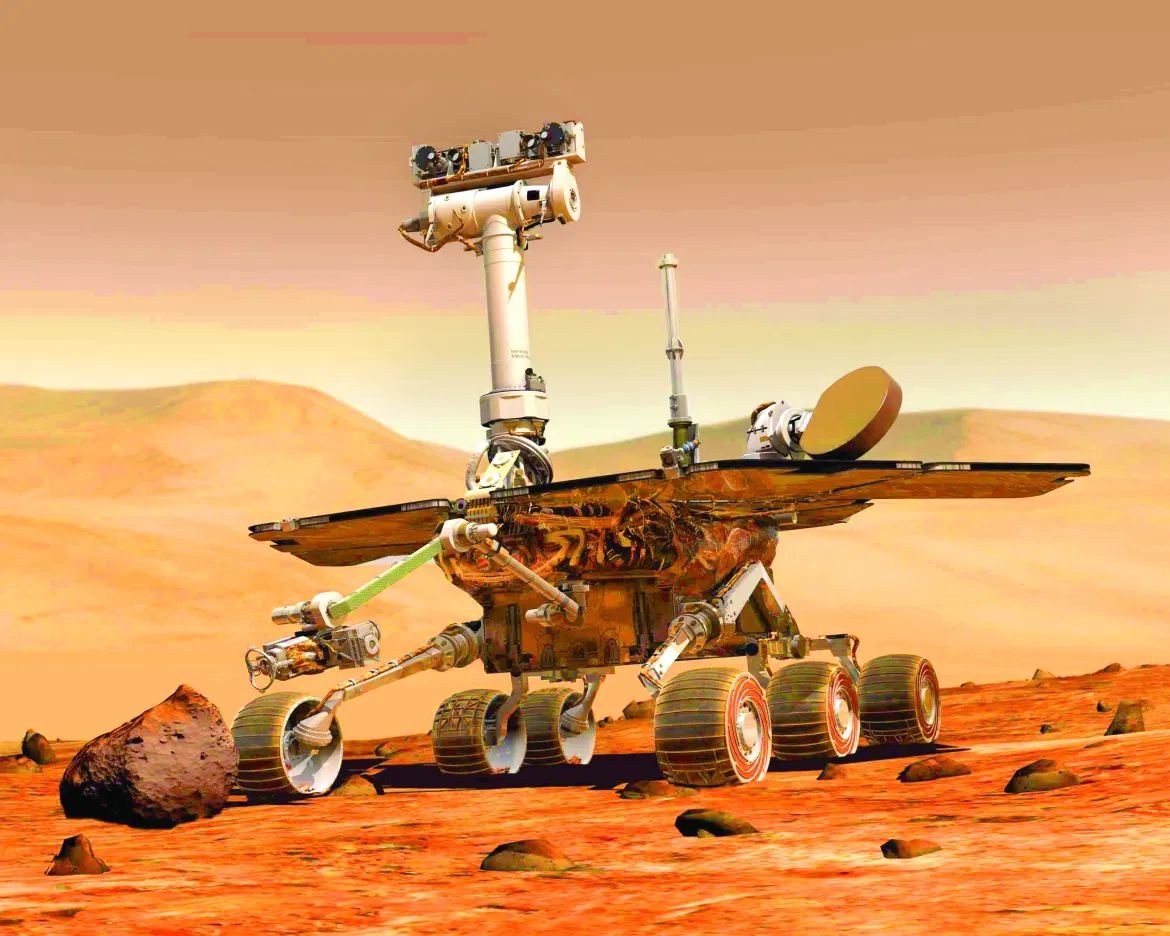
PROMISE will use an engineering test model of the Curiosity and Perseverance rovers currently at NASA’s Jet Propulsion Laboratory. NASA announced in June it was studying whether that engineering model could be adapted into a rover that can operate on the moon.
“We’ve been studying: Can we give it a new paint job? Can we put on new electronics? Would this actually work on the moon?” Carlos García-Galán, manager of NASA’s Moon Base program, said at the briefing.
PROMISE will be sent to the moon on the fifth Blue Origin Mark 1 cargo lander, scheduled for late 2028. JPL will handle rover operations for an 18-month prime mission.
“I could not be more excited about NASA’s PROMISE rover,” said Nicky Fox, NASA associate administrator for science, at the briefing. The rover “will characterize the lunar surface and subsurface, assess resource potential and provide critical data to enable future infrastructure and exploration activities.”
PROMISE will carry a suite of eight science instruments, including cameras, spectrometers and a drill designed to extract material from up to a meter below the surface. It will also host technology demonstrations for testing high-performance computing and autonomous navigation, as well as examining how the six-wheeled rover interacts with the lunar regolith.
Some of the instruments assigned to PROMISE are spares of those on another lunar rover, VIPER, going to the moon as soon as next year on another Blue Moon Mark 1 lander. “It’s an amazing opportunity for us because we can do comparisons on different parts of the South Pole using both VIPER and PROMISE,” she said.
One difference is that VIPER has a planned 100-day mission, while PROMISE is designed to work for at least a year and a half. VIPER uses solar power, whereas PROMISE will have a radioisotope thermoelectric generator, or RTG, much like the Mars rovers for which it was an engineering model.
Fox noted the RTG power source “will allow us to explore and conduct science within the moon’s frigid, permanently shadowed regions where sunlight has not reached for billions of years,” regions that could contain water ice.
When NASA announced in June that it was studying PROMISE, some scientists expressed concern that assigning an RTG to it could affect plans to make it available for future planetary science missions, such as the upcoming competition for the next New Frontiers mission.
Matt Wallace, deputy director for flight projects at JPL, said at the briefing that the RTG would use plutonium-238 originally processed for the Cassini mission, launched nearly 30 years ago. “It is degraded in its heat content now, and so it’s less useful for a lot of applications, but it’s perfect for PROMISE,” he said. “PROMISE does not need a lot of electrical power.”
Fox, though, said using that RTG for PROMISE would require development of a replacement for a New Frontiers mission. “We are working with our friends in Human Spaceflight Mission Directorate to look at what the replacement will be that will be able to be used for the next New Frontiers call.”
She added that experts also looked at what using that engineering test rover for PROMISE would mean for Curiosity and Perseverance. Those rovers have used engineering versions to help diagnose issues with the rovers.
The review “concluded that the Curiosity mission could continue with low risk,” she said, but did not specify the risk to Perseverance. She noted there are other engineering test articles available at JPL that could be used for supporting the ongoing Mars rover missions.
García-Galán downplayed any risks to the Mars rovers from developing PROMISE. “We know the type of things that are happening. We normally use that for troubleshooting. We feel pretty comfortable. We don’t need it for that purpose.”
Another issue with PROMISE is its cost. A study this summer by The Planetary Society concluded that PROMISE would cost between $723 million and $1.33 billion, including development, launch and one year of operations. It also concluded the rover would not be ready until the early 2030s.
García-Galán said at the briefing that NASA has a “pretty firm” agreement with JPL to deliver PROMISE for less than $400 million. That includes the rover itself and delivery on the Blue Moon lander.
NASA, in a separate statement, said it awarded Blue Origin a contract with a base value of $94 million and $140 million in options for delivering PROMISE. That would suggest the cost of the rover itself is no more than about $150 million.
“This was not a project to start from scratch,” he said. “It’s not a new start of a new technology project, so we think we can definitely hit that.”
See: Original Article


