
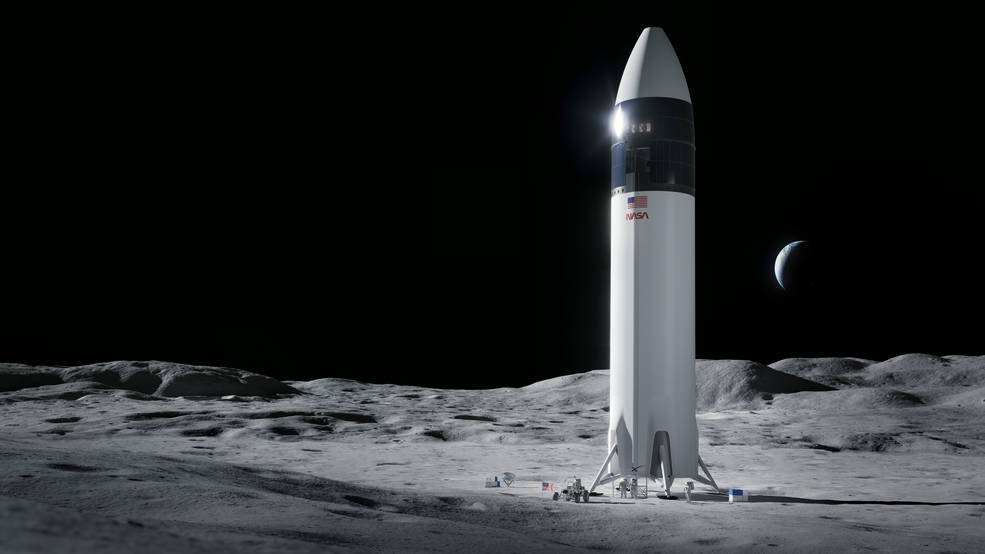
Illustration of SpaceX Starship human lander design that will carry the first NASA astronauts to the surface of the Moon under the Artemis program. Credit: SpaceX
By Daniel Patrascu,
Published by Autoevolution, 25 October 2026
American space agency NASA agains revises the profile of the upcoming crewed missions to the Moon, SpaceX and Blue Origin still to supply the landers.
About half a year ago, American space agency NASA announced it is slowing down the pace of the Artemis Moon exploration program, in a bid to make sure the astronauts who will be traveling to Earth’s natural satellite are safe. Now, the same organization announced the acceleration of the same program.
In an update provided at the end of last week by administrator Jared Isaacman and a number of other agency higher-ups, NASA revealed not only acceleration plans for Artemis, but also a series of changes for the upcoming missions that kind of once again rewrite the game plan.
In essence, the mission goals of the two next flights remain the same: Artemis III will launch next year to Earth orbit to test the two landers made by SpaceX and Blue Origin, while Artemis IV will follow a year after that with an actual Moon landing aided by one of the two commercial landers.
As it stood until last week, SpaceX was to provide its Starship-based human landing system (HLS) for the Artemis III and IV missions, while Blue Origin was to supply the Blue Moon Mark 2 for Artemis V.

In what may appear as a sort of blow to Elon Musk’s space company, NASA now says neither of the companies has been assigned to a specific Artemis lunar landing mission, essentially allowing it to select whichever would be ready first.
Before one of the landers gets to be selected to assist America’s return to the Moon, both of them will have to prove their worth as part of uncrewed demonstration runs. Depending on the results of those missions, which need to happen over the course of the next two years for them to be ready for the planned 2028 lunar landing, NASA will certify one or both of them.
The agency and its private partners have also changed the profile of the Artemis IV and subsequent landing mission. While initially the crews were to launch inside the Orion spacecraft perched on top of the Space Launch System (SLS) rocket, then meet up with their landers in a near-rectilinear halo orbit around the Moon, that’s no longer going to happen.
As per the revised plan, SpaceX and Blue Origin will approach the missions in a different fashion, adapted to the particularities of their own designs. Below you can read all about how these two plan to help astronauts get to the Moon.
SpaceX Starship
The Starship lander being put together by SpaceX will rely heavily on space refueling. The company will launch an undisclosed number of Starship tankers to Earth orbit, which will feed a depot Starship waiting up there.

These will be followed by the Starship HLS, which will link up with the depot and get the precious liquid propellant it needs to carry on with its mission. Once refueled, the HLS will wait for the crew-carrying Orion to join it in Earth orbit.
As soon as the spacecraft reaches the HLS and docks with it, the lander itself will be used to perform a trans-lunar injection burn, sending both itself and the Orion attached to it to the Moon.
Once at their destination, two of the four crew members will move into the HLS and lower themselves to the surface. In the early missions, NASA targets two-hour-long lunar surface Moonwalks, and, once these are done, astronauts would once again climb inside the HLS, dock with Orion, and head back home.
This approach comes with a series of advantages compared to the earlier plan, including flexibility in the crew launch timing on SLS and lowering the amount of fuel the Starship needs.
Blue Origin Blue Moon Mark 2 Alpha
Unlike its competitor, Blue Origin will not refuel the Blue Moon Mark 2 Alpha in orbit. Instead, it will use three transfer stages that will launch into Earth orbit, followed by the lander itself. These bits of hardware will then link up with one another, and then the complete stack departs for an elliptical polar orbit around the Moon.

The Orion spacecraft that carries the Artemis crew would then join it. Once the journey is complete, two astronauts would go down to the lunar surface, do their thing, and then travel back up to return home.
This new way of doing things should allow for faster returns from the lunar surface to Orion, reduced Blue Moon lander propellant requirements, and maximized performance of the SLS rocket.
Both landers, but in a cargo configuration, would also be used to transport stuff to the Moon as the American space agency starts building the permanent Base there. For now, we have no timetable or details on that.
NASA says both companies have set new development milestones for their landers. Before the crewed missions get going, SpaceX would fly two demo missions that will prove, for the first time, the merits of the Starship Cabin 1, where the crew will be located during their journey down to the lunar surface.
Blue Origin, on the other hand, has committed to adding new human-in-the-loop testing and hardware readiness milestones.
See: Original Article


