
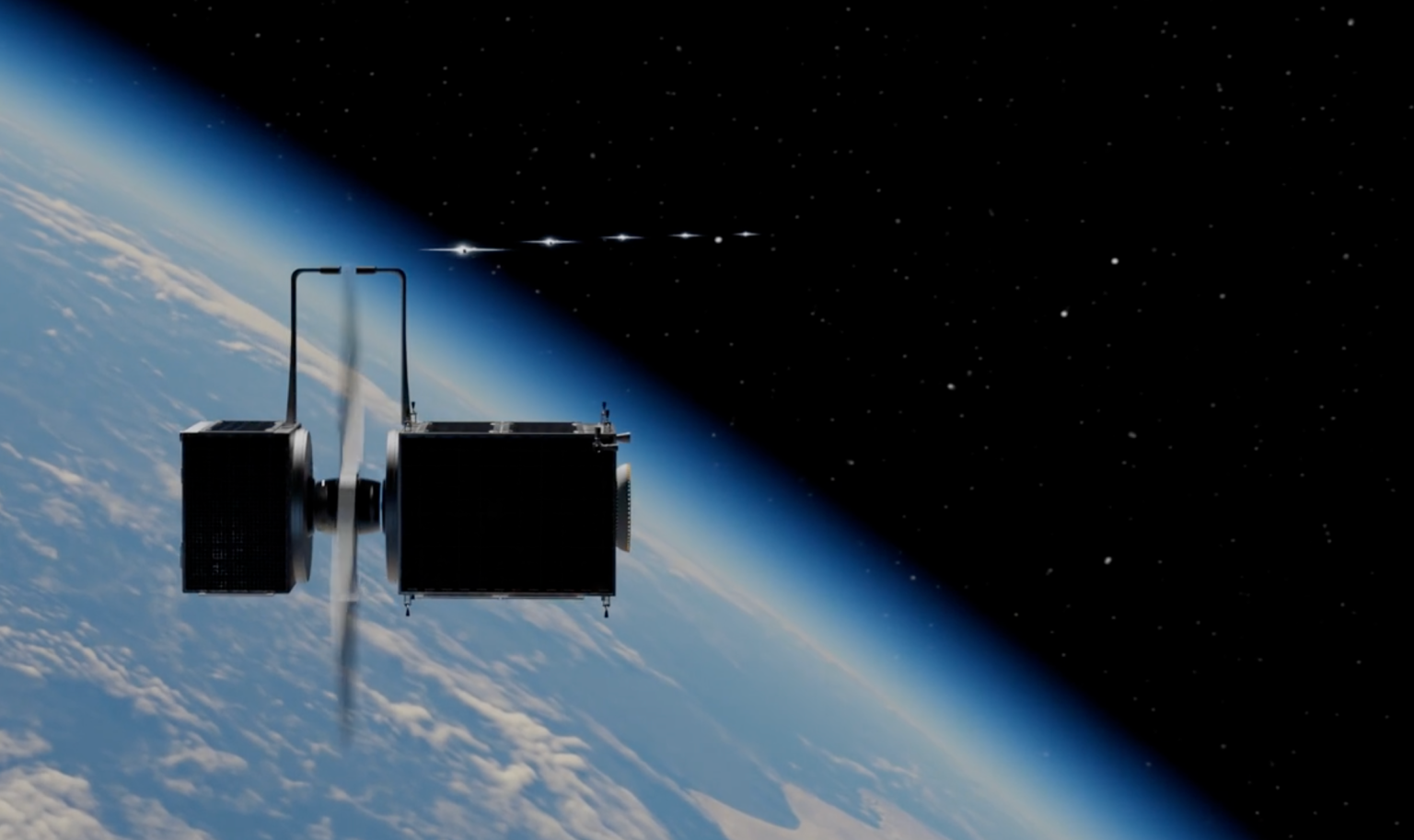
Illustration of Space Kinetic’s Whirlwind satellite deployment system. Credit: Space Kinetic
By Sandra Erwin,
Published by Space News, 7 September 2026
WASHINGTON — The U.S. Space Force is putting $50 million behind a startup developing an unusual way to dispatch small spacecraft from a larger vehicle in orbit.
California-based Space Kinetic is developing Whirlwind, an electromechanical system designed to release small spacecraft from a host vehicle at high velocity. The idea is to give those spacecraft an initial change in trajectory without requiring each one to carry the propulsion and propellant needed to make that maneuver on its own.
Space Kinetic announced Aug. 13 that it received a $50 million Other Transaction Authority agreement from the Space Force to develop the technology. The company describes Whirlwind as a space maneuverability and deployment system built around a “one-to-many” architecture, in which a single host could dispatch multiple smaller vehicles for different missions.
The company is not building a maneuverable satellite bus or space tug but is focusing on the machinery needed to release smaller payloads from a host platform, which could potentially allow the deployed vehicles to be simpler and cheaper. The broader concept is to make orbital maneuver less dependent on putting a dedicated propulsion system on every vehicle that may need to move.
The company’s technology is still being matured. Space Kinetic hasn’t disclosed when Whirlwind will be demonstrated in orbit, and has not identified host spacecraft or companies that could eventually integrate the system.
“They are currently focused on maturing the technology and have also started initial conversations about integration with partners,” said Abhi Mukherjee, a partner at the venture-capital firm CIVC, an early investor in Space Kinetic and an adviser to the company.
The $50 million figure represents the value of the prototype agreement, not necessarily money paid to Space Kinetic upfront. Pentagon prototype agreements are usually structured around negotiated milestones, deliverables and other payment events.
Space Kinetic was founded in 2022 by Scott Ziegler and Ryan Sullivan. The company’s early technology was developed through New Mexico’s Lab-Embedded Entrepreneurship Program, which works with Los Alamos National Laboratory. Space Kinetic raised a $12 million seed round in 2025 and has since focused on national security applications.
Space Kinetic has considered commercial applications that include mechanically moving cargo or excavated material in cislunar space. But defense applications are now a larger part of the company’s strategy, Mukherjee told SpaceNews.
In November 2025, the Defense Advanced Research Projects Agency awarded Space Kinetic a multimillion-dollar contract to develop what the company calls an “asymmetric space-based missile defense” architecture based on the company’s “one-to-many” concept.
For missile defense, that could potentially alter the economics of positioning interceptors or other defensive payloads by shifting some of the propulsion, mass and complexity from each deployed vehicle to the host.
Mukherjee said the Whirlwind technology could be applied to the Pentagon’s Golden Dome missile defense architecture that envisions deploying interceptors in space, as well as broader “dynamic space operations.”
Mukherjee said Space Kinetic will ultimately need to work with companies that can provide orbital infrastructure on which Whirlwind can be integrated.
He said the scale of the Space Force agreement reflects government interest that developed over time.
“This conversation has been going on for quite a while,” he said. “Looking at what Space Kinetic has developed, there is an active interest in having Space Kinetic develop this Whirlwind system, and that’s why this $50 million OTA contract was awarded.”
See: Original Article


