What the Anduril explosion tells New Mexico
By Elaine Cimino,
Published on Substack 14 July 2026
The Anduril Explosion Wasn’t Just an Industrial Accident—It Was a Warning About What Responsible Governments Should Do Before the First Static-Fire Test
The lesson isn’t that every rocket motor facility will explode. The lesson is that governments should prepare for the possibility before operations begin—not after. This is not what happened in New Mexico. Laws were broken and there is no accountability for it.
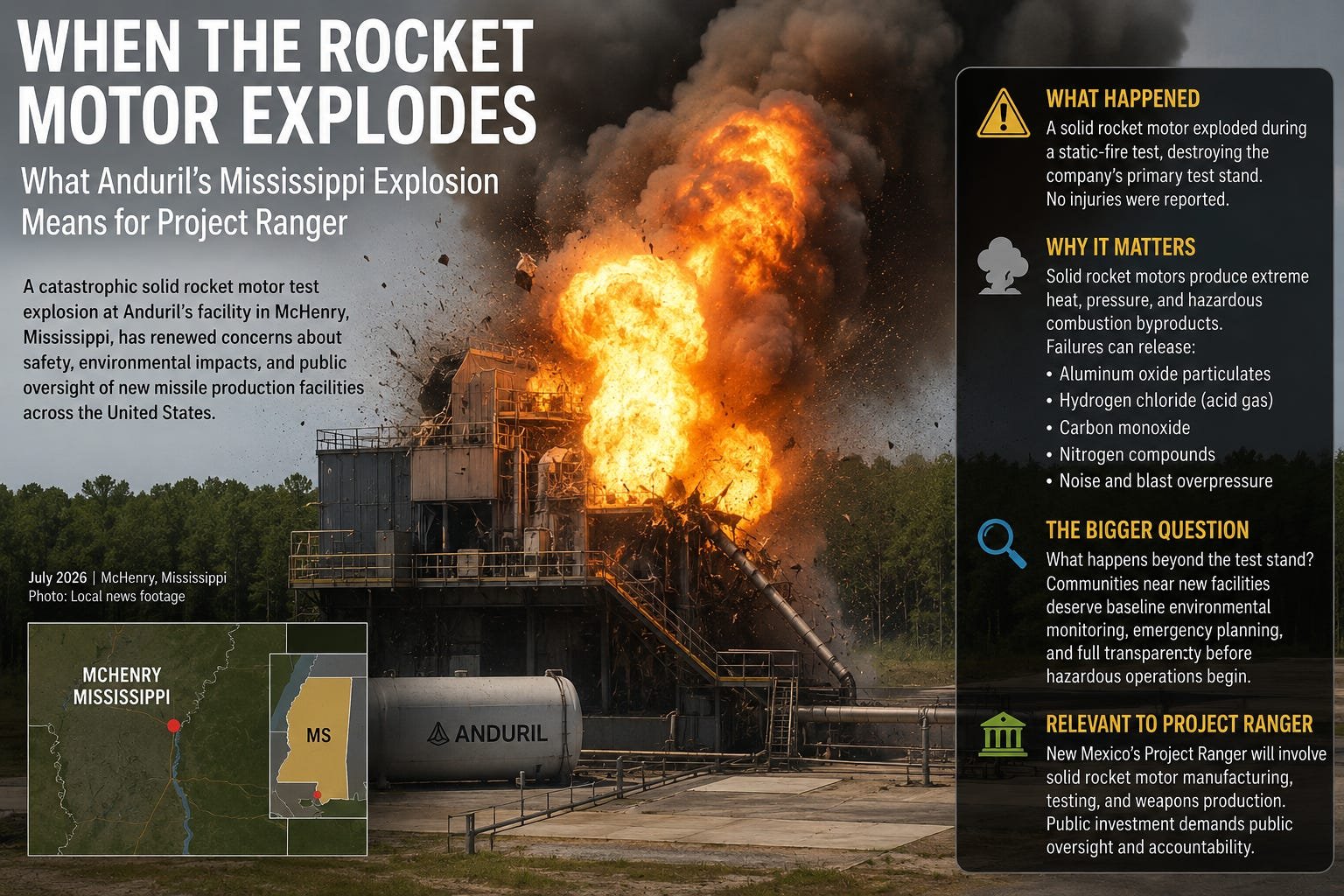
When a solid rocket motor exploded during a static-fire test at Anduril’s facility in McHenry, Mississippi, no workers were injured. Safety systems reportedly functioned as intended, but the blast destroyed the company’s primary test stand and interrupted portions of its rocket motor development program. While the incident is now under investigation, it offers an important reminder that solid rocket motor manufacturing remains one of the most hazardous industrial processes in modern aerospace.
For communities facing similar facilities, the Mississippi explosion is not simply another defense industry story. It is a warning about why transparency, environmental monitoring, and emergency planning must come before production—not after an accident.
That lesson is directly relevant to New Mexico’s Project Ranger.
Project Ranger is being developed to manufacture and test solid rocket motors and hypersonic weapons systems. Public records obtained through New Mexico’s Inspection of Public Records Act (IPRA) include an unredacted Sandia National Laboratories hazard assessment recognizing the potential for blast overpressure, hazardous combustion products, contaminated runoff, and the need for drainage studies, plume analysis, and retention of contaminated test runoff before hazardous operations begin. These recommendations were not theoretical; they reflected the known hazards associated with solid rocket motor testing.
The Anduril explosion demonstrates why those recommendations matter.
It is also important to recognize that Project Ranger and Anduril are not isolated companies operating in completely separate worlds. Public reporting shows that many engineers, executives, and technical personnel move within the same rapidly growing defense technology ecosystem, where experience with solid rocket motors, hypersonic systems, and advanced weapons programs is shared across companies. We do not have access to the proprietary engineering designs, manufacturing processes, or safety systems that distinguish Castelion’s facilities from Anduril’s, and no one should assume they are identical. However, they draw from many of the same technical disciplines, talent pools, investors, defense customers, and industrial networks. For that reason, when one company experiences a significant solid rocket motor testing failure, it provides an opportunity for regulators, policymakers, and communities to examine whether the broader industry’s safety practices, environmental monitoring, emergency planning, and public transparency are adequate before similar facilities begin hazardous operations elsewhere.
Solid rocket motors differ fundamentally from liquid-fueled rockets. Once ignited, the propellant cannot simply be shut off. If combustion becomes unstable, if the motor casing fails, or if internal pressure exceeds design limits, the result can be catastrophic. Engineers understand these risks. That is precisely why static-fire testing exists.
The question for nearby communities is different.
What happens outside the test stand?
An abnormal rocket motor event can generate blast overpressure, fragments, aluminum oxide particulates, combustion gases, and—depending on the propellant formulation—hydrogen chloride and other hazardous byproducts. Whether contaminants leave the site depends on many variables, including weather, terrain, engineering controls, and the nature of the failure. Those questions can only be answered through environmental monitoring.
That is why Common Ground Rising recently asked the New Mexico Environment Department to develop a comprehensive pre-operational environmental monitoring program before hazardous operations begin at Project Ranger. The request includes baseline monitoring of air, groundwater, surface water, stormwater, soil, sediment, and noise, along with event-based sampling during static-fire tests. It also asks that nearby municipal water supplies be incorporated into any long-term monitoring network and that environmental data be released publicly whenever practicable.
This request is not based on speculation that contamination will occur.
It is based on a simple scientific principle.
If no baseline data exist before testing begins, it becomes extraordinarily difficult to determine whether environmental conditions changed afterward. Regulators, companies, and communities all benefit from knowing what conditions existed before operations commenced.
The Mississippi explosion also illustrates another reality often overlooked in public discussions. Industrial accidents do not have to produce mass casualties to have significant consequences. They can damage infrastructure, interrupt production, require expensive investigations, and raise legitimate public questions about engineering, oversight, and emergency preparedness.
The Defense Investment Ecosystem Behind Project Ranger
The Anduril explosion also illustrates why Project Ranger should not be viewed in isolation. Castelion is part of the same rapidly expanding defense technology ecosystem that includes venture capital firms, AI companies, aerospace startups, and Pentagon contractors pursuing hypersonic weapons, autonomous systems, and missile production. One of Castelion’s principal investors is Lightspeed Venture Partners, a firm whose portfolio also includes major defense technology companies such as Anduril. New Mexico’s State Investment Council (SIC) has committed public pension capital to Lightspeed and other venture capital managers investing across this AI-defense sector. While the SIC is not a direct investor in Castelion, public retirement funds are flowing into investment managers that finance the broader ecosystem in which companies like Castelion and Anduril operate.
The timing of New Mexico’s public actions is also noteworthy. In August 2025, Castelion representatives were present during the State Investment Council meeting at which additional venture capital commitments—including commitments to Lightspeed—were approved. That same day, the Sandoval County Commission approved up to $125 million in Industrial Revenue Bonds for Project Ranger. In the months that followed, the State Land Office finalized the Project Ranger lease in September 2025, followed by LEDA agreements and additional public approvals. Yet during this period, public statements often suggested that key decisions regarding the project were still under consideration. Regardless of how those statements are interpreted, the sequence of events raises legitimate questions about how far the project had already advanced before the public understood the full scope of the approvals.
None of this establishes that Anduril’s engineering designs or safety systems are the same as Castelion’s. They are separate companies with proprietary technologies. The connection is financial, institutional, and industrial. They share overlapping venture capital, defense customers, engineering talent, and participation in the same national effort to rapidly expand domestic missile production. That is precisely why lessons learned from one company’s rocket motor testing program are relevant to evaluating oversight, environmental monitoring, emergency planning, and public accountability for another.
Those questions deserve answers before similar operations begin elsewhere.
Castelion’s Project Ranger has received substantial public support through New Mexico’s Local Economic Development Act (LEDA). Sandoval County and the City of Rio Rancho approved millions of dollars in public assistance, including funding for land acquisition and expansion of Paseo del Volcán to support the facility. The project agreements emphasize job creation and economic development while committing public resources to the project.
Public investment carries public responsibilities.
Communities have a right to know how emergency response will function if a catastrophic event occurs. They deserve to understand how nearby groundwater, municipal wells, air quality, and surrounding neighborhoods will be monitored. They deserve access to environmental data rather than relying on assumptions after operations begin.
None of these questions are anti-industry.
They are the same questions responsible governments ask before permitting chemical plants, refineries, hazardous waste facilities, or other industries handling dangerous materials.
There is no comprehensive public database documenting every explosion at solid rocket motor test facilities. However, the historical record demonstrates that catastrophic fires, explosions, and static-test failures have occurred repeatedly throughout the history of the U.S. rocket and missile industry.
The defense sector should not be exempt simply because national security is invoked.
The Anduril accident is not being used to claim that Project Ranger will experience a similar failure. Every facility has different designs, engineering controls, operating procedures, and safety systems.
But the explosion does establish something important.
Even well-funded defense contractors employing experienced engineers can experience catastrophic failures during solid rocket motor development.
That reality strengthens—not weakens—the case for independent environmental monitoring, transparent emergency planning, and meaningful public oversight before hazardous operations begin.
The opportunity to establish baseline environmental conditions exists only once.
After the first static-fire test, that opportunity is gone forever.
Author’s Note: This article does not suggest that Castelion’s engineering designs, manufacturing processes, or safety systems are identical to Anduril’s. Rather, it argues that both companies participate in the same rapidly expanding defense technology ecosystem, supported by overlapping venture capital, public investment, engineering talent, and federal defense priorities. The discussion focuses on governance, environmental oversight, and public accountability—not on assumptions about proprietary technologies.
Endnotes
1. Amanda Hoover, “Anduril’s Missile Factory Explosion Raises Questions About Rocket Motor Production,” WIRED, July 2026. Discusses the static-fire explosion at Anduril’s McHenry, Mississippi, facility, the damage to the test stand, company statements, and interviews regarding production challenges. https://www.wired.com/story/anduril-mississippi-explosion-missiles-rocket-motor/
2. National Aeronautics and Space Administration (NASA), Large Solid Rocket Motor Test Capability Assessment, NASA Technical Reports Server (NTRS), 2011. Reviews U.S. solid rocket motor testing infrastructure and the engineering requirements for conducting static-fire testing.
https://ntrs.nasa.gov/citations/20110009993
3. National Aeronautics and Space Administration (NASA), Solid Rocket Launch Vehicle Accident and Failure History, NASA Technical Reports Server (NTRS), 2015. Reviews historical solid rocket motor failures and lessons learned from decades of propulsion testing.
https://ntrs.nasa.gov/citations/20150002613
4. Presidential Commission on the Space Shuttle Challenger Accident (Rogers Commission Report), 1986. The definitive investigation of the Space Shuttle Challenger disaster and solid rocket booster joint failure.
https://history.nasa.gov/rogersrep/genindex.htm
5. U.S. Environmental Protection Agency, Perchlorate. EPA technical information describing perchlorate contamination associated with solid rocket propellants, munitions, and aerospace manufacturing.
https://www.epa.gov/sdwa/perchlorate-drinking-water
6. Agency for Toxic Substances and Disease Registry (ATSDR), Toxicological Profile for Perchlorates. Reviews environmental persistence, groundwater contamination, and human health effects.
https://www.atsdr.cdc.gov/toxprofiles/tp162.pdf
7. Agency for Toxic Substances and Disease Registry (ATSDR), Hydrogen Chloride (HCl) Medical Management Guidelines. Describes health effects associated with hydrogen chloride exposure.
https://wwwn.cdc.gov/TSP/MMG/MMGDetails.aspx?mmgid=758
8. Sandoval County and Project Ranger LLC, Project Participation Agreement (LEDA), November 1, 2025. Establishes the public financing, job commitments, infrastructure funding, and Project Ranger obligations.
3609_PPA_Castelion_LEDA_(10.17.25)-176659380-v7.pdf
9. Sandoval County and City of Rio Rancho, Intergovernmental Agreement, November 2025. Documents the City and County funding commitments for expansion of Paseo del Volcán supporting Project Ranger.
3609_SandCo_Ranger_LEDA_City_IGA_(10.17.25)-177094276-v2.pdf
10. Elaine Cimino, Request for Pre-Operational Air, Water, Soil, and Noise Monitoring Plan for Project Ranger, submitted to the New Mexico Environment Department, July 5, 2026. Requests baseline environmental monitoring before hazardous operations begin, including air, groundwater, stormwater, soil, sediment, perchlorate, and noise monitoring.
Letter for monitoring NMED 2.pdf
11. Sandia National Laboratories Hazard Analysis for Project Ranger (obtained through the New Mexico Inspection of Public Records Act). The unredacted report discusses combustion byproducts, runoff retention, plume analysis, drainage considerations, and explosive hazard planning associated with Project Ranger. (Cite the specific IPRA document in your files.)
12. New Mexico State Investment Council, August 2025 meeting materials and investment approvals. Documents venture capital commitments, including commitments to Lightspeed Venture Partners. (Cite the SIC meeting agenda and minutes if you reference this directly.
13. Lightspeed Venture Partners portfolio information identifying investments in Castelion and Anduril. Use Lightspeed’s official portfolio page or announcements to document the investment relationship.
See: Original Article