
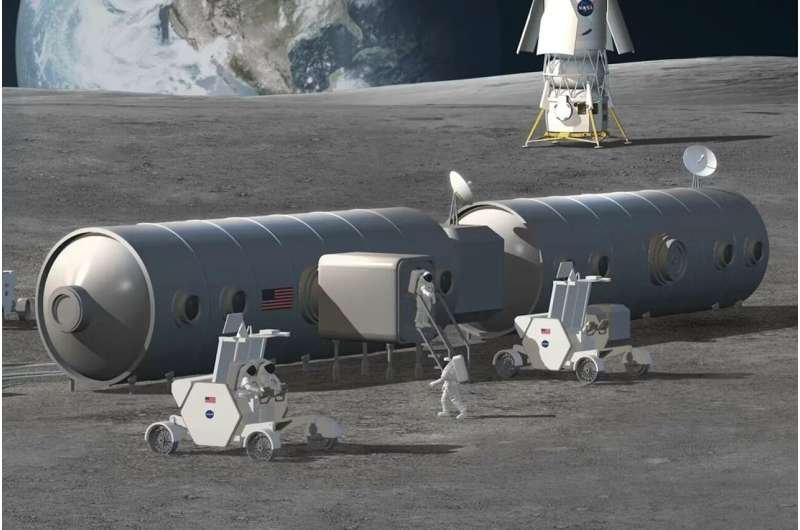
Lunar base concept released by NASA in February 2026. Credit: NASA
By Kevin Olsen, Fiona Henderson, The Conversation
Published by phys.org, 12 March 2026
A US Senate committee has directed NASA to begin work on a moon base “as soon as is practicable.” Under legislation advanced by the Senate lawmakers, the outpost would serve as a science laboratory and proving ground, where astronauts would develop the capabilities to live and work beyond Earth’s orbit.
A recent executive order issued by the White House directs NASA to establish the initial elements of a permanent moon base by 2030.
Since 2017, Artemis has been the NASA-led program working towards a sustained human presence on the moon. This year, it will send astronauts around the moon for the first time in more than half a century. And following a shake-up of Artemis announced in late February, the space agency plans to greatly increase the frequency of Artemis missions and return humans to the lunar surface in 2028.
A vote will now decide whether Senate legislation, known as the NASA Authorization Act of 2026, is passed to Congress, where a second bill is also circulating. The bills, which both break down this year’s funding for specific NASA programs, will be reconciled and voted on in both houses to become law.
Underlying some of the announced changes is a deepening concern in Congress and the current administration about the challenge posed by rival powers to US leadership in space. A Chinese–Russian led moon outpost known as the International Lunar Research Station is under development. A one-page summary accompanying the Senate bill calls for a US base “so we can get there before the Chinese” and to “dominate the moon, control strategic terrain in space, and write the rules of the 21st century.”
Site selection
The American habitat will be located at the moon’s south pole, a strategically important location which harbors valuable resources such as water ice. The water could support habitation systems at a lunar outpost and be turned into rocket propellant for onward exploration.
Where exactly the base is located will depend on the terrain, how much sunlight the site receives, how extreme the temperatures are, how easily astronauts can communicate with Earth and their access to resources such as water. The rim of a 21km-wide depression known as Shackleton Crater (which may hold abundant ice deposits) and a flat-topped mountain called Mons Mouton are among the leading candidates. The leading locations combine several favorable factors.
At high latitudes, such as the lunar poles, elevated crater rims can receive near-constant solar illumination. This makes them more thermally favorable than many sites at the equator, providing a consistent supply of solar power. However, the strategic value of these sites lies in what are called permanently shadowed regions (PSRs). These impact craters, untouched by sunlight for billions of years, are believed to contain water-ice deposits.
While the south pole remains a primary focus in upcoming missions, other targets near the equator, such as Marius Hills and Mare Tranquillitatis, offer alternative advantages. These regions feature massive underground lava tubes formed by ancient volcanic activity that can act as natural shields against solar radiation and micrometeorite bombardments. They could insulate human outposts against extreme swings in temperature: from 127°C to -173°C.
The interiors of lunar lava tubes are estimated to remain at about 17°C year-round, making them ideal sites for human bases. However, unlike at the lunar poles, water in these regions is typically trapped as molecules within volcanic glass beads or minerals. Extracting this water to sustain human activities would require intensive heating and significant technological development.
See: Original Article


