
Image source: Blacklisted News
Published by Military Watch Magazine, 27 February 2026
The head of the U.S. Space Force Combat Forces Command Lieutenant General Gregory Gagnon has stressed the importance of being able to attack and destroy Chinese satellites and other space assets, as a core part of achieving what he referred to as “space superiority.” “Protecting and defending satellites can’t simply be done by protect and defend. You can’t run away from a bully forever. Sometimes you got to turn around and punch,” he stated, adding: “protect and defend, although necessary is insufficient to deliver space control. We also need, as part of our joint force, the ability to attack.” He stressed that the ability of the Chinese satellite network to bolster situational awareness had become tremendous, indicating that blinding Chinese forces by taking out space-based sensors could be vital to U.S. strategies in future.
 China Launches First Reusable Rocket ZhuQue-3
China has built “the second-best remote sensing architecture in the world from outer space, and that’s now what they have,” according to Gagnon. He added: “So when 2013 started, and he came to power, he had less than 100 satellites that were the total of what China had in outer space. They have about 1,900 today. Over 500 of those satellites are remote sensing satellites, which are purposely designed and networked to track mobile forces such as U.S. carriers, destroyers, and cruisers in the Pacific, as well as aircraft that deploy around the Pacific. Those have been built with a purpose. The purpose is to cue their long-range fire weapons.” Gagnon also observed that efforts were underway to bolstering the survivability of U.S. satellites, observing: “Protective measures on satellites is just like thinking about protective measures on aircraft, okay? And we’re working through that.“ “I won’t provide specifics, because I want those protective measures to work, right? I don’t want to tell Beijing and Moscow what I’ve done,” he added.
 Quantum Communications Using Micius Satellite – Artwork
China has increasingly led the world in developing new space capabilities, including leading by close to a decade in operationalising a space-based quantum communications network, where no other countries have taken serious steps to contest its leadership. The world’s first quantum satellite Micius, which was launched in August 2016, quickly demonstrated satellite-to-ground quantum key distribution, creating cryptographic keys based on quantum physics rather than mathematical complexity. This provides communications that are outstandingly resilience against cyberattacks, and makes command and control significantly more robust. In January 2026, Chinese firm Alibaba’s Qwen-3 on January 25 was confirmed to have become one of the world’s first general-purpose artificial intelligence models to be uploaded and operated in orbit, marking a major milestone in China’s emerging leadership in space-based computing sector.
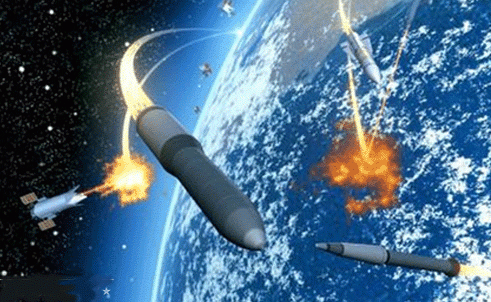
 Space Based Anti-Missile Interceptor – Artwork
The U.S. Golden Dome program announced in 2025 is expected to unprecedentedly escalate the militarisation of space through the deployment of the world’s first space-based anti-missile interceptors. These interceptors have seen their feasibility widely questioned, however, due not only to the costs involved, but also to the viability of reliability neutralising advanced new generations of ballistic missiles such as those with hypersonic capabilities. The Golden Dome program has been widely assessed to represent a response to major advances in Chinese intercontinental range hypersonic strike capabilities. Vice Chairman of the U.S. Joint Chiefs of Staff General John Hyten warned as early as 2021 regarding the threats these posed: ”They launched a long-range missile. It went around the world, dropped off a hypersonic glide vehicle that glided all the way back to China, that impacted a target in China.” He stressed the high degree of accuracy demonstrated, adding that China was is developing capabilities “stunning,” and that its technological advantages could provide the capability to launch a surprise nuclear attack on the U.S. The future head of U.S. Strategic Command (STRATCOM) Vice Admiral Richard Correll in November 2025 stressed that the Golden Dome had a vital role in ensuring the U.S. Armed Forces’ ability to launch retaliatory nuclear strikes.
See: Original Article


