
Image by Getty / Futurism
By Sylvain Biget and Xavier Demeersman,
Published by Futura, 14 February 2026
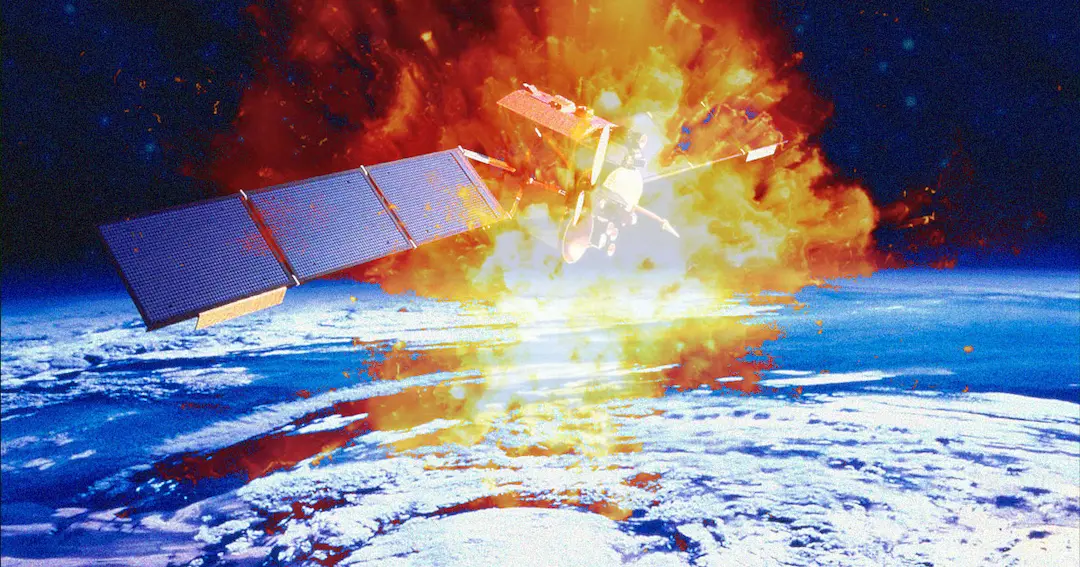
A Russian spy satellite has broken apart in geostationary orbit, generating a cloud of debris and raising fresh concerns about the growing risks in space. Was it an attack? An explosion? Here’s what we know and why the incident is troubling.
On January 30, a rare event unfolded far above Earth. Swiss space surveillance company S2A Systems captured the moment a Russian satellite disintegrated, leaving multiple fragments along its orbital path.
The breakup occurred at an altitude of approximately 36,100 kilometers. The satellite, known as Luch Olymp, is listed as object #40258 in the NORAD catalog. NORAD, the North American Aerospace Defense Command, tracks all objects orbiting Earth, including debris.
Luch Olymp belongs to a class of orbital inspection or intelligence satellites, often referred to more broadly as spy satellites. These spacecraft are designed to maneuver close to other satellites, monitor their operations, and potentially intercept signals.
In 2017 and 2018, satellites from this same family approached French and European spacecraft, including the Franco Italian military communications satellite Athena Fidus. At the time, French Defense Minister Florence Parly publicly denounced the maneuver as aggressive. Incidents like that contributed to the creation of France’s Space Command in 2019.
A short time lapse of the fragmentation event on LUCH (OLYMP) #40258 that took place today, 2026-01-30 from 06:09:03.486 UTC. pic.twitter.com/0bwbNvlnCL
— s2a systems (@s2a_systems) January 30, 2026
A graveyard orbit
Launched in 2014, the satellite had been positioned in geostationary orbit to “inspect” its surroundings just below 36,000 kilometers. This altitude is far above commercial constellations such as Starlink, which operate at around 550 kilometers.
In geostationary orbit, commonly known as GEO, roughly 500 to 600 satellites are distributed along the equatorial belt. They serve mainly military, telecommunications, television broadcasting, and weather observation functions.
However, Luch Olymp was no longer in active GEO. It had been decommissioned in October 2025, moved slightly higher, and placed into what is known as a graveyard orbit. This disposal zone sits above the main geostationary belt and is reserved for retired satellites. The goal is to keep inactive spacecraft away from operational traffic lanes.
Before being transferred, satellites in this region are typically powered down, with remaining fuel and energy sources depleted to minimize the risk of unexpected explosions and debris generation. This makes an internal malfunction less likely. A deliberate destruction also appears improbable, as such an action would almost certainly have triggered swift international reactions.
Eternal debris
According to S2A Systems and independent orbital analysts, the most plausible explanation is an accidental collision with an untracked fragment of space debris. These fragments may not have been cataloged by NORAD or other monitoring agencies.
NORAD and the US Space Force currently track around 43,000 objects measuring 10 centimeters or larger. This continuous monitoring allows operators to adjust satellite orbits and avoid potential collisions. However, millions of smaller fragments, some less than a centimeter wide, remain impossible to track individually. It is likely that one of these tiny pieces struck the Russian satellite in the disposal zone.
A high orbit Kessler effect
The real concern lies in the nature of geostationary and graveyard orbits. At these altitudes, debris does not naturally burn up in Earth’s atmosphere. Instead, fragments can remain in space for centuries.
The destruction of the Russian satellite is therefore problematic. Dozens or even hundreds of small fragments now increase the risk of further collisions among other decommissioned satellites. More worrisome still, some debris could drift and intersect the paths of active satellites below.
Because of their small size and extremely high speeds, these fragments are difficult to detect and track. This increases the likelihood of unexpected collisions and contributes to what experts fear could become a cascading chain reaction of impacts, sometimes referred to as the Kessler syndrome.
So far, the event has not been officially confirmed by national or international space agencies. The absence of immediate diplomatic reaction suggests it was not a deliberate act. Nevertheless, the incident underscores the fragile and increasingly congested state of Earth’s orbital environment.
Beyond the proliferation of space debris, the breakup also highlights persistent geopolitical tensions in space. Despite political efforts, particularly in Europe, to promote stronger cooperation and regulation, space remains something of a frontier. Coordination exists, but it is fragile. And every new fragment added to orbit makes that frontier a little more hazardous.
See: Original Article


