
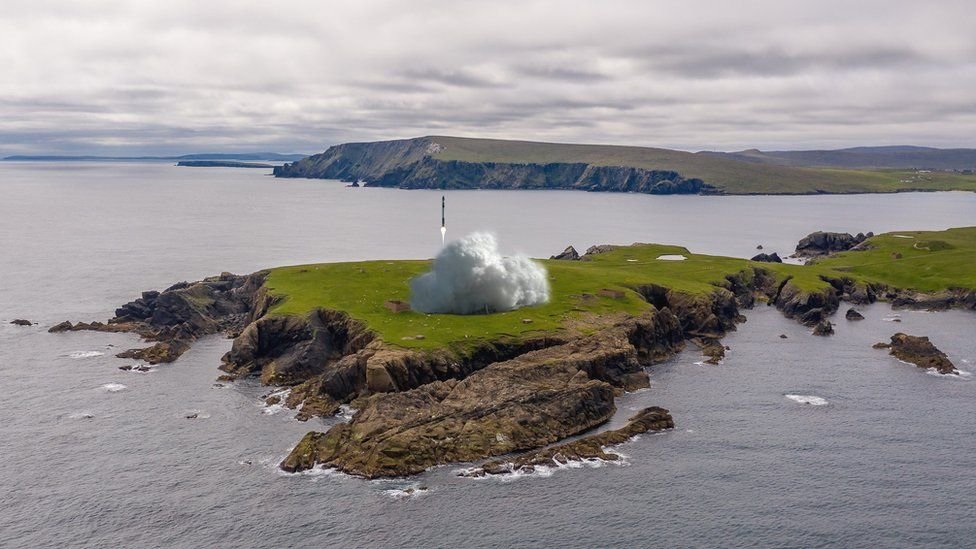
Render of a small launch vehicle launching from SaxaVord Spaceport – via Shetland Flyer Aerial Media
By Skye Jacobs,
Published by Techspot, 14 January 2026
CubeSats, rocket startups, and a Shetland launch site are redefining the UK’s orbital future
Winners & losers: In workshops scattered across Glasgow, engineers assemble CubeSats – compact, modular satellites that have made Scotland’s largest and most populous city Europe’s most prolific builder of spacecraft. These small satellites, once a niche university project, have become the core of the nation’s fast-growing space industry.
AAC Clyde Space, a Swedish-backed company that has helped define Glasgow’s reputation over the past decade, is at the center of this transformation. Since launching its first satellite in 2014, the company has expanded from hardware manufacturing to selling data and services derived from its own orbiting fleet. “The demand is for people to know things,” Chief Executive Luis Gomes told The Financial Times. Operating satellites, he said, is complex, and many customers prefer to buy actionable information rather than operate hardware themselves.
Scotland’s space ecosystem has evolved rapidly, forming a vertically integrated industry that spans satellite manufacturing, launch, and data analysis.
Edinburgh’s analytics firms process data from more than 10,000 active satellites orbiting Earth. Meanwhile, rocket builders Orbex and Skyrora – along with SaxaVord Spaceport on the Shetland island of Unst – are establishing the infrastructure to launch those satellites from Scottish soil. SaxaVord, based on a former Royal Air Force site, aims to become the UK’s first vertical-launch facility and hopes to handle up to 30 launches annually once fully operational.
Skyrora, founded by Ukraine-born entrepreneur Volodymyr Levykin, obtained the first UK license to launch from SaxaVord this year. The company positions itself differently from large-scale launch providers such as SpaceX. Alan Thompson, head of government affairs, said Skyrora’s rockets would serve as a “space tug,” maneuvering and refueling satellites before deorbiting them. He explained the company’s philosophy as complementary, not competitive: SpaceX is like “a bus,” he said, while Skyrora aims to be “a taxi service” catering to more targeted missions.
Yet as these firms assemble a domestic ecosystem, concern is growing that Britain’s investment in space is falling behind. Europe’s ongoing rearmament and renewed focus on orbital defense have accelerated funding on the continent. Germany committed €35 billion to expanding its space-based security capacities, while at the recent European Space Agency ministerial meeting, Germany, Spain, and Canada all dramatically increased their contributions. The UK, by contrast, reduced its ESA allocation by roughly 10 percent.

For companies operating on thin margins in an industry dominated by large national budgets, the funding disparity is difficult to ignore. “Now it’s very, very difficult to compete with this huge capital given to our competitors on the continent, so it is imperative that the UK actually invests more,” said Gomes. He added that AAC Clyde Space frequently receives invitations to open factories overseas to tap into foreign funding streams.
Richard Lochhead, Scotland’s business minister, voiced similar concerns. “Lots of governments are throwing significant investments at the space economy, for commercial reasons, defence and security,” he said. “It’s really important that the UK government does all it can to not fall behind.”
The UK government maintains that investment remains strong, citing a “record amount” of £2.8 billion ($3.7 billion) committed to the UK Space Agency as part of the national spending review. A spokesperson said the government had focused those funds “in areas which deliver maximum value for UK’s taxpayers,” emphasizing that ESA contributions represent just one piece of a broader program.
Glasgow’s place in the sector traces back to the early 2000s, when a wave of Scottish space engineers returned home, bringing expertise from abroad. Their collaborations with local universities helped establish Scotland’s specialization in CubeSat manufacturing – relatively inexpensive, modular satellites that can be produced efficiently.
Malcolm Macdonald, a professor at the University of Strathclyde, argued that government support must evolve as the market matures. He urged the UK to move “beyond grants to contracts,” funding longer-term programs that guarantee service delivery and industry stability.
SaxaVord chief executive Scott Hammond, whose launch site is seeking an additional £50 million ($67.2 million) in infrastructure investment, echoed that call. He said initial government support could help early launch companies manage their high-risk first operations. “It would not take lots of money to kick-start an industry which will create jobs,” Hammond said. “We are at that stage now, pump-primed, to have a real vital industry.”
See: Original Article


