
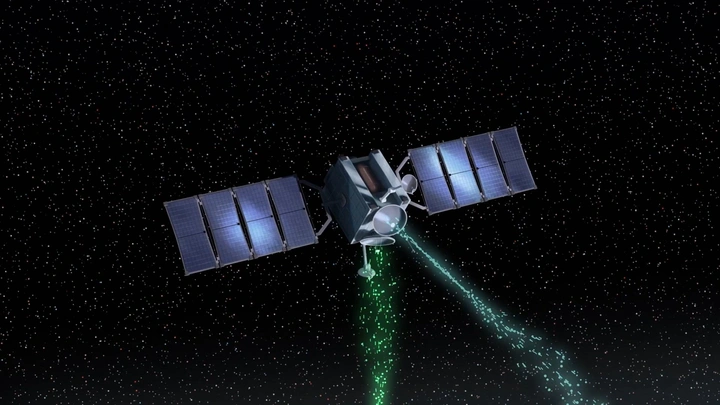
An artist’s rendering of a satellite sending and receiving data (Space Systems Command)
Published by The Meridiem, 26 March 2026
- Satellite data infrastructure is being actively weaponized through delays, spoofing, and private control during Gulf conflict
- Attribution crisis emerges as commercial space operators can’t identify manipulation sources
- Transition from open observation utility to contested information warfare asset reshapes conflict transparency
- Critical infrastructure now operates without accountability framework or regulatory oversight
The satellite infrastructure humanity relies on to see conflict clearly just crossed from neutral utility to contested weapon. As war reshapes the Gulf, commercial satellite data—the backbone of everything from journalism to defense intelligence—is being systematically delayed, spoofed, and privately controlled. The inflection point isn’t just technical manipulation. It’s the attribution vacuum: nobody knows who’s responsible, and the transparency layer the world counted on for ground truth is now as unreliable as the propaganda it was meant to counter.
The Gulf conflict is revealing a fundamental shift in how the world sees war. Not the conflict itself, but the infrastructure we use to observe it. Commercial satellite networks that governments, media organizations, and humanitarian groups depend on for ground truth are being manipulated in real-time, and the companies operating those systems can’t definitively say who’s doing it.
This isn’t theoretical vulnerability. Wired’s reporting documents systematic delays in imagery delivery, spoofed coordinates that place military assets in civilian zones, and private satellite operators making unilateral decisions about what data gets released and when. The infrastructure layer that was supposed to bring transparency to modern warfare has become another contested domain.
The transition matters because satellite data graduated from nice-to-have to critical infrastructure over the past decade. Insurance companies price maritime risk from it. Supply chain operators route cargo around conflict zones using it. International courts weigh it as evidence in war crimes tribunals. When Planet Labs or Maxar capture imagery of a bombing, that data shapes diplomatic responses and public opinion within hours.
But commercial satellite operators are now facing the same problem that plagued early internet infrastructure: they built for scale and accessibility, not adversarial manipulation. There’s no authentication layer proving an image hasn’t been altered before delivery. No standardized latency that would reveal suspicious delays. No framework for operators to share threat intelligence without violating commercial agreements.
The attribution gap is where this gets dangerous. When satellite data shows apparent civilian casualties, is the delay in releasing those images a technical glitch, commercial decision, or state-sponsored interference? Companies won’t say, often because they genuinely don’t know. The same GPS spoofing techniques that redirect commercial drones now affect satellite positioning systems. Ground station attacks can delay data without leaving clear forensic evidence.
Private control adds another dimension. Unlike government reconnaissance satellites with clear command structures and accountability, commercial operators make real-time editorial decisions. They choose which customers get priority access. They decide whether releasing imagery might endanger their ground infrastructure in hostile territories. They weigh reputation risk against transparency obligations that don’t technically exist.
This mirrors the earlier inflection when social media platforms became information warfare infrastructure. Facebook and Twitter initially positioned themselves as neutral pipes, then faced a reckoning when that neutrality became weaponized. Satellite operators are hitting the same wall, but with higher stakes. A delayed tweet is one thing. Delayed imagery of a war crime is different.
The technical reality compounds the problem. Modern conflict produces massive data volumes. A single high-resolution pass over active combat generates terabytes that must be downlinked, processed, analyzed, and distributed. Every step creates manipulation opportunities. Cloud processing infrastructure might be compromised. Transmission paths might be intercepted. Even the AI systems that flag potential incidents for human review can be trained on poisoned datasets.
Market response is fragmenting. Some defense contractors are building proprietary satellite networks with military-grade authentication. Others are developing blockchain-based verification systems for civilian imagery. But these solutions take years to deploy at scale, and the Gulf conflict is demonstrating the vulnerability right now.
The regulatory vacuum is striking. No international framework governs how commercial satellite operators should handle wartime manipulation. The Outer Space Treaty predates commercial earth observation. Export controls focus on satellite technology transfer, not data integrity. Even domestic oversight is unclear—should the FCC regulate this? Department of Defense? State Department?
For enterprises relying on satellite data for critical decisions, the ground just shifted. Insurance underwriters pricing political risk can’t trust their primary data source. Logistics companies routing around conflict zones are navigating with potentially compromised information. Even financial markets reacting to geopolitical events are trading on delayed or manipulated imagery.
The precedent here is sobering. When GPS was revealed as vulnerable to spoofing, it took nearly a decade to implement meaningful authentication at scale. The civilian aviation industry still uses signals that can be manipulated. If satellite imagery follows the same trajectory, we’re looking at years of uncertainty about what’s actually happening in conflict zones.
The timing matters because satellite infrastructure is simultaneously becoming more critical and more distributed. SpaceX’s Starlink demonstrated how quickly new constellations can deploy. Amazon’s Project Kuiper is launching. China’s expanding its commercial capabilities. Each new network increases coverage and reduces costs, but also multiplies attack surfaces and attribution challenges.
What we’re watching is the end of satellite data as trustless infrastructure. The assumption that imagery from orbit provides objective ground truth just collapsed. Like every other information layer, it’s now contested, manipulable, and requires verification frameworks that don’t exist yet. The Gulf conflict is simply making that transition visible to audiences who previously treated satellite data as definitional reality.
For decision-makers depending on satellite data for operational intelligence, the trust model just broke. Enterprises need secondary verification sources and contingency protocols for compromised imagery. Investors should recognize this as a forcing function for authentication infrastructure—whoever solves satellite data integrity at scale owns the next layer of critical infrastructure. Professionals in geospatial intelligence face a skills inflection: knowing how to interpret satellite imagery matters less than knowing how to verify it hasn’t been manipulated. The next threshold comes when the first major policy decision based on spoofed satellite data becomes public. Watch for international frameworks emerging from the Gulf conflict’s aftermath, likely within 12-18 months as attribution failures force regulatory response.
See: Original Article


